by: Emma Helmick

To eliminate all distractions for students, GS has enforced a no-phone rule.
It is now mandatory for students to put their phones in a holder at the beginning of every class. Today, phones are viewed as a distraction and in the past few years they have become a problem in schools around the world.
While most students have been cooperating with the new system, frustration has built up within the school and many are questioning the reasoning behind this decision.
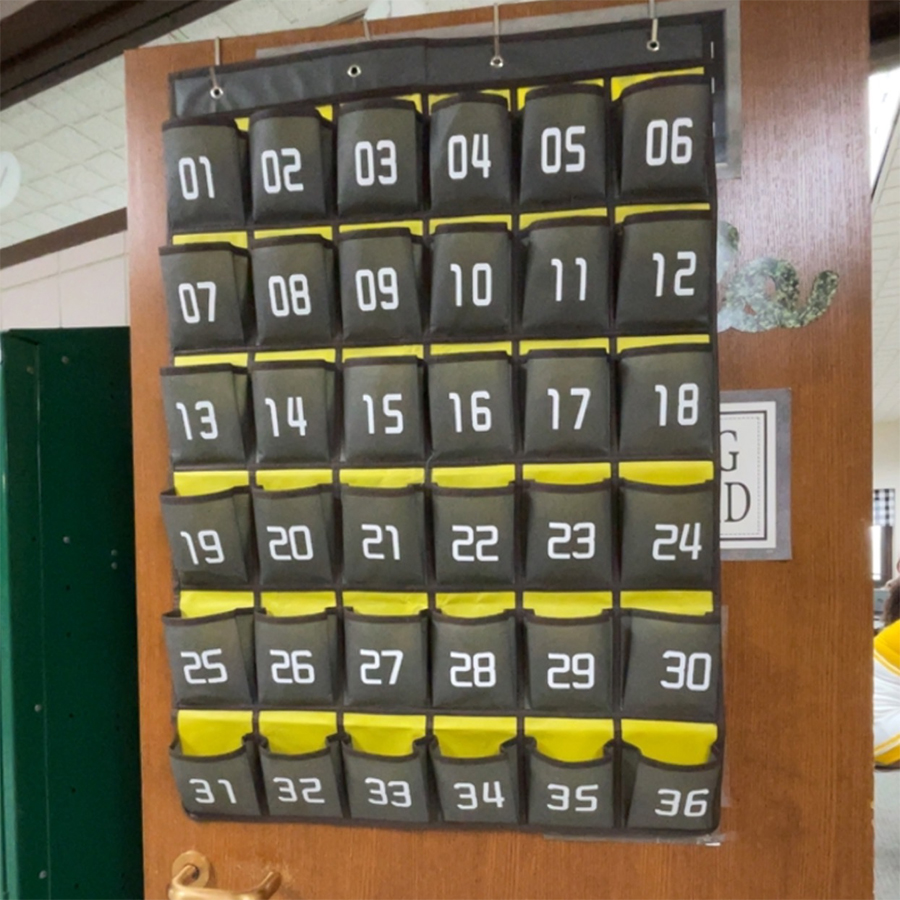
A phone holder is attached to the inside of a teacher’s door. Students must put their phones into the holders when they enter classrooms now. Photo by: Emma Helmick
“If we never had any problems, if 150 kids came in, didn’t use their phones inappropriately, weren’t walking around with earbuds in or whatever, this wouldn’t exist,” High School Co-Principal Mr. Adam Jones said. “But to expect 15–18-year-olds, having been one if I had a cellphone, I would’ve been misusing it and I would’ve been super distracted in class.”
The evolution of cellphone usage during school hours has extremely increased since they were invented, but in the past few years, some student’s grades dropped which may be because of the distraction to their learning environment.
“Every teacher who I have spoken to has thanked me, and I told the teachers that the decision in their classrooms was ultimately theirs, so if a student doesn’t have a device and they absolutely have to use their phone for an educational purpose, the teacher has the ability to let them, but on the flip side I also told them that if they let students use phones and something happens, I don’t want them to be sent up to me,” Mr. Jones said.
Originally, teachers had the decision on what they wanted to do for their individual classrooms, but at some point, that structure fell apart and left the District no choice but to take away that freedom.
Without phones, students are more likely to become more engaged in the content they are learning and more likely to socialize with the people around them.
“People need to communicate back and forth, so that was a big reason why,” Jones said. “You should be focusing on school, not Snapping the kid in the next classroom.”
This rule seemed to be a positive step for GS, however, not everyone was thrilled with the restrictions put in place.
“Everyone is definitely mad about it because we’re being treated like children as almost adults and it just kind of sucks, but there is not much we can do about it,” senior Bryonna Macioce said.
While this has caused students to become more involved with their learning, most of them are not happy with the situation.
“I feel like if somebody is on their phone and obviously not paying attention or not doing what they are supposed to, they should get their phone taken and it should go to the office,” Macioce said. “Everyone shouldn’t be punished just because of what some people do.”
This could feel unfair to the people who followed the rules and only used their phones at the appropriate times.
Not only did this make some people upset, but it also created challenges for some students who have already experienced a hard time adjusting to the change.
“There’s so many classes that we used to use our phones in, and it was just so much easier than using the slow computers, I don’t even have a charger for mine,” she said.
There are many faults with this approach that are tricky to work around and the main one is that phones are a very handy tool to have when computers become unavailable.
“People just sat in class on their phones and the school definitely just got sick of it,” she said. “I know a lot of people who were on their phones who had really bad grades and that does affect us as a school, too.”
Students being distracted in class also reflected badly on the teachers who had to work around the disturbance.
“It was becoming such a problem for some people and I’m not saying everybody because there were people who were fine with their phones, but it was just becoming such a distraction that they had to try something and this may not be perfect, but at least they are trying something,” International Studies Teacher Mr. Robert Lehman said.
There is no flawless solution for this; there will be obstacles to tackle no matter what route is taken.
“This was something that was coming; it was inevitable,” Lehman said. “The studies show that phones are a distraction; I think it’s just going to get to where people get used to it; they just come in and do it and that’s that.”
Now that the phones are gone, students have a better chance of being more involved with the content they are learning, but some cons come with this.
“Now if I want kids to use their phones, I have to let them get up and go get them then go back to their seats so timing wise you have to adjust a little bit, but that isn’t much,” Mr. Lehman said.
For some classes, cell phones are often used, so having to get up and get a phone could be a distraction in itself.
“People who use their phones when they are supposed to are losing; a phone is a resource that gives me access to every bit of knowledge that civilization has that I can use for my research,” junior Ari Case said.
The school computers have certain topics that students research for classes that are blocked. If students must use their phone to search for those things it may be hard for the teachers to keep track of who is using their phone as a resource and who is using it to mess around.
“When I start working a 9-5 after high school, I’m not going to have to put my phone in a pocket,” Case said. “I’m going to have to know how to not look at my phone while I’m working and that’s not something this is teaching.”
High school is preparation for adulthood. Learning responsibility and self-control is part of that, but when the majority of students prove that they are not capable of that and it starts to reflect badly on the school, it becomes not just a problem for an individual student, but the entire District.
“I understand the benefit broadly for a lot of students in classes, and there are other perspectives here and it’s not like they didn’t think about it,” they said.
There was no solution to this problem that would have left everyone completely satisfied.
“It’s also something to help you, it’s not from a punishment perspective, it’s from a helping perspective and I know that may be hard to see as a teenager, but I hope in 10 years they can see why I did this,” Jones said.
 The Lions' Den