by Kerrick Shaw
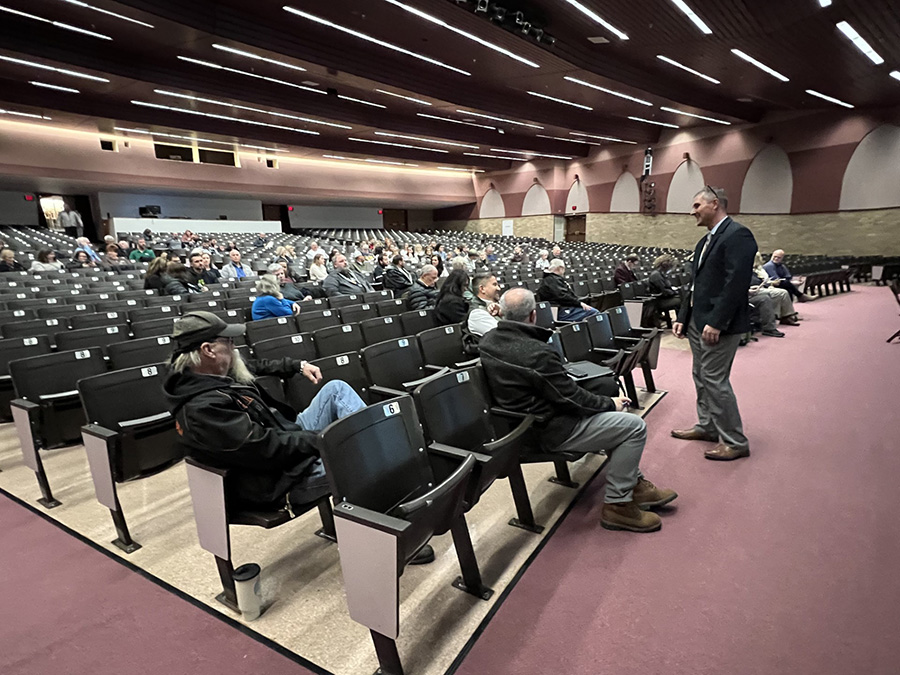
Photo courtesy: Mrs. Kayla Tamer
On Wednesday, January 17th, GS Superintendent Dr. Ken Bissell held a presentation revealing the district’s “laundry list” of potential construction projects.
The listed projects consisted of refreshing the interiors of the district’s buildings, plumbing and HVAC (heating, ventilation and air conditioning) repairs, landscaping and better accessibility for people with disabilities.
GS is forming a steering committee to decide what upgrades should be prioritized across the board, based on urgency and specific school buildings.
“My first priority is to look at the current state of all of the buildings,” Dr. Bissell said. “Number one is looking at what’s going to be here in the long term and what we need to do to bring them up to speed. There are three big topics we’re looking at: Safety and security … ADA, accessibility for everybody … and the last one is community engagement.”
Bissell said the district will take the concerns and recommendations from students and staff into consideration once the steering committee is formed.
Teachers are anticipating the completion of the district’s future plans, but have expressed worries of their own.
“There are things that have been left going for long periods of time, which is causing all of these issues to come together at once,” Social Studies teacher and Track and Field Coach Mr. Robert Lehman said. “Had the problems been addressed, it may not have gotten to this point.”
A number of teachers at the high school have experience teaching in the middle school as well, giving them a broader view of what the district might need.
“I believe the middle school needs the most updating,” Math teacher Mr. Al Toret said. “It has the most glaring needs. … My opinion is that the classrooms are too small; they were very tight. It was tough to do anything different because of the little amount of space.”
Mr. Toret and Mr. Lehman both agree that the biggest factor regarding the problems with the district’s middle school is age. Lehman considers problems harder to solve when caused by age. The High School, while still having issues of its own, could require less of an overhaul.
On top of the school buildings themselves, other areas on school grounds require acknowledgment for repairs, such as the High School’s tennis courts, fields and the athletic facilities.
“As a coach, I of course would want them to focus on the athletic facilities,” Lehman said. “One of the biggest problems is the locker rooms. That’s what I see the most as being in disrepair. You have lockers with no doors and some that can’t lock because the doors they have are bent so badly. The way the locker rooms are set up creates a lot of blind spots where you can’t see what is happening. It was a relatively poor setup to begin with.”
There is a lot to be done, but teachers have no doubt about Bissell’s ability to accomplish it all. Lehman said, having been friends with him throughout his career at the High School, that he “understands” what any problems are and trusts that he has the right plans to solve them.
Money is also a factor that needs to be greatly considered during the planning, which is why the steering committee being formed for determining what the top priorities are is essential.
“I believe when we got new roofs that was in the millions of dollars,” Toret said. “When you’re considering structural changes, there are architects that need paid, engineers that need paid, there’s construction costs – materials aren’t cheap, labor costs aren’t cheap. There’s a lot that goes into those numbers and it adds up quickly. It is a big deal.”
Students have also expressed opinions of their own. Their experiences in each building are much broader than the majority of the staffs’, as many students had, and have, classes on all floors every day.
“I think the high school needs a lot,” senior Lucy McChesney said. “Air conditioning and heating need worked on; there’s often problems with those. It definitely needs renovations, like in the bathrooms. … Comfortability is the most important thing.”
Bissell also believes comfort is necessary for the students. He spoke on upcoming HVAC repairs set to begin this April, funded by ESSER, which is a program, started in 2020, that focuses on supplying educational learning aids for classrooms and improvements within the schools.
He’s confident in the district’s capability of completing each project, but acknowledged that they will not be done in a day. There’s currently no way of determining an exact timeline. “If we as a district think it’s important to invest into the education of the youth in our community, it isn’t necessarily just a teacher standing in front of the room,” Toret said. “The environment we have our students in is almost just as important.”
 The Lions' Den