
by Gabi Elentri and Abigail Romeo
Although one of the reasons artificial intelligence was invented is to improve education, today’s students use it in a separate way.
Students today view artificial intelligence tools like ChatGPT as a free cheat sheet instead of the education enhancing technology it was created to be.
ChatGPT offers instant information and quick answers. While it is a great tool for things like immediate homework help and language translation, convenience comes with a cost.
Some students have discarded the idea of ChatGPT being a tool to help learn new things and have replaced it with it being a tool that does work for them.
“Most students use ChatGPT to cheat on assignments and quizzes instead of studying,” sophomore Katie Jurkiewicz said.
ChatGPT can be used negatively by copying answers and using it to do the work for them, which avoids the challenging work needed to understand a subject.
“Students also use ChatGPT to write entire essays instead of just researching themselves,” Jurkiewicz said.
Reliance on ChatGPT can make students lazy, skipping the demanding work needed to understand a subject. It can also give answers that are not always correct, which is just confusing.
“Students are losing the ability to conduct actual research,” History teacher Mr. Mark Zahorchak said.
What may seem like a harmless habit now can expand into long lasting behaviors. Relying on ChatGPT will cause students to trust information without checking twice, weaken their critical thinking, and their struggle to solve problems on their own will worsen.
“It’s going to ruin people’s ability eventually because they are not going to learn how to articulate their thoughts and writing,” English teacher Mr. Marcus Moffa said.
Teachers have learned to adapt to the use of ChatGPT and have started to run each essay through Ai detecting websites. Some students run their writing through the same websites to makesure it looks like their own work.
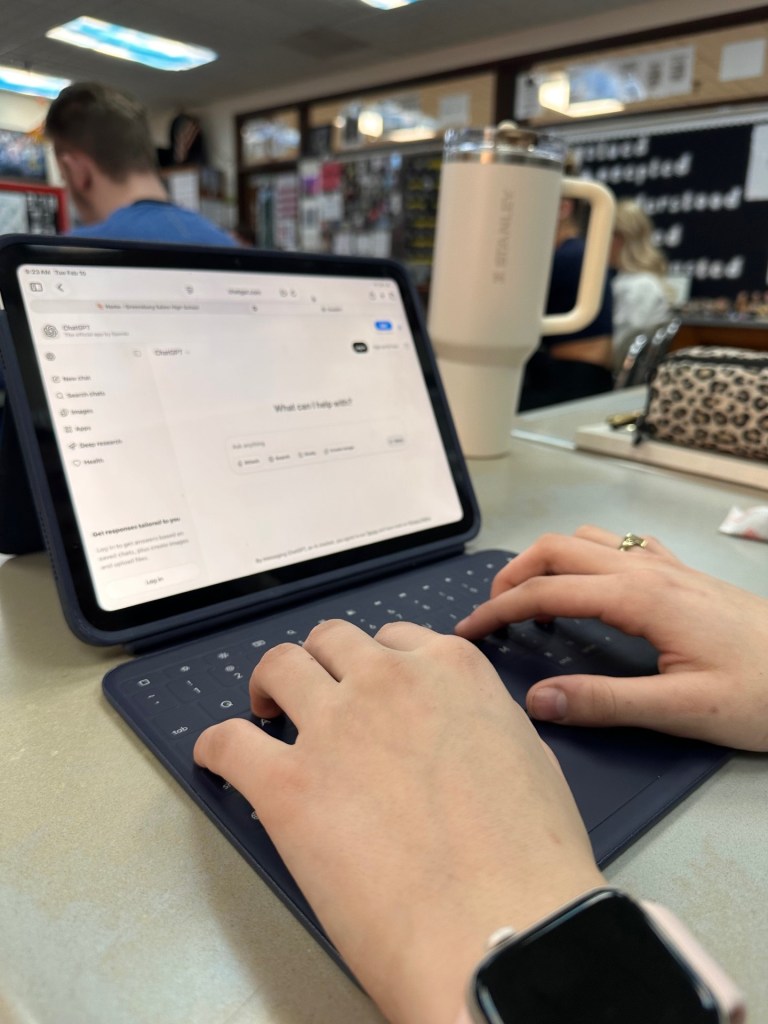
A student uses ChatGPT for research in the classroom.
Photo by: Abigail Romeo
“I think the hardest part is that we don’t necessarily know anymore when kids are cheating,” Mr. Moffa said. “With some it’s hard to tell.”
Ways to limit ChatGPT usage might involve re-introducing traditional paper-pencil assignments and making sure every assignment does not leave the classroom.
“I could go back to paper assignments, but I don’t really want to do that because that’s not the real world,” Moffa said.
Restricting electronics and having students complete every assignment on paper might seem ideal, but it doesn’t reflect real-world expectations.
“I think that ChatGPT can be helpful to education if used correctly,” freshman Shayne Grzelewski said.
In most jobs and adult life, people manage tasks in their own time. If students never practice working independently outside the classroom, they might struggle with time management and self-discipline later on.
While ChatGPT and similar tools offer opportunities to enhance learning, it’s important to use them wisely.
Education can be designed to help students complete assignments while also encouraging critical thinking, time management, and the development of skills that may be useful beyond the classroom. Striking a balance between these aspects can support students in their future.
“ChatGPT can be a helpful classroom tool if used correctly,” Jurkiewicz said. “I do think it can be beneficial, but it shouldn’t do all the work.”
 The Lions' Den