Concerns Surrounding the Department of Education 

By: Kerrick Shaw

A controversial push to eliminate the U.S. Department of Education is gaining momentum in Congress, raising concerns about the future of federal oversight in schools.  

If the Department of Education (DOE) is dissolved, school districts could face significant disruptions in funding and resources. Programs that rely on federal support, such as Title I for low-income schools or special education services under the Individuals with Disabilities Education Act, could stall or disappear, forcing districts to find alternatives. 

On March 20, President Donald Trump signed an executive order to begin shutting down several functions of the DOE. 


Greensburg locals participating in the Hands Off protest on April 5.

Photo Courtesy: Barb Ciampini


“It feels very rushed, without deeper thought into the implications of dismantling or reducing,” GS Superintendent Dr. Ken Bissell said. “Our district relies on federal funding for our Title I, II, III and IV grants, which help us with things such as special education needs and equity issues for students from marginalized populations. If there were no federal funds, that’s a lot of teaching positions that go away.” 

The federal government’s role in schooling is to “uphold civil rights” for children, Dr. Bissell explained. He stated that he believes the shut-down will not happen, but acknowledged the hypothetical question of how those funds would be made up.  

“Teachers are the direct support for students; education is a human-to-human endeavor of building relationships and trust, to then learn from each other,” Bissell said. “If we lose funding, it will definitely result in us not having enough funds to support the teachers and staff.”  

 According to the district’s Director of Curriculum and Federal Programs, Dr. Lenni Nedley, school districts handle variations in their funding yearly, stating that schools will adapt as necessary if federal funding is dissolved.  

“Each school year, districts are faced with federal and state funding fluctuations; they’ll make adjustments to their general budgets as needed in different areas,” Dr. Nedley said. “The district always places children at the forefront of their decision-making to ensure they’re receiving what they need to be successful.” 

The federal grants support four reading specialists, three school counselors, one science teacher and two classroom assistants, as stated by Nedley.  

“If funds are reduced, we’d be put in a situation where we’ll have to make very difficult decisions,” Bissell said. “Staffing is the number one indicator of student success; good teachers make successful students. If we’re forced to reduce the number of staff we have, that’s going to directly impact the kids.” 

On top of the human resources students are provided through teachers and staff, a majority of students in the GS school district take advantage of the food services available. 

“Our school district is just over 60% free and reduced lunch,” he said. “That is a lot of kids that these funds help provide resources to.” 

Having heard of the possible closure of the DOE, some students are considering what the absence of such programs could mean for their school experience. Senior Adien Carota expressed confusion over the reasoning behind the proposed closure. 

“It simply shouldn’t be closed, I don’t understand the motivation,” Carota said. 

Senior Kyle Keller believes “education will go down” following the change in funding. 

Principal Mr. Adam Jones echoed concerns about how the closure could impact schools across the country. He explained that a lack of federal guidelines will result in disparity among states. 

“Not having oversight to ensure students across the country are receiving the same protections and rights makes me worry about if it’ll further create ‘haves’ and ‘have-nots’,” Mr. Jones said. “Some states could take advantage of it, seeing it as them not having to follow federal mandates anymore. I don’t think every state values their educational system the same.” 

The DOE’s involvement in schools is generally focused on broad policy and compliance with federal regulations. In contrast, states directly shape the daily operations of schools, making key decisions that affect classroom instruction and testing. 

“For the country to run an effective educational system, you have to have an overall level to ensure that all of the states and kids are getting roughly the same standards, curricula and resources,” Jones said. 

Although much remains uncertain, GS’ faculty and administration will focus on maintaining stability for students, regardless of what decisions are made at the federal level. Their attention remains on adapting to whatever comes next. 

“Pennsylvania has always had a very strong educational system, so I don’t fear a major negative outcome for our district,” Jones said. “In ten years, if there’s no Department of Education, I don’t think there will be a noticeable difference in our school.” 

The Purpose of School Sanctions

By: Theresa Schuetz

GS enforced punishments this year for students who played hooky.  

Sanctions go into play when a student misses 13 or more days of school. The main premise of sanctions is to make it more of a priority for students to be present in school. When a student is put on sanctions, attending prom, walking at graduation or attending extracurriculars is not allowed. 


GS 2025 prom advertisement posted throughout the halls.

Photo by: Theresa Schuetz


“Fundamentally, they are a goal to get kids to make up the academics that they miss when they miss school, especially when they miss a lot of school,” Dean of Students Mr. Jeff Kronenwetter said. “And in order to go on sanctions in and of itself, you’re missing 12, 13, 14 days of school. And there’s going to be an academic consequence to that.” 

When a student is put on sanctions, they can be reduced by staying after school for two hours on Tuesdays and Thursdays.  

“The punishments could be fair for the people who genuinely skip school,” senior Josselyn Blawas said. “To knock off an absence you have to stay after school for two hours, and you have to do that twice to get one absence off. So, if you’re someone who just skips school, you could use that time to do work.” 

When students stay later for two of those days, it removes one absence from the record. When students stay at the school they are not allowed to be on their phones, and they must be working on schoolwork. However, this way of removing absences may be hard for students who have jobs outside of school. 

“Each student should be able to pick what day of the week they want to stay to make up for an absence,” senior Gregory Paravate said. “It’s unfair for students who work outside of school.”  

To be put on the list requires 12 unexcused absences. Excused absences that do not count towards sanctions include doctor’s appointments, funerals and college visits. When students are out because of illness, parents can write them an excuse, but it still gives one point towards sanctions. 

“If we don’t know where you were or even if a parent sends a note that explains, ‘this student was absent on this date because she was sick,’ it does count towards sanctions,” Mr. Kronenwetter said. 

Students are not required to make up unexcused absences through participating in detentions, but if they do it allows them to participate in extracurriculars, dances and the graduation ceremony. 

“We’re just trying to establish a routine like there is in the workforce when it comes to sanctions,” Kronenwetter said. 

High School Happenings

By Kerrick Shaw 

Photo by: Kerrick Shaw

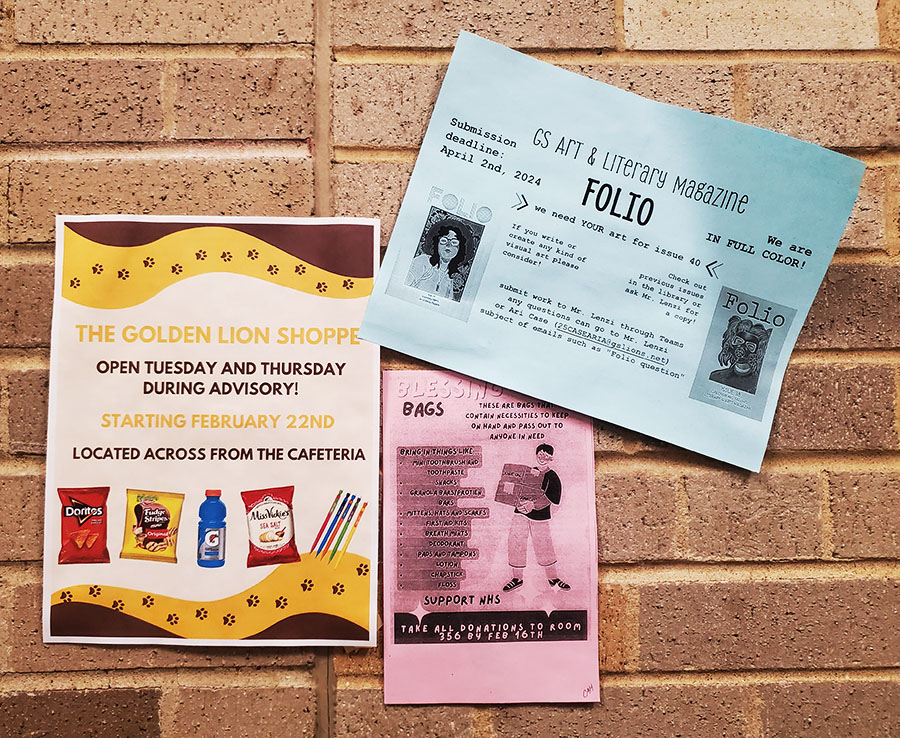
Papers are posted all over the high school walls promoting what is happening now and coming soon, some serving as call-to-actions and others being informational. 

Dodge For a Cause 

Flyers around the school were promoting sign-ups for this year’s Mini-THON. Push Week Incentives were recently shared on the GS Mini-THON Instagram, @gsminithon, motivating students to donate towards the fight against childhood cancer. 

“The constant is to raise money and awareness for pediatric cancer,” Faculty advisor Mr. Matthew Boe said. “We try to go about that in different ways, learning from previous years, keeping in mind what went well and what didn’t. We try to continue to add something new, different twists to keep it exciting.” 

The incentives start with pieing Mr. Demary in the face at $5,000 raised, ending with the leadership team going skydiving at $50,000. 

Blessing Bags 

“Blessing Bags” are being promoted as well; a movement to put together as many bags as possible, filled with necessities such as toiletries, food, clothes and other small things anyone could find useful. The goal is to have bags available at GS Threads, as well as giving them to people within the school for handing out. 

“We still need more items before we can build viable bags,” NHS faculty advisor Mrs. Cheryl Harper said. “We are getting there, but it has slowed down a lot. … We are still taking donations.” 

Bio-Club 

GSHS’ Bio club took donations for their Humane Society Donation Drive, all of which went to Westmoreland’s Humane Society. Cleaning products, animal care products and other supplies were taken during first block classes from January 29th until February 9th.  

Golden Lion Shoppe 

Located across from the cafeteria, The Golden Lion Shoppe is now open on Tuesdays and Thursdays during advisory. 

 “We wanted to give students the opportunity to practice job and social skills,” Faculty advisor Mrs. Leisa Ecklund said. “We’re selling snacks, like chips, drinks, cookies, as well as some school supplies.” 

Prom 

Tickets for this year’s Prom will soon be available, starting March 25th. A special presale will begin on March 18th and end on the 22nd. Forms will be located outside of room 352 and are due to Mr. Gazze by 3:00 pm on April 5th

Folio 

Folio is now taking submissions for its 40th issue, asking students to consider sharing any artworks or writings for this year’s release. The magazine will be printed in full color once again. Submissions are due by April 2nd

“It’s a great way of bringing attention to how much talent we have at Greensburg Salem,” Folio editor Ariana Case said. “I think it also inspires others to create.”