New Year’s Day Terrorist Attacks
By: Ari Case
Although the new year often brings hope and good fortune, 2025 began with tragedy for many in two major U.S. cities.
In the early morning hours of Jan. 1, a crowd of celebrating citizens in New Orleans, Louisiana were faced with the headlights of an oncoming truck and eventually the barrel of a gun. Only a few hours later, bystanders at the Trump International Hotel in Las Vegas, Nevada witnessed an explosion from within a Tesla Cybertruck.

The street signs on the corner of Bourbon Street where the attack took place.
Photo courtesy: Adobe Stock Photos
Only three hours after midnight, there were 14 victims killed and at least 33 others were injured when Shamsud-din Jabbar drove a pickup truck loaded with improvised explosive devices (IEDs) into a crowd on the sidewalk of Bourbon Street in the French Quarter.
The incident has been determined as a premeditated domestic terrorist attack. Jabbar was a 42-year-old U.S. Army veteran from Texas who showed no concerning behaviors to family or friends before the attack. He did, however, visit and surveil the area at least two times using Meta smart glasses to record in the months leading up to the attack. In videos posted online, he pledged his support to the foreign terrorist organization ISIS, and a corresponding flag was recovered from the vehicle.
In addition to the IEDs in the truck, Jabbar planted two coolers containing IEDs on nearby streets that did not detonate. After stopping the truck, he stepped out of the vehicle wielding a gun and was eventually killed in a shootout with police officers. Two officers were injured.
It was later discovered that he set fire to a rented Airbnb in a suspected attempt to destroy evidence.
He rented the Ford F-150 Lightning from a car rental platform called Turo, a service that allows owners to rent directly to customers, similarly to Airbnb.
The Tesla Cybertruck used in the Las Vegas explosion was also rented through Turo, but investigations found no connection. Turo claimed they background check all users and neither individual raised any red flags.
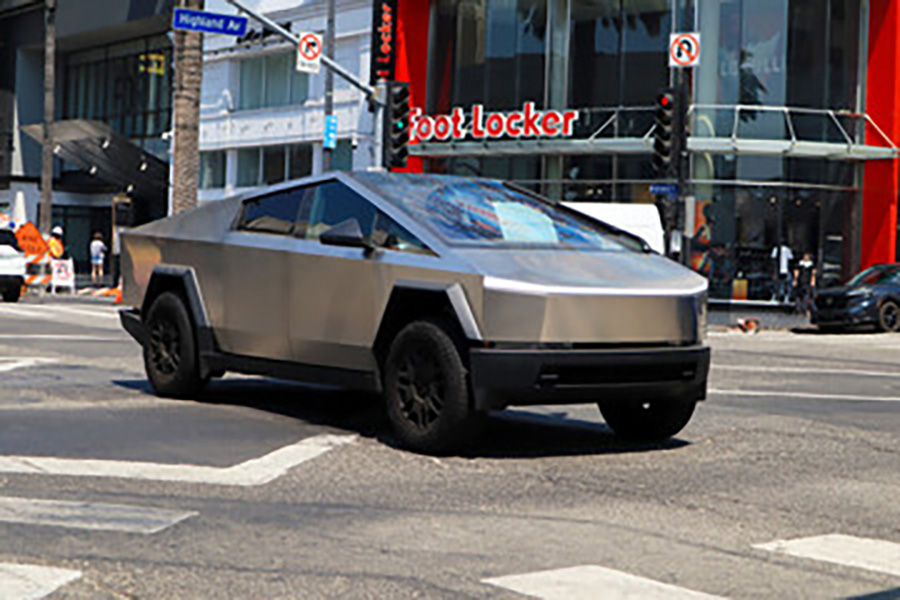
A Tesla Cybertruck similar to the one used in the explosion.
Photo courtesy: Adobe Stock Photos
“The use of a vehicle [for violence] has become commonplace and it’s honestly terrifying,” Law and Economics teacher Mr. Mark Zahorchak said.
37-year-old U.S. Army Green Beret Matthew Livelsberger ended his own life by gunshot just before the detonation of explosives inside the rented Cybertruck. At least seven injuries were sustained by bystanders, but no one was severely injured. There was also effectively no damage to the building as the steel body of the vehicle contained the majority of the explosion.
Letters and audio recordings of Livelsberger prior to the attack state the intent was to provide a “wake up call” to the public. He expressed support of president-elect Donald Trump, Tesla CEO Elon Musk and others involved with the Trump campaign. He held disdain for diversity, equity and inclusion initiatives, income equality, and the rising issue of homelessness. Investigations revealed his use of ChatGPT to research and plan the attack, which had not previously been seen in major criminal investigations.
Coming right at the start of the new year and just before Trump’s inauguration, the increase in national—and even international—conflict has created a social and political landscape brimming with negativity.
Mr. Zahorchak stated that there is “simply no place” for politically motivated violence, and that it was “obviously un-American.”
In recent years, there has been an uptick in political violence on a larger scale, from school shootings to assassination attempts, and even wars. Predictably, this has caused an increase in worry around the globe.
“Yes, it concerns me,” social studies teacher Mrs. Beth Simone said. “I do sometimes question: are things worse now or am I just more aware?”
Tragically, the future likely holds an increase in these events.
“The idea of someone harming someone for political reasons is something I can unfortunately see increasing because we live in a volatile time,” Zahorchak shared.
Both Mrs. Simone and Zahorchak shared that it changes how they approach situations with their families, around crowds and at big events.
Although these events were important news, many students were unaware they even happened or missed most details.
“I just knew that there was a car involved, and it ran into a crowd, and there was a football game cancelled because of it,” sophomore Aiden Jackson said.
The cancellation of the Sugar Bowl 2025 game in New Orleans was the most common knowledge shared by students and staff.
Several, including Jackson, cited family and friends as their initial source for the information.
Others, like Zahorchak, first saw it on social media before researching on news sites.
Recently, more and more people find news on social media sites just as it happens. Although this can be beneficial for some, it can also over-stress and drown out other relevant events.
“It’s a sort of diffusion of information,” Simone explained. “There’s so much going on and being shared everywhere that we don’t know what’s important. Big picture, I don’t think it’s truly possible for anyone to stay informed at this point.”
While both Jabbar and Livelsberger were politically motivated, it has been determined that they were working alone, and their messages have not seemed to influence others yet.
“As far as using these events to send a message—that is ineffective,” Simone said. “Because there is so much happening, it won’t have much of an effect. We cannot control the narrative—it happens so often that people won’t know your name.”
Many Americans are desensitized to tragedies that happen outside of their community, and this can cause a disconnect in the population.
“We can still believe in each other, but it does concern me that it takes an event hitting home to realize that,” Simone said. “We tend to trust our neighbors, and we tend to be willing to help each other.”
 The Lions' Den