Planning Ahead

by Abby Romeo
Students across GS are beginning to plan their course schedule for next school year.
At the beginning of March the idea of scheduling was being talked about and quickly became everyone’s focus.
“We try to prepare and start early, and as early as we can so administration can look at the course requests and build a master schedule based on the requests of the students,” Guidance Counselor Mr. John Manley said.
Classes met with guidance counselors to communicate about requirements, electives and tips within their grade level.
“We like to review the entire rundown, especially with juniors,” Mr. Manley said. “We like to provide other information about post-secondary, extra high school college courses and graduation requirements.”
The meetings give students the chance to choose electives, review graduation requirements and start thinking about their future academic plans.
“We provide students with papers of the schedules for them to prepare within the time of our meeting and their private scheduling meeting,” Manley said.
Counselors want this process to be simple and meaningful to the students; they know that scheduling can be challenging at times.
“This year’s scheduling process was exciting and enjoyable for me,” junior Kalina Kreutzer said. “It’s a different ballgame when planning for senior year.”
Both counselors count on making sure the students are on the right path and make sure they are prepared in every possible way they can.
“The more you communicate with teachers, counselors, admin, upperclassmen and parents should help you gain a more confident and open mindset within scheduling,” Guidance Counselor Mrs. Laura Klipa said.
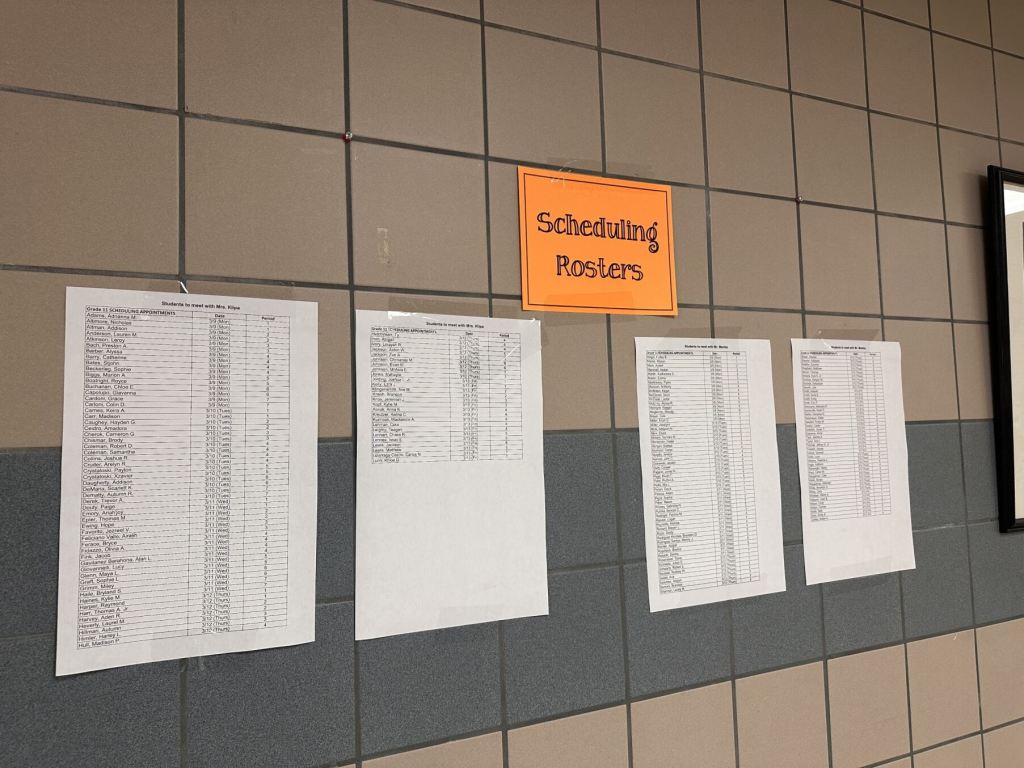
Scheduling times are posted outside of the office for students to check before meeting with guidance counselors.
Photo by: Abby Romeo
As school years fly by, more courses open within the school district.
“GS has a lot of elective course options,” Mr. Manley said. “It gives students more opportunities to expand their interest.”
Students often notice the new courses and focus on which classes may raise their skills within their interests.
“I plan to go into real estate or interior designing,” Kreutzer said. “I took Accounting 1 and Accounting 2; any business class really spiked my interest.”
Students also choose the fun courses that they know they would enjoy.
“I look forward to taking Child Development and American History,” freshman Kessler McIntyre said.
The process of finding the classes can be stressful and hard to decide; it’s hard to decide what course to commit to when there are many others out there that may help get to the goalstudents want to achieve.
“Some of the scheduling process is challenging,” McIntyre said.
Counselors work through all the processes of trying to make the scheduling process easy going for students and not a stressful situation.
“It’s okay to be overwhelmed and stressed,” Mr. Manley said. “All students are supported by so many people.”



















 The Lions' Den