New Electronics for the 2025-26 School Year

by Kerrick Shaw

District Approves $535K for iPads and MacBooks in 5–4 Vote

Students will be welcomed with new electronics next school year following the $535,000 funding approved by the GS School Board.

The decision, which followed a split vote of 5-4, will fund the purchase of updated devices and classroom technology designed to support student learning. The plan is part of the district’s ongoing effort to keep pace with the evolving demands of digital education.

The funding will provide 900 iPads for high school students and 65 MacBook Air laptops for teachers.

“We investigated multiple options for student use, including HP laptops, Google Chromebooks and iPads,” GS Superintendent Dr. Ken Bissell said. “Ultimately, the iPads met all of the instructional and learning needs and were the most cost-effective in building a four-year cycle of device replacement. The cost of the device includes a keyboard case, a plan for broken or replacement devices, and a buy-back plan at the end of the 0% lease.”

The total cost per device will be $513, according to Dr. Bissell; but this price will be discounted after the buyback by Apple in four years. 

Although the vote was not unanimous, board members who supported the investment emphasized the need to modernize the district’s educational tools. Board member Ms. Kacey Byrne-Houser described technology as “vital” rather than a luxury.


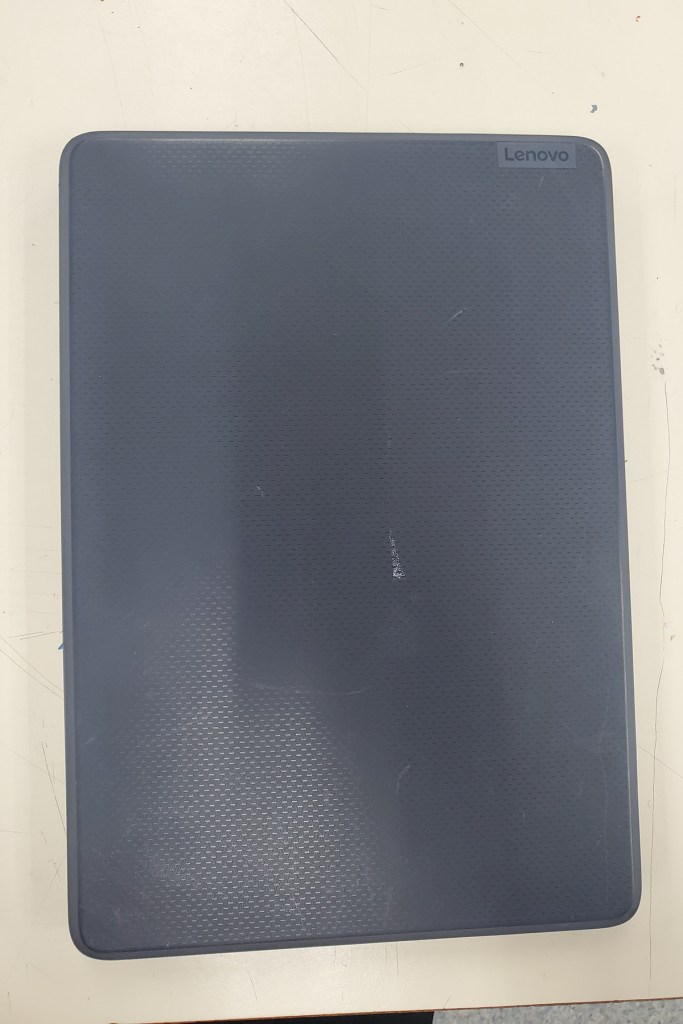
The exterior of a students’ old laptop

Photo by: Kerrick Shaw


“It’s a smart, forward-thinking move that aligns with where education is headed,” Ms. Byrne-Houser explained. “This new approach not only saves money over time, but also supports sustainability and better tech management. I have a great deal of trust in our school administrators who spent considerable time researching and evaluating options before bringing this recommendation forward.”

In agreement, board member Mr. Brian Conway thinks the access to technology is essential, stating that the new electronics “will allow the district to ensure that the necessary devices are available.”

“Initially, I had reservations about transitioning from laptops to tablet devices,” Mr. Conway said. “However, after considering the inclusion of protective cases and keyboards, along with assurances from the administration that no additional technology would be necessary to facilitate the change, I ultimately supported it.”

While some board members opposed the purchase due to cost concerns, board Vice President, Mrs. Robin Savage, voted against the purchase based on the limited time board members had to fully review the details before voting.

“The main reason I voted against it is we were not given what I believe was enough time to review,” Mrs. Savage explained. “As a board member, I felt that we should have had a thorough discussion and had more time to review the proposal.”

Despite the differing viewpoints, the district will be able to move ahead with its technology replacement in time for the 2025–26 school year.

Students, who use the current laptops on a daily basis for everything from taking notes to submitting assignments, are especially eager about the arrival of the new technology. Sophomore Kelsey Wigfield said she found out about the purchase through teachers.

“I’m excited to have a working school device,” Wigfield said. “Our laptops now never wanted to load and are very slow; they freeze a lot, too. I know from having my own iPad that they work really well even if they’re not brand new.”


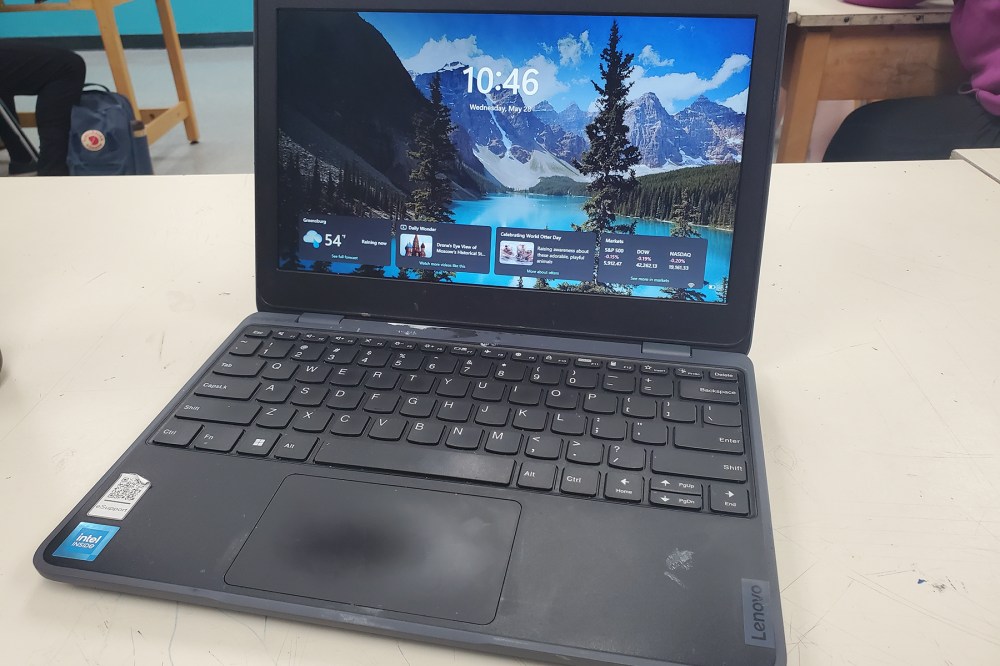
Students current laptop conditions

Photo by: Kerrick Shaw


Sophomore Grady Rizzo heard about the iPads from other students. He explained the new electronics will be “great” as he uses his laptop in nearly every classroom.

The implementation of this Apple package is one of the most significant steps in upgrading the educational process over recent years, going along with multiple upgrades underway at different buildings in the district.

“At the end of the day, this isn’t just about upgrading devices,” Ms. Byrne-Houser said. “It’s about investing in our students’ future, supporting our educators, and making sure our district stays ahead of the curve.”

Concerns Surrounding the Department of Education 

By: Kerrick Shaw

A controversial push to eliminate the U.S. Department of Education is gaining momentum in Congress, raising concerns about the future of federal oversight in schools.  

If the Department of Education (DOE) is dissolved, school districts could face significant disruptions in funding and resources. Programs that rely on federal support, such as Title I for low-income schools or special education services under the Individuals with Disabilities Education Act, could stall or disappear, forcing districts to find alternatives. 

On March 20, President Donald Trump signed an executive order to begin shutting down several functions of the DOE. 


Greensburg locals participating in the Hands Off protest on April 5.

Photo Courtesy: Barb Ciampini


“It feels very rushed, without deeper thought into the implications of dismantling or reducing,” GS Superintendent Dr. Ken Bissell said. “Our district relies on federal funding for our Title I, II, III and IV grants, which help us with things such as special education needs and equity issues for students from marginalized populations. If there were no federal funds, that’s a lot of teaching positions that go away.” 

The federal government’s role in schooling is to “uphold civil rights” for children, Dr. Bissell explained. He stated that he believes the shut-down will not happen, but acknowledged the hypothetical question of how those funds would be made up.  

“Teachers are the direct support for students; education is a human-to-human endeavor of building relationships and trust, to then learn from each other,” Bissell said. “If we lose funding, it will definitely result in us not having enough funds to support the teachers and staff.”  

 According to the district’s Director of Curriculum and Federal Programs, Dr. Lenni Nedley, school districts handle variations in their funding yearly, stating that schools will adapt as necessary if federal funding is dissolved.  

“Each school year, districts are faced with federal and state funding fluctuations; they’ll make adjustments to their general budgets as needed in different areas,” Dr. Nedley said. “The district always places children at the forefront of their decision-making to ensure they’re receiving what they need to be successful.” 

The federal grants support four reading specialists, three school counselors, one science teacher and two classroom assistants, as stated by Nedley.  

“If funds are reduced, we’d be put in a situation where we’ll have to make very difficult decisions,” Bissell said. “Staffing is the number one indicator of student success; good teachers make successful students. If we’re forced to reduce the number of staff we have, that’s going to directly impact the kids.” 

On top of the human resources students are provided through teachers and staff, a majority of students in the GS school district take advantage of the food services available. 

“Our school district is just over 60% free and reduced lunch,” he said. “That is a lot of kids that these funds help provide resources to.” 

Having heard of the possible closure of the DOE, some students are considering what the absence of such programs could mean for their school experience. Senior Adien Carota expressed confusion over the reasoning behind the proposed closure. 

“It simply shouldn’t be closed, I don’t understand the motivation,” Carota said. 

Senior Kyle Keller believes “education will go down” following the change in funding. 

Principal Mr. Adam Jones echoed concerns about how the closure could impact schools across the country. He explained that a lack of federal guidelines will result in disparity among states. 

“Not having oversight to ensure students across the country are receiving the same protections and rights makes me worry about if it’ll further create ‘haves’ and ‘have-nots’,” Mr. Jones said. “Some states could take advantage of it, seeing it as them not having to follow federal mandates anymore. I don’t think every state values their educational system the same.” 

The DOE’s involvement in schools is generally focused on broad policy and compliance with federal regulations. In contrast, states directly shape the daily operations of schools, making key decisions that affect classroom instruction and testing. 

“For the country to run an effective educational system, you have to have an overall level to ensure that all of the states and kids are getting roughly the same standards, curricula and resources,” Jones said. 

Although much remains uncertain, GS’ faculty and administration will focus on maintaining stability for students, regardless of what decisions are made at the federal level. Their attention remains on adapting to whatever comes next. 

“Pennsylvania has always had a very strong educational system, so I don’t fear a major negative outcome for our district,” Jones said. “In ten years, if there’s no Department of Education, I don’t think there will be a noticeable difference in our school.” 

High School Working 

By: Kerrick Shaw 

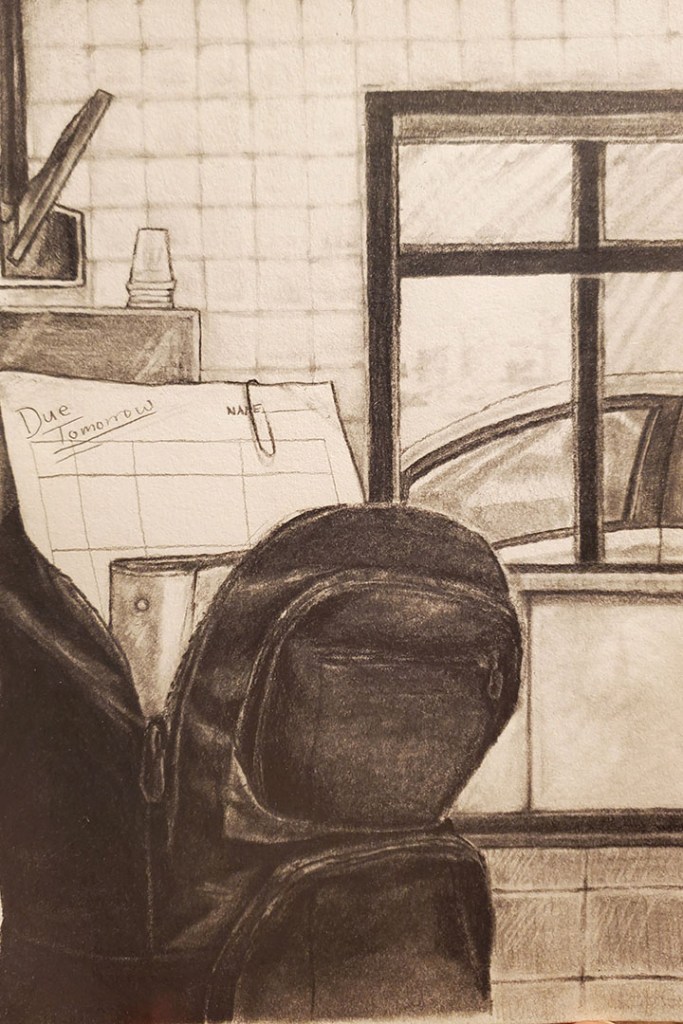
Students are stuck juggling their responsibilities while stocking shelves or handing out orders with homework due the next morning. 

Some teenagers begin their search for work once in high school, but with both school and a job, students might struggle to manage their time efficiently. 

“It is definitely hard to manage my time because my plate is full with school, work and softball,” junior Maggie Alcorn said. “It gets challenging, but I try my best to work around my work schedule.” 

Sports and other extracurricular activities can make it especially hard to handle the workload. Senior Katie Shea, Fundraising Director for Mini-THON, said that most employers are “more lenient towards students.” 

“If something comes up for Mini-THON or volleyball, I make sure to let my manager know right away,” Shea said. “They usually understand with high school students that school comes first; if your job gets in the way, you need to put it on the back burner.” 

Principal Mr. Adam Jones believes that having a job isn’t as important as some students make it out to be, saying that students who participate in school activities like clubs, musicals or athletics should focus on those. However, Mr. Jones also understands that jobs teach teenagers life skills that they cannot learn in school. 


Comic by: Kerrick Shaw


“I think going to school is your primary job,” Jones said. “If the time you’re committing to your job is impacting your studies or if your grades are going down then you need to set your priorities. I hear so many kids say that they have to work, but school should be number one on their list.” 

Regardless of her busy schedule that can sometimes be a struggle, Alcorn thinks it is very important for high schoolers to have a job, saying it gives teenagers an “early work ethic.” 

“I started working the summer before my freshman year; I was fourteen,” she said. “I would recommend getting a job early and working hard. I think working will only get harder as you leave high school.” 

Shea agrees it’s ideal to start working as soon as possible. She explained that it teaches responsibility and is a different way for teenagers to meet new people. 

“I started working at the end of my junior year,” she said. “I’m a food runner which can sometimes be difficult because we have three floors, so having to run food up three floors as quickly as possible can be really tiring. I also have to close on school nights at times which means I don’t get home until 11:30 some nights.” 

Balancing work on top of school requires adjustments for teenagers and its important to ensure that responsibilities, like good grades, will be maintained.  

“Each individual is different,” Jones said. “Some students can juggle high level courses and a 30-hour work week; some can’t, and that’s okay. Everything really depends on what the kids are comfortable with and what they need to do. It’s important to remember what comes first.” 

Student Help Programs 

By: Kerrick Shaw 

Resources are available at GS for students who need a boost with their classes. 

Tutoring services at GS include the Next Step program and the National Honor Society’s student-led tutoring program. 

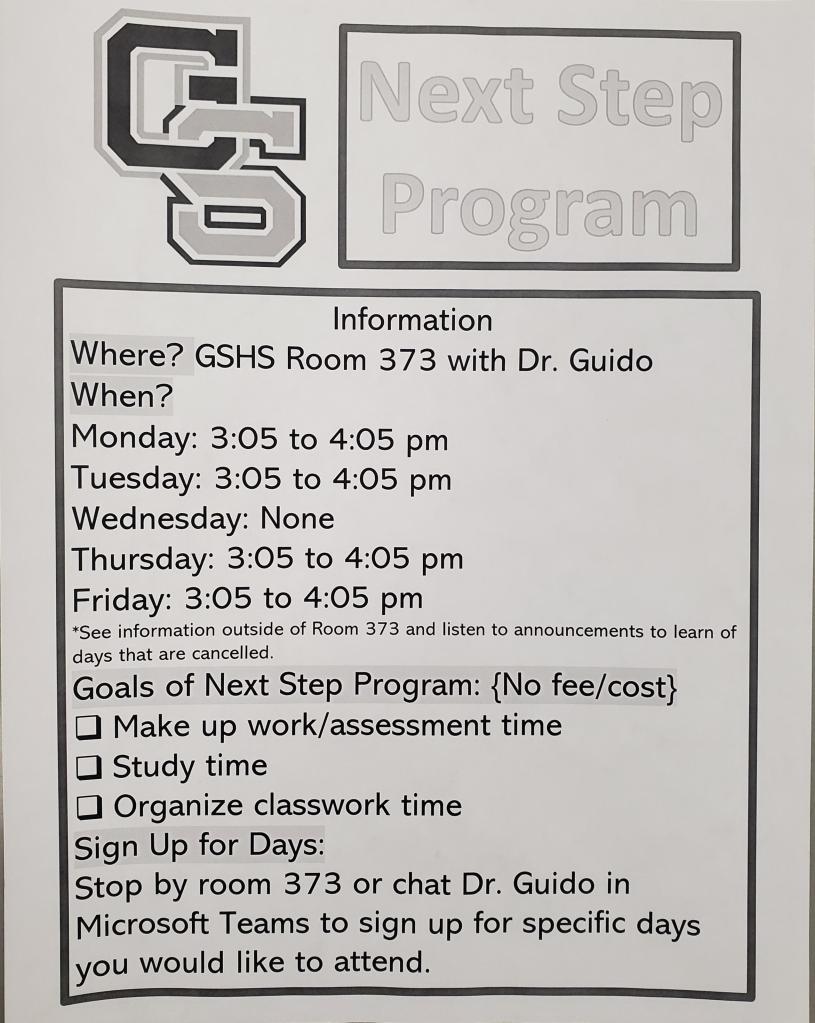
Next Step is a resource for students to work on missing assignments, make-up/retake assessments and get help with any questions they may have. Next Step takes place from 3:05 to 4:05 p.m. in room 373 on Monday, Tuesday, Thursday and Friday. Transportation is available for students on Tuesdays and Thursdays.  

“It’s not meant to seem like a detention, it’s meant to be more relaxed,” Next Step teacher Dr. Taylor Guido said. “As a student, I would’ve liked to have this because when you get home, you get distracted. It’s a quiet, extra hour of working time for students who need it.” 

Next Step keeps students in “school mode,” according to Dr. Guido. No paperwork or form is required to participate in the program; students only need to communicate with Guido in advance, giving them freedom to pick and choose when they want to stay. 


Next Step times and goals.

Photo By: Kerrick Shaw


“I like to ask students what their goal is for the day; I also communicate with their teachers,” she said. “More students have started to stay more recently, but I hope more do take advantage of it in the future.” 

On the other hand, tutoring through National Honor Society (NHS) requires filling out a Microsoft Form that’s available with a QR code posted throughout the school. The form requires the student’s name, advisory and advisory teacher, the class they need help in and answering a few multiple-choice questions that will help them be set up with the best-fitting mentor. 

NHS is a national program that gives students the opportunity to engage in community outreach and service and encourages the development of important skills. The GS chapter is a group of about 50 seniors who are highly engaged in the school and community. 

“I go through the NHS members and find who’s able to help students in need,” NHS Adviser Mrs. Cheryl Harper said. “Once they’re matched, they meet in advisories and work it out. I think the students who show up, and want the help, really do benefit from it.” 

NHS Member senior Everett Redinger believes the tutors are “very helpful” when working one-on-one. Tutors are working with the same education, having taken most of the same classes and knowing what hardships went with them. 

“I don’t think enough students that need help take advantage of it,” Redinger said. “The students are generally all aware of the tutoring program, but for students to sign up for it, they themselves must want help. If the students don’t want to truly improve in the area, tutoring can be very difficult.” 

Both Next Step and NHS’ tutoring have grown recently according to Dr. Guido and Mrs. Harper respectively, but both hope to see more students participate in the future. 

“I hope that students who need help become more self-advocating, more willing to ask for help,” Harper said. “I think the school’s tutoring services are something kids should turn to before falling behind and having more trouble. They’re here to help.” 

GSHS Outdoor Classroom Project

by: Quinn Isenberg


Summer is over and school has begun, but GS students’ time in the sun isn’t over yet.  

The outdoor classroom has made significant progress over the summer with brand new additions marking the beginning of a new learning environment at GS. 

“They fixed the concrete patio and they put the pavilion up,” biology teacher Mrs. Andrea Redinger said.   

These specific changes were made to create a safer environment for students compared to the state of the outdoor classroom last school year.  

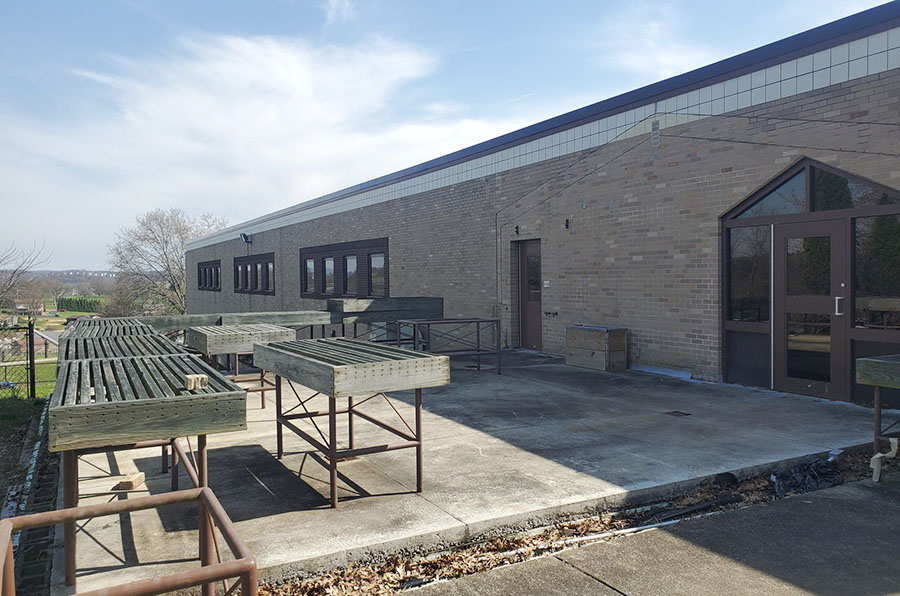
“The concrete had exposed wires and pipes because it used to be a greenhouse that went up, so we couldn’t go out there at all because it wasn’t safe,” Mrs. Redinger said. “They also made it wheelchair accessible I believe.” 


The Outdoor Classroom so far.

Photo by: Quinn Isenberg


The outdoor classroom taking shape allows for more class activities to be held out there this school year. The new additions have already proven to be helpful. 

“We were using the scientific method to test how mass affects paper airplanes, and we used it as a shady area to have some consistency in the data,” biology teacher Mrs. Julie Firmstone said.   

Students and teachers alike are pleased with the upgraded outdoor classroom. Students have already recognized the benefit of having classes outside in the shade when it’s too hot inside the school building. 

“It’s a good thing because then they can go outside and learn from there,” senior Valerie DiNunno said.  

It’s not just a way to escape the heat inside the school building, but also a way to create a change of pace for students’ classes.  

“I feel like it’s going to help students learn better if they need to be outside more, rather than just sitting in a classroom,” senior Jackie Dennis said.  

Despite the improvements to the classroom there is still much to be done for it to reach its full potential. Staff who have been involved in the project, including Redinger, physics teacher Mrs. Cheryl Harper and former ecology teacher Mr. Angelo Testa, had ideas for the future of the outdoor classroom. 

“We are definitely getting furniture of some type, and the pond is up next to be revamped,” Redinger said.  

Although, there is still much to be done. The new aspects of the outdoor classroom are already working to create a wonderful learning environment.  

“It was wonderful, better than being indoors,” Dennis said.  

Changes Being Made to the GS Schedule 

by: Emma Helmick 

Students and staff at GS were met with a few unexpected changes after walking through the school doors this year. 

Many changes have been made throughout the high school for the 2024-2025 school year. Former high school English and creative writing teacher Ms. Alyssa Bewszka and former high school math teacher Mr. Scott Shirey were moved to teach at the middle school.   


Ms. Bewszka’s old room number.

Photo by: Emma Helmick


Former science teacher Mr. Angelo Testa left the district, but a teacher has been hired to replace him. Building substitute Mrs. Joan Zahorchak is filling in for his classes until the new teacher arrives. 

Unlike Mr. Testa, no one has been hired to replace Mr. Shirey or Ms. Bewszka. This resulted in Sports Stats and Creative Writing being cut as classes. 

“The middle school lost two teachers, they left,” High School Principal Mr. Adam Jones said. “So, they needed a math and an English position. They absorbed two from up here, so all of that trickled down to why you see those courses being cut.” 

Bewszka’s room was turned into a life skills classroom, while Shirey’s room is used by Dean of Students Mr. Jeff Kronewetrer during the afternoon for his Freshman Seminar classes. 

“I am very sad to hear the class is gone because I felt it gave many students an outlet to write freely and really express themselves,” Bewszka said. “Many of the students, if not all of the students in my Creative Writing class, really enjoyed what we did and enjoyed the class as a whole.” 

Both teachers received a phone call over the summer telling them that they would be teaching at the middle school. 

“I taught middle school before and didn’t enjoy it very much, but I thoroughly enjoyed teaching at the high school,” Shirey said. “I also wish I knew I was being moved before the school year ended so I could have said proper ‘goodbyes’ to the students I made connections with and enjoyed talking to, as well as my coworkers.” 

Sports Stats being removed left an open spot in Math teacher Mr. Jake Cole’s schedule, allowing him to take on the role of Shirey’s Math for the Trades class. 

Both teachers’ classes were dispersed through other teachers in both subjects. This causes core subjects to have more students. 

“I’ve noticed an increase with my class sizes this year, which is one of those things that they don’t realize when they move a teacher,” Mr. Cole said. 

This could make it harder for teachers to check in with each student, which could impact some ways students learn. 

“I think we lost two really great teachers who both brought joy into the classrooms,” junior Lorelai Leatherman said. “I never had Mr. Shirey, however he had lunch duty in my lunch last year, and he was always nice, welcoming, and made conversation with everyone. I did have Ms. B for creative writing last year, and she was one of my favorite teachers.” 

2024-2025 Rule and Policy Changes 

by: Ari Case 

Every school year brings new changes, and this year is no different. 

During the class meetings held the first day of school, High School Principal Mr. Adam Jones and Dean of Students Mr. Jeff Kronenwetter reminded students of old and changing rules in the school. These included the returning cell phone rule, a change in second run bussing and the attendance policy. 

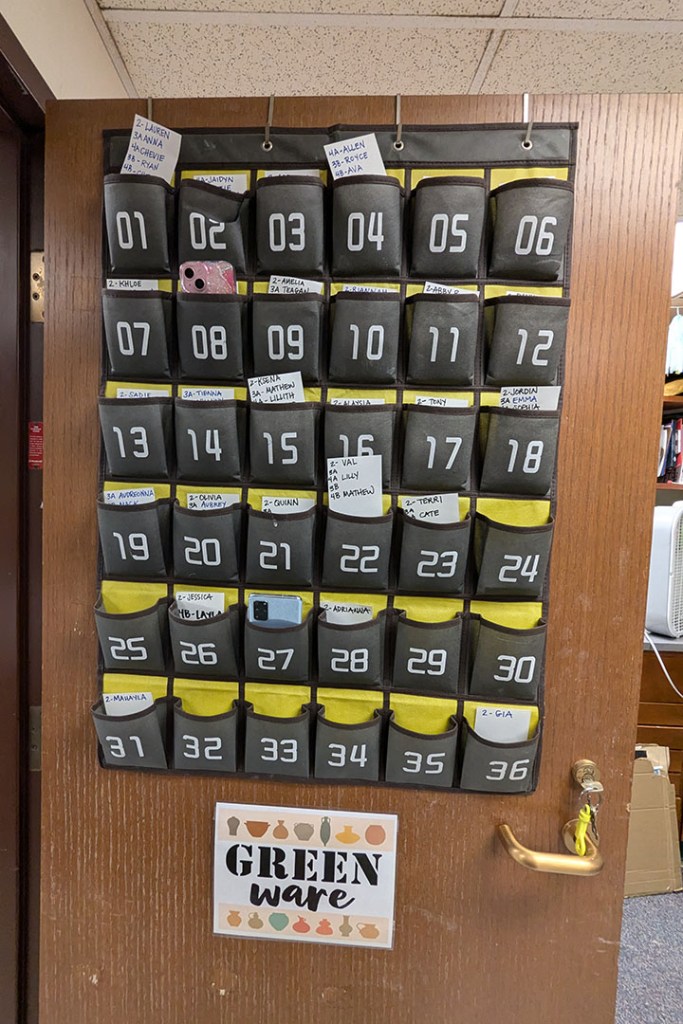
The cell phone rule, initiated last year, dictates that each student is required to place their phone into numbered and assigned pockets before class. All students are prohibited from using phones during classes and exceptions must be approved prior to implementation. 


A typical phone holder hangs on a door.

Photo by: Ari Case


“We did it [to] get kids more engaged in their learning,” Mr. Jones said.  

Teachers have varying opinions on it, but most appreciate the value in removing classroom distraction.  

“The teacher part of me loves it, [because] it is a distraction for students that have them out in class,” Mr. Kronenwetter said. 

Student views on the rule are hard to quantify, but many agree with the idea—just not the execution. Some students aren’t normally on their phones but prefer to have them in backpacks or pockets. 

“It’s not that I like being on my phone, but I like it being near me,” junior Nico Bortz said. “So at least I know if I need it in any case of emergency, it’s there.” 

The rule has not changed since last year, but its application is stricter. Previously, many teachers did not mind if students kept their phones away in their bags or used them to listen to music during independent work time. This year, however, students felt some teachers had been rude or overbearing about their cell phones even if they did not want to be. 

Bortz shared that the rule can distract them from learning more than their phone at times. One class they accidentally put their phone in the wrong numbered pocket, which prompted the teacher to disrupt class and have them move the phone. 

Students, like senior Leia Felmley, feel the rules are causing “unnecessary mayhem” and extra stress. 

This added stress, for students like Bortz, takes away from their learning. 

“I come to school and I want to learn,” they said. “I don’t want to have to worry about making sure my phone’s put away so I don’t get a detention.”  

Some have raised concerns about the potential negative impact on student learning when there is reliance on only school-provided technology. Historically, school devices and Wi-Fi networks are unreliable and cause consistent issues for many students and teachers. 

“A lot of our classes depend on technology,” Felmley said. “A lot of us went through Covid, and [technology] was our only source of education.” 

According to Jones, teachers are expected to have a backup plan for all lessons that can be completed without technology.  

Reportedly, the blame would fall on teachers if students were caught with their phones during classes. This has increased classroom tension, and Felmley disagrees with the choice to broadly pressure teachers when only some behaviors are truly disruptive or problematic.  

Education has changed drastically in large part due to the pandemic, coupled with technological advancements—many teachers have had to shift how they teach in recent years. 

“The teacher’s job is to educate their students,” Felmley said. “They should not be punished for it [because] it’s making them feel like they aren’t doing a good job of teaching when they’re trying their best just to learn how to redo everything again.” 

The high school also changed the procedure for second run bussing this year. 

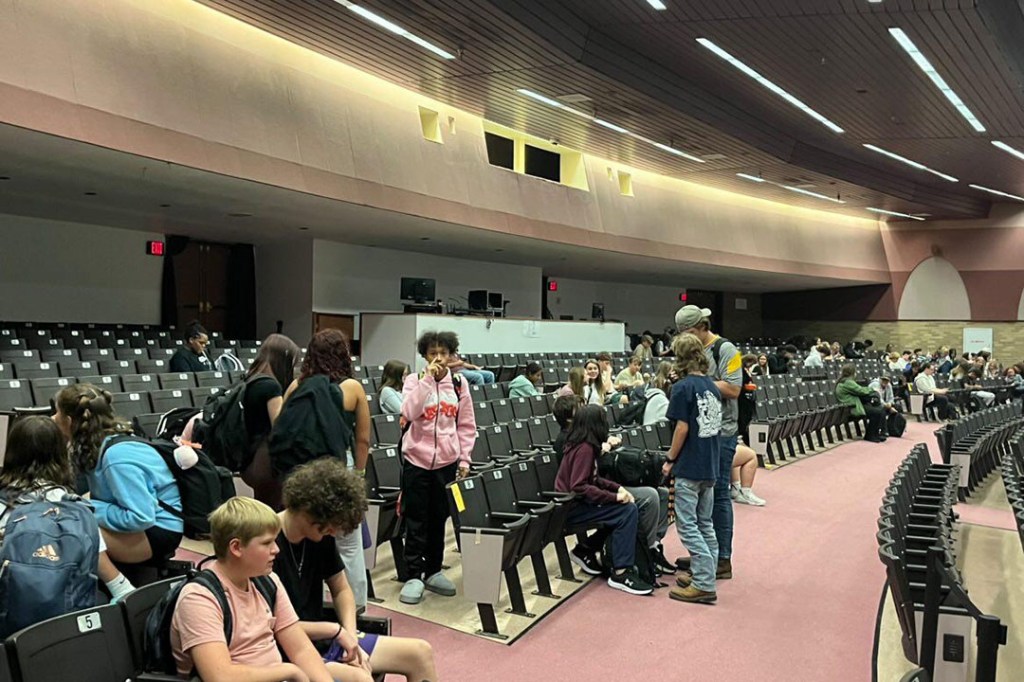
Previously, students who rode second run buses waited in the auditorium lobby or outside after school. This year, they are assigned seating areas in the auditorium based on which bus they ride and dismissed accordingly.  

It was explained that the reason for changing the bussing procedure was initially unrelated to students. In previous years, the buses were often clumped and out of order, sometimes blocking the road. Along with some conflicts between students, the main goal was to organize things for the sake of safety and efficiency.  


Students wait in the auditorium for their buses.

Photo by: Quinn Isenberg


Jones explained that “it just streamlines the process” of getting students home safely. He also said that it is important they are able to find students in case of emergency. 

Second run bus riders have decidedly less positive views about the change. 

“I absolutely hate it because [it] is wickedly hot in the auditorium, even though we have an air conditioning unit in there, and it seems like they aren’t applying something that they put lots of money towards,” Felmley explained.  

She believes the air conditioning has been on some days, but it has not seemed like it most days.  

Bortz expressed frustration at losing the freedom of standing outside. 

“It feels like they’re treating us like elementary schoolers,” they said. “I don’t like being treated like that when I’m 16 years old in high school. It’s kind of annoying and demeaning.” 

Both Bortz and Felmley resent being separated from friends and social groups. 

“It feels like you’re being isolated, away from those people you normally would bond with,” Felmley said. 

The bus procedure is new this year, but the attendance policy remains the same on paper as it has been for years.  

In recent years, several unexpected challenges disrupted the attendance policy at GS. Now, Kronenwetter hopes to get attendance more consistent. 

“We’re trying to help establish good habits,” he explained. 

He expressed that during and after the COVID-19 pandemic, he was just glad to see students attending school at all. 

The district policy is that any absences after 12 missed days count towards sanctions. A student on the sanctions list must make up two hours for every day missed over the limit and may not participate in school-related activities like sports or dances. 

The school legally excuses any absence with a note, but notes from parents still mean an absence counts toward sanctions. Any absence excused by a third party, like a doctor, does not count toward the sanctions limit. Neither do pre-approved absences for vacations, college visits, job shadows and senior projects. 

Bortz expressed concerns for specific medical and family situations, and the appearance of transcripts for college. Kronenwetter explained that he isn’t concerned about potential issues, because they can be handled on a case-by-case basis—and the rules aren’t the important part to him. 

“I know the academics come first,” he said. 

The policy has not significantly changed this year, so any grievances are largely the same as last year. General frustration at the scheduling of school is the most common, with such an early start in the morning. 

“There’s so many reasons for being tardy to school that should be excusable, but to the school are not,” Bortz said, mentioning car and health problems. 

Both Bortz and Felmley expressed concerns about COVID-19, considering the recent surge in cases. Current Center for Disease Control and Prevention (CDC) guidelines do not have a set quarantine, though they were previously five days at least. Now, quarantining until fever-free and limiting contact while wearing a mask for several days are recommended. 

According to Jones, the district has no current policy on COVID-19, and “it’s treated as any illness.” If you do not have a doctor’s note, days missed because of it will count towards the sanctions limit. 

Amid student frustration and added stress from new rules and policies, most students just want to be treated like their opinions and experiences matter. 

“I know that as a young adult, I hope that our voices will be heard,” Felmley said. 

Salem Psychos  

By: Rubee Stillwagon 

With fall sports in full swing, the Salem Psychos are busy showing their support. 

The student section at sports events is there to bring fun to games and encourage the teams. These students are led by five leaders. 

“Lauryn Swierczynski is our main leader,” Salem Psychos Advisor Mr. Nick DeMary said. “Then we have Kayla Ramer, Grace Sybesma, Dom Rosensteel and Cooper Dann.” 

These leaders do their best to ensure that students have fun at sports events. But beyond this, they make sure that student athletes always have someone supporting them. 


The HS student section at the GS vs. Valley football game.

Photo Courtesy: Mrs. Andrea Redinger


“The student section is a major driving factor of school spirit, no doubt,” Swierczynski said. “As an athlete, having your peers come to your games really does make a difference. It gives you another reason to play, to push through and gives the team a wave of school pride.” 

While the student section works to keep them supported outside of school, they are also working to arrange in school support. 

“I want to get involved in the school,” Mr. DeMary said. “Maybe a pep rally. We are also trying to get t-shirts made and stuff like that.” 

Getting the students involved may draw bigger crowds to school events. The leaders and DeMary are working hard to get advisory meetings set up. This would open the opportunity to get more ideas and opinions.  

“Hopefully we see student athletes from all grades and sports come down to Mr. DeMary’s room and have some input on future themes, chants and ways to get more involvement at games,” Swierczynski said. 

Having student input can be helpful when trying to gain involvement. If students like the themes and chants there will be more of a turn out. 

“Everything is truly for the students and your voice matters,” DeMary said. “What students want is important because I’m a teacher and what was cool six years ago isn’t anymore.” 

Although DeMary works to make things happen for students, the leaders play a role in keeping things up to date. 

“Right now, we are working on Gold Rush t-shirts that will most likely be free,” Swierczynski said. “Another thing the other leaders and I are working on is a short video to go over different chants and traditions we do at each game.” 

The chants are a way to keep the students having fun and interested at games. This video could help students be prepared for the games and louder when chants are called. 

Although all students are in the same general area, it can be hard for some groups to hear and stay involved due to the grade sectioning. In the student section seniors are in the front and it goes by grade level all the way to the back. 

“I think they could do a little better trying to involve the freshmen,” freshman Sophia Ginder said. “I think it’s awkward sometimes because they already know what they are going to do in the front and no one in the back knows what’s going on.” 

While it may be hard to hear chants, there are still fun things for the younger students participate in, such as themes. 

“I like the themes because I feel like it’s a way we can all be connected,” Ginder said. 

Another thing that has been updated this year is the location of the middle school student section. Instead of being on the other side of the field, it is now next to the band which is in between the two sections. 

“I personally like this change,” Swierczynski said. “Another section can hear the band better, and it creates connectivity between the middle and high school.” 

Introducing the middle school students to the high school section can help show them what they have to look forward to. It can get them excited for what they get to be involved with soon. 

“What I really want to see happen after I leave is the revival of the old days,” Swierczynski said. “What I mean by this is it being competitive to become a psycho. Bring back the passing of the torch culture. And keep the energy for all sports, not just football. Pack the section.” 

Overall, this year’s group of senior leaders have a lot of goals, and the hope is that they can achieve them all. But it’s also important that there is other students’ interest in carrying on the Salem Psycho traditions. 

“We are one at GS and I’m excited to see what the future holds,” DeMary said. 

GSHS Outdoor Classroom Project

By Kerrick Shaw

Photo by: Kerrick Shaw

A change in scenery will be implemented by the start of the next school year for students and teachers to enjoy time learning in the sun. 

On top of renovating the pond and landscaping, the school board is moving forward with a pavilion project for classroom purposes, building on top of the cement slab outside of the science wing. 

“There used to be a greenhouse that sat outside by Mrs. Harper’s room … when that got taken down, that cement area was just left there,” GS Superintendent Dr. Ken Bissell said. “A lot of the science teachers still use that outdoor space … the science department really took the lead on deciding how to renovate it.” 

All students were taken into consideration during the decision making for this project, keeping it available to all classes rather than exclusively sciences. 

“It became, ‘can we have an area that any class or any student can use?’ with the pavilion and seating,” Environment and Ecology teacher Mr. Angelo Testa said. “Everything from science classes, obviously, to art classes, English – just anyone who wants to go outside will get to have this space.” 

Students have shared excitement for the space, agreeing that it will be beneficial for everyone. 

“I think the introduction of an outdoor classroom will be a great addition to the school, especially with the ecology classes,” junior Aiden Carota said. “… many students will be happy to get out of the building for some fresh air.” 

The School Board will be voting to move forward with a contractor and will then be able to map out the full timeline of the project. 

“I am hopeful for the pavilion to be done before summer,” Dr. Bissell said. “However, for the whole project – pavilion, pond, landscaping – I’d like that all to be ready for the next school year.” 

The staff involved are eager to provide this designated spot for outdoor learning. 

“There’s a certain energy that comes out of it,” Principal Mr. Adam Jones said. “It’s like: ‘Aw man!’ That’s what I hope it becomes, ‘Hey, let’s go use the outdoor classroom.’” 

Snow Days VS.  FIDs Days  

By Samarah Guy  

Photo Courtesy: Alyssa Martinez

Many schools don’t have snow days anymore because Covid-19 opened a new world of virtual learning.  

GS has flexible instruction days, so students can do work from the comfort of their own home when the weather gets bad.  There are many advantages to FIDS days, but there are also many disadvantages.  

“I wouldn’t be comfortable doing online because I don’t get the hands on learning I need,” sophomore Nevaeh Hirst said.  

Many students need a teacher to physically show or help them when it comes to learning, and a computer screen doesn’t allow that to happen.  

Some teachers will make videos or step-by-step directions for the students, and many benefit from this because they can look back and make sure they are doing what is being asked.  

“If I were to virtually learn, I would slack off because there are more distractions for me at home,” Hirst commented.  

Distractions are more limited in school, and the teacher can bring the student’s attention back to the subject at hand. When the child is at home, anything around them can take their attention away from school because they are in their comfortable place.  

Students can also cheat on assignments using the technology around them. Not only is this not helping their brain work, but it’s also giving kids the opportunity to become dependent on technology.  

When GS has a FIDS day, many students may fall behind on their work or their grades may even lower.  

“When we do online my teachers usually don’t give work, but when they do, I don’t do it because I’m used to not having to,” junior Savannah Herring said.  

Some students may not be able to attend their virtual classes because they don’t have access to the items they need. Not being able to do work or log onto the live class, the students not only are falling behind on work, but they also will be marked absent.  

“I think if you have access to a computer or WIFI at home, you can benefit, but if you don’t have access, school shouldn’t hold you accountable for it,” U.S. government and politics teacher Ms. Sierra Aires said.