By: Kerrick Shaw
A controversial push to eliminate the U.S. Department of Education is gaining momentum in Congress, raising concerns about the future of federal oversight in schools.
If the Department of Education (DOE) is dissolved, school districts could face significant disruptions in funding and resources. Programs that rely on federal support, such as Title I for low-income schools or special education services under the Individuals with Disabilities Education Act, could stall or disappear, forcing districts to find alternatives.
On March 20, President Donald Trump signed an executive order to begin shutting down several functions of the DOE.
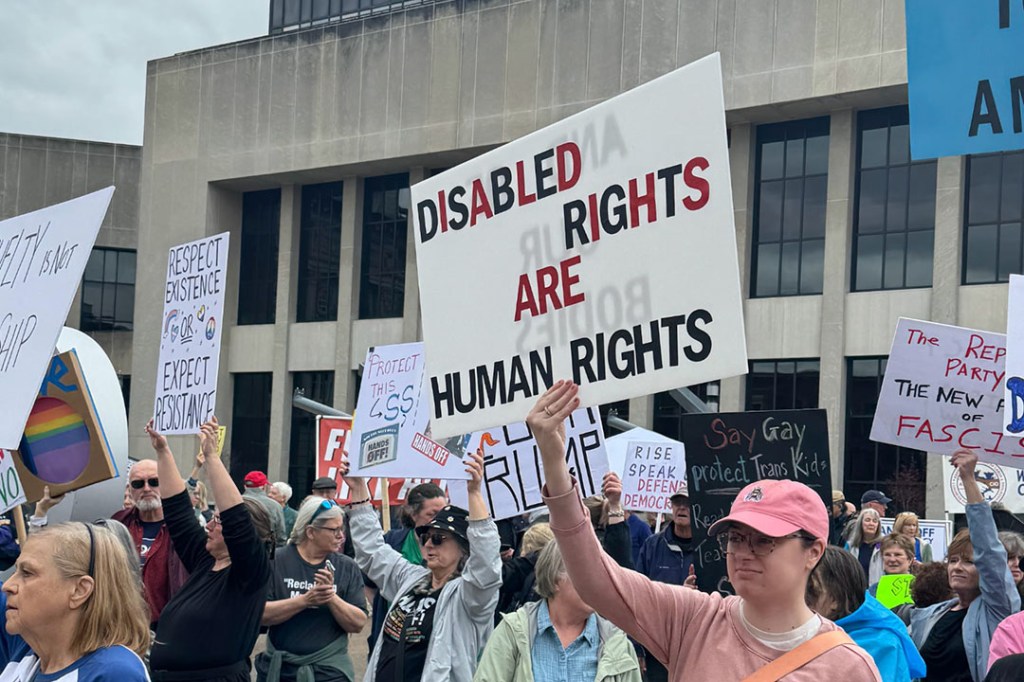
Greensburg locals participating in the Hands Off protest on April 5.
Photo Courtesy: Barb Ciampini
“It feels very rushed, without deeper thought into the implications of dismantling or reducing,” GS Superintendent Dr. Ken Bissell said. “Our district relies on federal funding for our Title I, II, III and IV grants, which help us with things such as special education needs and equity issues for students from marginalized populations. If there were no federal funds, that’s a lot of teaching positions that go away.”
The federal government’s role in schooling is to “uphold civil rights” for children, Dr. Bissell explained. He stated that he believes the shut-down will not happen, but acknowledged the hypothetical question of how those funds would be made up.
“Teachers are the direct support for students; education is a human-to-human endeavor of building relationships and trust, to then learn from each other,” Bissell said. “If we lose funding, it will definitely result in us not having enough funds to support the teachers and staff.”
According to the district’s Director of Curriculum and Federal Programs, Dr. Lenni Nedley, school districts handle variations in their funding yearly, stating that schools will adapt as necessary if federal funding is dissolved.
“Each school year, districts are faced with federal and state funding fluctuations; they’ll make adjustments to their general budgets as needed in different areas,” Dr. Nedley said. “The district always places children at the forefront of their decision-making to ensure they’re receiving what they need to be successful.”
The federal grants support four reading specialists, three school counselors, one science teacher and two classroom assistants, as stated by Nedley.
“If funds are reduced, we’d be put in a situation where we’ll have to make very difficult decisions,” Bissell said. “Staffing is the number one indicator of student success; good teachers make successful students. If we’re forced to reduce the number of staff we have, that’s going to directly impact the kids.”
On top of the human resources students are provided through teachers and staff, a majority of students in the GS school district take advantage of the food services available.
“Our school district is just over 60% free and reduced lunch,” he said. “That is a lot of kids that these funds help provide resources to.”
Having heard of the possible closure of the DOE, some students are considering what the absence of such programs could mean for their school experience. Senior Adien Carota expressed confusion over the reasoning behind the proposed closure.
“It simply shouldn’t be closed, I don’t understand the motivation,” Carota said.
Senior Kyle Keller believes “education will go down” following the change in funding.
Principal Mr. Adam Jones echoed concerns about how the closure could impact schools across the country. He explained that a lack of federal guidelines will result in disparity among states.
“Not having oversight to ensure students across the country are receiving the same protections and rights makes me worry about if it’ll further create ‘haves’ and ‘have-nots’,” Mr. Jones said. “Some states could take advantage of it, seeing it as them not having to follow federal mandates anymore. I don’t think every state values their educational system the same.”
The DOE’s involvement in schools is generally focused on broad policy and compliance with federal regulations. In contrast, states directly shape the daily operations of schools, making key decisions that affect classroom instruction and testing.
“For the country to run an effective educational system, you have to have an overall level to ensure that all of the states and kids are getting roughly the same standards, curricula and resources,” Jones said.
Although much remains uncertain, GS’ faculty and administration will focus on maintaining stability for students, regardless of what decisions are made at the federal level. Their attention remains on adapting to whatever comes next.
“Pennsylvania has always had a very strong educational system, so I don’t fear a major negative outcome for our district,” Jones said. “In ten years, if there’s no Department of Education, I don’t think there will be a noticeable difference in our school.”

 The Lions' Den