As Covid-19 cases rise this holiday season, families must think outside the box to safely spend time with each other.
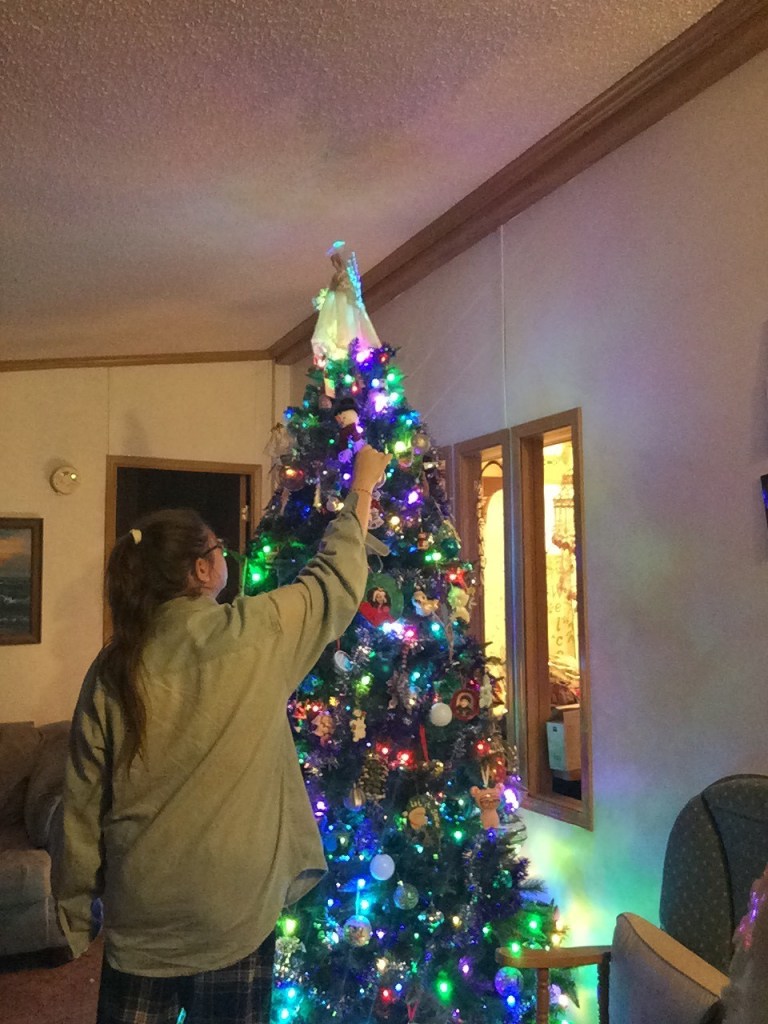
Decorating inside with family is a safe way to introduce the holiday spirit. Photo by: Sierra Hauer
Thanks to technology, spending time with family is more accessible than ever. In order to avoid any risks of spreading the virus, family members of all ages and in all areas can video call one another.
“We have been using Zoom in my family,” art teacher Mrs. Kelley Audia said. “We used it to celebrate Thanksgiving. I was with my immediate family and we video-called people.”
Staying at home with just immediate family can greatly reduce the risk of catching or spreading Covid-19. Even though some people might not prefer video calls, it is one option to keep in contact with others.
“I don’t like video calls, but it is better than nothing,” junior Evelyn Swanson said. “I’m glad that since we can’t visit, we can at least see each other and talk.”
Many families have had to adapt the way they celebrate this year and Zoom makes a good alternative for meeting in person. They can stay at home and do similar activities, like watch movies, listen to Christmas music or bake cookies.
“Because we can’t do our normal traditions for Christmas, Zoom calls and Facetime become the next best thing,” sophomore Glenn Willcox said.
Video calling and social distancing have also provided a way to somewhat preserve old traditions.
“We are doing everything that we usually do that we can do at home,” Swanson said. “We have been decorating, painting ornaments and baking.”
Baking cookies is a safe and easy way to bring joy this holiday season. Photo by: Sierra Hauer
New traditions have also had the opportunity to arise.
“We’ve had a lot of campfires and been outside a lot,” Mrs. Audia said. “That’s been a tradition that we’ve started doing this year because we can be socially distanced and not have to bring everyone inside.”
If families are planning to get together during the holidays this year, there are many things that they can do to minimize the risk of contracting the virus.
“If people plan to visit their loved ones this year, I think that they should wear masks and try not to stay long,” Audia said.
Overall, there are many ways that people can interact with loved ones without endangering anyone.
“I just hope that everyone is careful and does their part to keep the community safe,” Audia said.
As local cases of Covid-19 rise, schools in the area have been forced to close down and go fully remote.
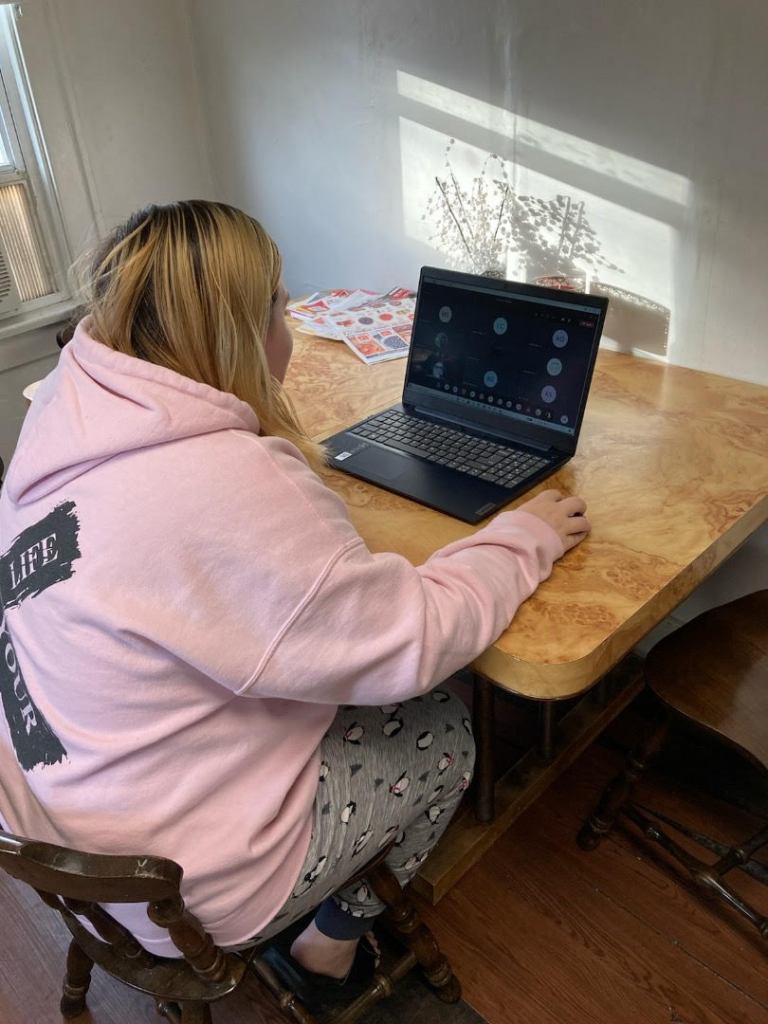
Junior Hannah Schweiger uses Microsoft Teams for remote learning. Photo courtesy: Hannah Schweiger
GS schools have been as fortunate as possible during the Coronavirus pandemic, but no one knows what the future holds. The elementary schools have gone fully remote twice and the entire district is fully remote until at least January 4th. With the uncertainties surrounding Covid-19, many people have started to worry and speculate how long the hybrid system will last.
“I think that we should honestly close [all schools] if we want to stop the spread of the virus,” freshman Drezden Gesalman said.
With cases rising in Westmoreland County, there is a possibility of all schools shutting down. Schools like Yough and Greater Latrobe have already gone fully remote during the spike in cases, and they will remain online until their county statistics show two weeks of “Moderate” transmission rates.
GS had to make a similar call when they decided to go fully remote until at least the end of Christmas Break.
“There were several data points to examine when looking at that decision,” administrator Dr. Gary Peiffer said. “These factors include the most recent number of positive Covid-19 cases per 100,000 in our county, the positivity rate of Covid from PCR tests which indicate the rate the virus is spreading, the numbers of positive tests among our students and faculty and the number of faculty who have to quarantine due to being in close contact with a positive case.”
Many factors dictate whether or not GS schools can stay hybrid or not, but one of the most important ones is attendance. If there are too many students and staff at home, it can be difficult to keep the schools open. It is challenging to find enough ways to cover the classes of a teacher who is home quarantining. However, it’s better to be safe and quarantine if there is a possibility of having been in contact with a positive case than risking spreading the virus even more.
“I think that we should be remote [because of] the number of cases in tech schools because kids hang out with lots of other people and are capable of spreading Covid-19 unnoticed,” senior Kassidy Sullenburger said. “On top of that, there are probably more cases than we think because not everyone shows symptoms and that puts everyone at risk.”
Asymptomatic patients are difficult to detect, which is definitely not a good thing when dealing with a highly contagious virus. People may be carrying Covid-19 and not even know it, so ordinary precautions like masks may not be enough.
Similarly, teaching children to wear a mask and stay six feet apart is a challenge, so it did not surprise some to hear that Metzgar Elementary had to close for a week in October due to cases within the school.
“Maybe it should remain closed because the little kids aren’t always capable of understanding the complicated things happening right now, so they’ll continue to spread it,” Sullenburger said.
It can be a challenge to understand the risks of Covid-19 at any age, especially that young. However, there are many advantages and disadvantages to keeping children out of school for safety.
Especially for high schoolers, online school can be tedious and confusing.
“I believe that it is difficult to get ahold of teachers because everyone is online at different times,” Gesalman said. “If I were to message a teacher and say they wouldn’t respond for an hour, then I may log off and get an answer in the morning. For some students and I, it’s been hard to explain to myself and receive directions over the computer.”
Communication has been difficult for some teachers as well because they may have a hard time reaching some students.
“It is more difficult [to get in touch with students],” chemistry teacher Mrs. Tammy Elliott said. “It is much easier when you see students in class every day to check in with them or remind them of assignments. Now, I can send chat messages and it may take hours for them to respond, and sometimes they never do.”
Communication isn’t the only issue regarding online school, though.
“It’s harder to do my tech classes because sometimes I don’t have the materials I need to do the work I need to do,” Sullenburger said. “Tech kids are struggling heavily right now because we have classes that make virtual learning impossible.”
While GS schools may be fully remote right now, classes offered at the Central Westmoreland Career and Technology Center are still being held in person, as well as online. As long as a student has transportation to and from the high school, they can attend the in-person classes at CWCTC.
“If we can drive there we are allowed to go, but f we can’t we have google classroom stuff that has all of our assignments, projects and attendance,” Sullenburger said.
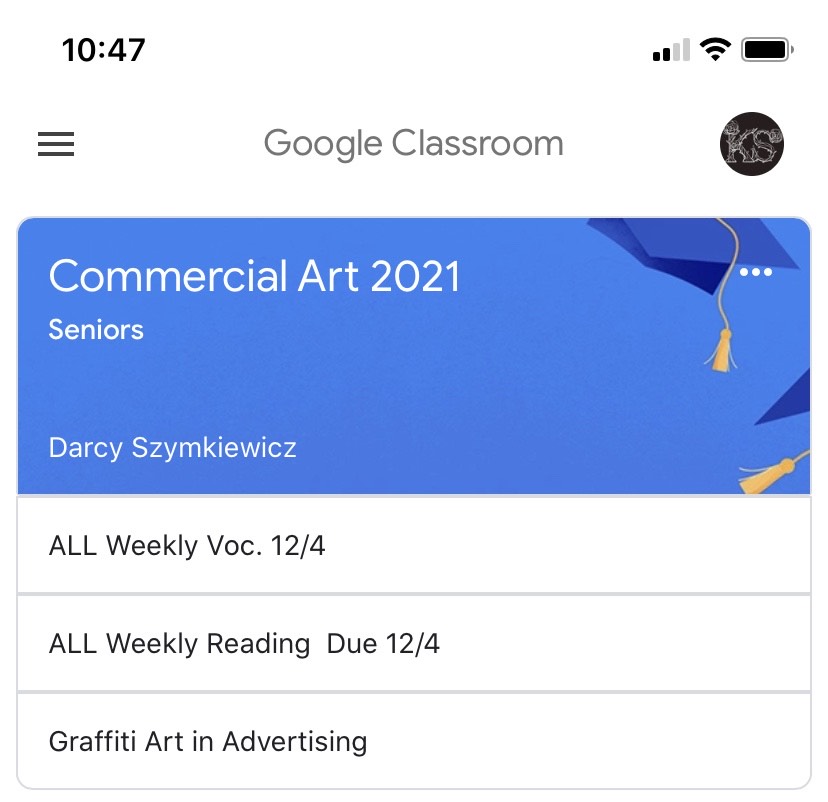
GS students already have to navigate between Teams, Onenote and Moodle, but some CTC students must also use Google Classroom for their classes. Photo courtesy: Kassidy Sullenburger
Even fully remote students can agree that some classes are more challenging to do online.
“I think there are definitely classes that are harder to do online,” junior Hannah Schweiger said. “I think pottery is definitely one of them because most people don’t have the materials for it and if they don’t have a license and their parents work and can’t get off, it can be difficult going to the school a lot to get stuff or drop stuff off. I also think classes like chorus, child development and drama could be harder to do online.”
Despite how challenging a course may be, some students just might need a little extra support with online instruction. There are many distractions outside of a school setting, and most teachers understand that it isn’t always as easy to learn online.
“I think it depends on the student,” Mrs. Elliott said. “Many students do very well with working and learning independently, setting their own schedule and getting their work done. However, there are students who are social learners who need or prefer the interaction and group work. That is what motivates them to learn, and so far it is harder for them to be remote.”
Sports and afterschool activities would also be greatly affected by going fully remote. If there are too many cases, there is a chance that the activities will be canceled.
“Different after school activities have been affected in different ways,” Dr. Peiffer said. “Many activities were postponed or canceled. Coaches and sponsors have been thinking out of the box to provide extra-curricular activities for students while adhering to the guidelines established by the Pennsylvania Department of Health.”
In general, going fully remote might make some classes a struggle to do. However, health and safety remain a priority for most staff, students and parents, so they are willing to deal with a little bit of discomfort.
“Overall if classes do get shut down (in person), there will have to be ways to accommodate every class and if the school doesn’t get shut down there will have to be changes made to keep it safe for every student and teacher,” Schweiger said.
Despite numerous new regulations set in place because of Covid-19, GS’ football team was able to make history.
The GS football team changes their career victories sign after their historic 700th win. Photo by: Kimberly Gray
After ending last year’s season at 699 wins, the team was set on making 700. On Sept. 18, the team won 13-12 against the Knoch Knights, making them the fifth WPIAL team to join the 700-wins-club.
“I was so excited,” junior Billy McChesney said. “It was really amazing because the whole city can get behind it. Milestone victories like that do not happen very often, and when they do, it seems like everyone who ever played for Greensburg has a small part in that accomplishment.”
McChesney stated that it was one of the most memorable games he’d ever played, and that probably goes the same for most of his teammates. Making the night even more memorable for him, though, was the fact that he was nominated for player of the week because of his performance in the game.
“My favorite moment of the season was probably the win against Knoch,” senior Alex Briggs said. “The season didn’t go as we planned, and we didn’t have as much success as we wanted… but there are many games that we can be proud of.”
Briggs was one of the captains for this year’s season, so it was essential for him to motivate and rally his teammates. Even though they lost six out of seven games, the team played fiercely and to the best of their abilities.
“Some of our best games we played were against our best competition, so that’s something I really liked about the season,” Briggs said.
The football team gave this bizarre season their all, and sometimes that was tough. Many regulations were set to keep everyone safe from Covid-19, but those regulations influenced the team.
“There were many regulations set early on that set us back,” McChesney said. “One of the biggest setbacks that had an impact throughout the year was the limited use of the weight room.”
Not being able to use the weight room to its full capacity made a major impact on the season because all athletes need to train and practice to not only improve their performance and prevent injury, but to build a bond between players as well.
“The weight room also helps with team bonding,” McChesney said. “In a normal season, you would spend two hours a day, four days a week with your team. This helps get the team and the new players closer as a unit. Football is a team sport, and the better friends the teammates are off the field, the better they will play on the field together.”
Communication was a key part of making the season go as smoothly as possible as well.
“We had to do zoom calls at the beginning of quarantine,” senior Joey McGough said. “It actually worked out because we were able to discuss plays and bond with each other.”
Even though the team was able to discuss what they needed to in order to play, some gaps remained within the energy of the team.
“I’d say the energy was different, and the focus was the same,” Briggs said. “The energy was different because everyone plays for a different reason. Some people play for fans while others play for a chance to play for colleges. Whatever their reason might be, some people just weren’t as excited to play as they should’ve been.”
While not having the support of the Salem Psychos for some games impacted the environment of the games, the players didn’t let it influence their performances on the field.
“It’s nice to have fans and to be able to see people having a good time, but at the end of the day, it didn’t change the outcome of the games,” McGough said.
While everyone was thankful to be there and did their best to adjust to everchanging rules and guidelines for attending the games, there was some hesitation. The number of Covid-19 cases in the area was thankfully low enough that the sport was never canceled, but the thought certainly crossed the minds of both players and spectators.
However, the threat of each game being their last never phased the team. Likewise, the new changes and regulations never stopped them. They persevered through it all and managed to land that historic 700th win.
“I wasn’t worried about the season being canceled because I knew that regardless we had to go out and play like every game was our last because any game could be,” Briggs said.
The GS football team celebrates on the field after their 700th win. Photo by: Kimberly Gray




 The Lions' Den