Students are involved in sports typically done by the opposite gender but is their experience any different from those around them?
The next match is about to start, and the two opponents walk onto the mats. They take their positions and wait for the cue to start wrestling. They look each other in the eye. One is a girl.
Seeing students in a sport dominated by the other gender is a rare occurrence at GS. There are two students who openly participate in an activity like this, sophomore Owen Johnson and junior Riley Stoner. Johnson is a member of the dance team and Stoner is on the wrestling team.
“A lot of my friends are on dance team and they asked me to do it, and I agreed to do [dance team],” Johnson said. “Also, I thought it would be fun.”
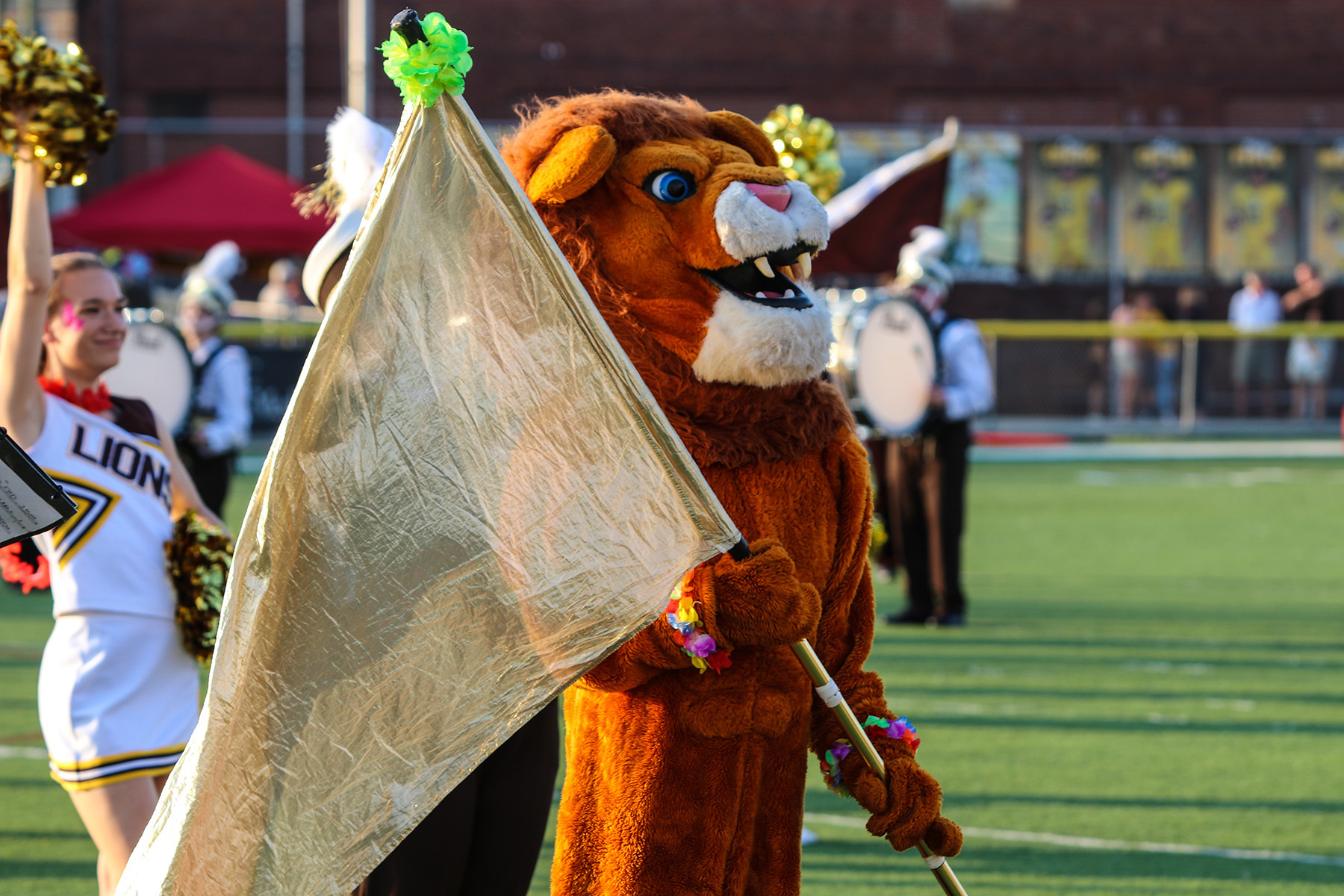
Sophomore Ethan Kelley as the mascot at the first football game of the season. Photo courtesy: Mr. Lenzi
Despite the threat of being discriminated against for participating in something that isn’t typical, they both said that they’ve had no real issues with discrimination or stereotyping.
“[Due to participation in dance team] I learned that our school is a lot more accepting than I thought it’d be,” Johnson said. “I thought I’d be bullied for doing it, or something, but I really wasn’t. It’s been really great.”
While he doesn’t really receive any prejudice for being on dance team at GS, Johnson said that other schools are often surprised to see him out on the field with the group of girls.
“Not anyone here, but a lot of dance teams from other schools are like ‘oh, there’s a boy,’” he said.
The stakes are a little lower for Johnson than Stoner in their activities. Dance team is a part of the band, and doesn’t compete individually, while wrestling is a one-on-one contact sport. People could refuse to wrestle against Stoner if they choose to, forfeiting their match.
“They usually do want to wrestle me,” she said.
With so many different options of activities, some people still choose to pick the hardest route, going with the one that has the opportunity to give them more issues. It could be started as an activity in high school, or something that’s been a part of daily life for years.
“[I’ve been wrestling] since I was seven,” Stoner said.
Choosing an activity to participate in can be a big decision, and should be considered carefully, especially if the decision could be pushing what is considered normal. The activity could require extra effort that wouldn’t necessarily be needed for another activity. Miss Alyssa Palenchar, the girls’ health and gym teacher, has seen more students participating in activities dominated by the other gender.
“I have seen a rise where a lot more students are going out of their comfort zone and participating in sports that [they wouldn’t] necessarily have,” Miss Palenchar said. “For example, football. There are more girls going out for football and wrestling. Guys [are joining things like] the dance team. There has been a rise and I think those people are starting to have an impact on other people as well.”
As more people push the norms of athletics, it gets easier for everyone to pursue one. Today, there are less restrictions on men and women, and what they get to partake in. There is still a limit on what they can participate in, though.
“I think it stems back from a while ago when we were so set on seperate genders because I feel like men are stronger than women, in some sense, just by the way their anatomy is,” Palenchar said. “I feel that that’s why we have had separate gender sports for such a long time, because they still see that as a setback or a difference between the two. It’s just that the anatomy is different.”
“Just try it out, and if it’s bad for you then don’t do it. It’s better to try than to not do it at all”
— Owen Johnson, ’21
Despite there being less of a divide between men’s and women’s athletics, it can be hard for them to be successful in particular situations.
“I think [that] in certain circumstances there are,” Palenchar said. “A woman isn’t going to go out and be a linebacker, but they could be just as successful as a male in kicking, or something like that. I think it just depends on the sport, and what position they’re trying to fill.”
Trying something new and different can be scary, but the people who have tried new things have really enjoyed it.
“Just do it,” Johnson said. “Just try it out, and if it’s bad for you then don’t do it. It’s better to try than to not do it at all.”
The businesses that add community value and good coffee to Greensburg share their experiences and secret to success.
Sitting at the small, round metal table in the middle of the cafe, Kim Renter ran up to the counter to attend to a customer asking for a brownie to-go. Moments later, the woman asked if she could put a sign in the window advertising a fundraiser for the library and if she could take a picture of the interior for social media. This interaction was just a small window into the life of a small business owner, and Renter’s reality.
Nestled on the same block as the Greensburg Hempfield Area Library and the post office, the DV8 cafe has married coffee and local art for over 15 years.
“If you look around, I mean, these are your every day people that live in the area that create awesome, awesome art,” co-owner of DV8 Renter said. “These are people, age range from 15 to well into their 70s. People like it. We try to do local everything.”
The coffee shop offers much more than just hot drinks, they often provide a venue for local organizations and participate in or host numerous fundraisers.
“We did Art For Recovery which is recovering addicts who do art, we had that as one of our exhibits,” Renter explained. “We did [a] Diversity Coalition fundraiser and this past Friday had a fundraiser for No More Dysphoria, which was actually not organized by us but we offered up the venue and had four bands play. It was packed.”
However, this wasn’t always Renter’s life and learning how to own a small business definitely had a learning curve.
“My background was in the corporate world; I was in marketing,” she said. “The hardest part [about running a small business was that] I did not know coffee. I was in consumer products in marketing but it was not food products.”
DV8 is no stranger to being unique and being different is exactly what they believe in.
“Sometimes people just think about the basics when they’re starting a business and sometimes there’s a lot more underlying”
— Rachel Flowers
“One of our biggest achievements is we always say that we want this to be a space for people to feel comfortable and we’re not like everyone nor do we want to be like everyone else,” she said. “I think we’ve brought together a collective group of people.”
While they don’t intend to expand like some of their competitors, their business is always growing.
“We’re always coming up with new ideas of how to expand business,” Renter said. “We want to do a monthly open mic night so we can really dip our toe more into the music because everytime we do have music there, it’s very successful.”
Despite being a small business, their product combined with the one-of-a-kind atmosphere of the cafe means that being priced out by chain businesses is not a concern.
“To the best of my knowledge, [I] price better than my competitors, certainly better than Starbucks,” she said. “I provide a very, very high quality product for the price.”
However, Renter does feel she is on the outskirts of the business district of Greensburg.
“I would like to see more development [in the area] because that’s what brings new customers in,” she said. “My daytime business is very strong, particularly with the post office and the library; that generates traffic.”
The cost of running a small business is also much more than meets the eye.
“If you want to have a decent staff, you need to pay a decent wage,” co-owner of Sun Dawg cafe Rachel Flowers explained. “It’s a matter of the fact. It’s not only just your cost of having an employee, there’s also the cost of training an employee, too. Then there’s also a lot of other things that come into play like taxes and whatnot.”
Factors like insurance, workers’ compensation and building upkeep make for a lot of different aspects to worry about.
“Sometimes people just think about the basics when they’re starting a business and sometimes there’s a lot more underlying that you don’t [think about],” Flowers said.
Being relatively close to college campuses and the high school, the cafe sees lots of student clientele, but ultimately, it’s a mix. This is also influenced by their advertising, which can be found mostly online through social media.
“On occasion we might run a Facebook ad and they’re so reasonable and their outreach is so much more than even a newspaper would be,” she said. “We truly believe that people get most of their information via social media these days.”
While they have implemented new menu items and have even moved to a new building, customers are still hungry for more. However, balancing work and personal life is just as difficult, if not more, for a small business owner.
“We’ve been doing this for a lot of years and one of the reasons we started doing Sun Dawg for breakfast and lunch is that we have children and our children mean a lot to us,” Flowers said. “We wanted to be able to be home with them in the evenings whereas we were always away for the evenings and the weekends with our other jobs working in the restaurant industry. It became very important for us to be there with the kids, however Sun Dawg has just grown into something way more than we ever anticipated it to grow into.”
Due to the rapid growth of the business, they expanded to a larger store front in February of 2018. This milestone can be credited to their hard work and dedication to the restaurant and why they believe they able to succeed.
“We’re here working it,” co-owner Ray Flowers said. “Other places sometimes will have employees that work it, we’re actually physically here working.”
In addition to that, Sun Dawg attributes some of their success to a great, fresh product that can be enjoyed by anyone, strong customer service and originality. For this reason, the cafe does not fear being priced out by larger, chain businesses.
“We have a very unique product and everything that we do here is fresh,” Rachel explained. “When things are fresh like that and then you can typically see a local business working like that, people are a little more forgiving as far as your price goes and they can see what they’re getting.”
Co-owner of The White Rabbit Thomas Medley sees his success partly as a product of timing and location.
The White Rabbit Cafe and Patisserie on Main Street
“I think that we opened in a time and in a location, meaning not just Greensburg, but in this particular spot with a lot of visibility,” Medley said. “We were delayed by at least 3 months with our opening, it was actually closer to five, so we had signs up for a really long time. It hurt us monetarily but it also generated a lot of interest.”
Medley sees the coffee shop as more than that. It’s a place for live music, meetings, studying and even conducting interviews.
“We’re not just a place to grab a coffee or biscuit and go,” he said. “If you’re sitting here for six hours, there’s a very good chance you’re going to strike up a conversation with one of us or with someone around you. It’s almost a sort of community building thing from within the walls.”
Similar to Sun Dawg, The White Rabbit went through a change once they started gaining popularity, but what’s the secret to success?
“I think you have to be [confident] almost to the point of arrogance in what you do in order to open a business,” Medley said. “If you don’t think you’re the best, you should go work for someone who’s better so you then become as good as them. If you don’t think you’re the best at what you do, then you have no business opening a business. There are going to be a thousand things a day that make you second guess that.”
Medley doesn’t credit his growth to just the quality of the product; every factor works to make a business successful.
“People don’t just come here to have a good cup of coffee, service is everything,” he said. “If we don’t create an environment where people want to be-and that’s not just me that’s the staff that we hire, the way that we train, just the general atmosphere the building itself has that we’ve sort of brought to light-I don’t think we’d be nearly as successful.”
That success was fast growing and much more than Medley could have projected.
“We were way wrong [in our business projections],” Medley said. “It doubled what we thought we were going to do, then the next year doubled that and then the next year was another 15 percent on that. We expanded really quickly, it was almost like an inflationary sort of expansion.”
Due to this, a renovation was imminent.
“Our work flow was not set up to handle the volume we were doing, the floor was literally falling apart,” he said. “The floor behind the counter, there were literally holes in it from us running back and forth.”
This renovation meant that The White Rabbit was here to stay.
“This is not a side gig for us [Amber and I]; we’ve devoted everything we have to making it work, and I think that shows,” he said.
“The secret to success is just [to] put everything on the line. If I fail I lose my house, I’m homeless. If my business closes I have nothing. Therefore, failing is not an option.”
— Thomas Medley
Devoting everything is exactly what they did, and what the reality is for many small business owners.
“The secret to success is just [to] put everything on the line,” he said. “If I fail I lose my house, I’m homeless. If my business closes, I have nothing. Therefore, failing is not an option.”
This makes the possibility of competing with a larger business especially terrifying.
“We’re pretty on par with Starbucks pricing,” he explained. “What does instill a sense of fear in me is not being priced out but being outbranded. People view Starbucks as the epitome of specialty coffee. If you’re walking down the street with one of their cups and their obnoxious green straws it’s a status symbol.”
While people are usually willing to support small businesses, there’s always an air of uncertainty when compared to a larger chain.
“With a Starbucks or a place like it, you know when you walk in what the experience is going to be like almost down to what the cashier is going to ask you,” he said. “That’s from Singapore to New York, that’s a universal experience. That’s where I think chains have the biggest benefit and that’s why that’s the thing that scares me.”
With an undergraduate degree in philosophy and a masters in library science, as well as looking for a job during the 2008 recession, opening a small business wasn’t always the end goal.
“I went back into the cafe world full time and then met Amber and said, ‘Oh, we’re both really good at what we do,’ I was a cafe manager at a shop and she was the executive chef,” he said. “Like all good employees, she and I would complain about the owner and in doing so after six or seven months we kind of had a de facto business model. We thought, ‘You know what, let’s just do it.’”
After being both an employee and an owner, Medley realized that the coffee world and this path were his passion.
“I’ve always been better at this than anything else I’ve ever tried,” Medley said.
While the cafe boasts good coffee and delicious desserts, it is also home of the The Rabbit Hole, a small record shop just underneath the storefront.
“Every little town needs a coffee shop and a record store,” Medley said. “And a book store, but I’m not opening another business.”
While each business does something different to set them apart from their competitors, they all add an equal amount of community value.
“The three businesses, they kind of overlap,” Medley said. “We all have such different customer bases and a different meaning to different people.”
Students have started second instagram accounts in order to post things they wouldn’t otherwise make known, but why?
Sometimes, talking to faceless people on the internet is the best way to share your problems. Many teenagers have an instagram account dedicated to doing exactly this. They call it a finsta.
A fake instagram account (finsta)
isn’t an account on a different media site made to look like an instagram. It’s
an account on instagram that’s hidden from a main grouping of followers, with
only a select few chosen to bear witness to the person behind the facade of fun
activities and perfectly staged pictures.
“It’s cool because you can post
things on instagram but there’s not the pressure of a main account,” junior
Elizabeth Armentrout said. “[The pressure of] having [your main account] look
aesthetically pleasing [isn’t there]. [With a finsta], you can just post
whatever, and be real.”
People have a mixed opinion on
finstas. Some people have one and actively use it. Some have one just to fit
the trend. Others hate the idea of having a finsta account. Junior Mia Parise,
who thinks finstas are unnecessary, has a good grasp on the difference between
a main instagram account and a fake one.
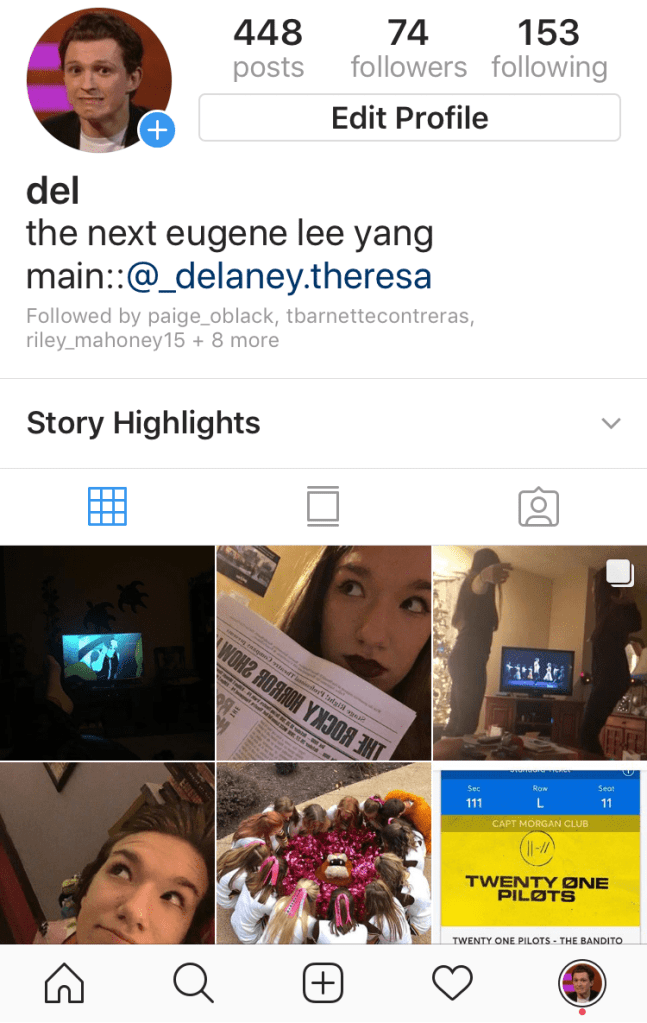
An example of a finsta.
“Basically, a main account people
post what they want everyone to think their life’s about,” Parise said. “On a
finsta, they post what they want to complain to their friends about.”
A main account is commonly called
a rinsta (real instagram) as a companion to the slang for the fake one. As you
decide what account you’re going to post your pictures on, you have to think of
the content, and where it’s appropriate.
“My finsta posts are just about
how I’m feeling, or what’s going on in my life,” Armentrout said. “My rinsta
posts are more just like the highlights.”
On a finsta, people tend to post
about things that have happened to them, or pictures that they don’t deem
worthy of the public eye seeing. Some do polls, or tags about themselves to
share more with the select people who follow them.
“I don’t like them ‘cause they
don’t really serve a beneficial purpose for anything other than for people to
complain on,” Parise said.
Many people do use them to
complain to no one, hoping that someone will see the post and like or comment
on it in solidarity. Junior Mason Palmiere has a similar opinion, despite
having an account himself.
“I know I have one, but I think
they’re dumb,” Palmiere said
He, like many others, has an
account just because people he knew had one.
“My friend has one, and my sister
has one,” Palmiere said. “So [I said] you know what, I want to complain about
stuff and no one’s going to listen to me. I’ll just post pointless stuff, and
post it on there.”
Many people use social media to complain about their life circumstances; however, it’s not always on a finsta account. Social media is the fastest way to share your experiences with the public, so why not use it to complain about the annoying person who interacted with you on the street today?
“They can be good if that person doesn’t really have anyone to talk about their problems, and wants to vent to whoever their followers are on their finsta. But they can also do that on other platforms, or just text people or make friends. [They could] actually go out and talk to people”
— Mia Parise
“I feel like people do the same
exact thing on twitter often, and I feel like there’s not really a reason to
have another instagram where you do that,” Parise said. “If you don’t want to
post something on your regular instagram, why are you going to post it anyway
to a different account?”
People seem to post about their
issues more on social media for the whole world to see instead of talking to
friends about the problem. Talking about your life to an unknown audience seems
a much more daunting task than just talking to your friends about it.
“I don’t really know [why I talk
about things on my finsta],” Armentrout said. “It’s just kind of been
instinctive [to talk to people online]. I think the finsta, it feels like a
safe place, even though it probably isn’t.”
By talking online instead of in
person, many people know all of the things that happen in life, even if it’s
not stated directly to them. However, more people see the heavily filtered
version of life that’s posted to a main account, with significantly more
followers than the private finsta.
“I think it’s about how they want
people to think of them,” Parise said. “On their main account, they’ll post
what they want everyone to see, but on their finsta, they’ll post about stuff
they probably verbally communicate to their friends too.”
Some posts are more personal than
others, which could seem weird sharing to an audience that can’t be seen.
“I don’t really post it for them,”
Palmiere said. “I just post it so I have a place to complain to.”
“Now, it’s more real and you realize that everybody has problems and stuff. You’re not comparing yourself to others in the same way”
— Elizabeth Armentrout, ’20
The art of complaining is a fine one. Being able to make it vague enough that no one will know who it’s about in case they’ll tell someone else, but give enough information to fully get the emotions across and gain people’s sympathy is how a finsta post is designed.
“They can be good if that person doesn’t really have anyone to talk to about their problems, and wants to vent to whoever their followers are on their finsta,” Parise said. “But they can also do that on other platforms, or just text people or make friends. [They could] actually go out and talk to people,”
Whether the finsta account is a
necessary part of the daily routine or an occasional occurrence, it can be a
benefit for everyone. By posting about the everyday life events, the internet
isn’t just a place to broadcast the best version of you.
“Before, it was just all fake, and you had to live up to those standards,” Armentrout said. “Now, it’s more real and you realize that everybody has problems and stuff. You’re not comparingyourself to others in the same way.”
As seniors take on applications and college visits, some can’t help but thinking about the reputation of the school.
They’ve noticed your SAT scores, and they think you’d be a good fit for their school. Colleges are reaching out to get people to attend their school, but just getting a promotional ad in the mail isn’t enough. When looking at schools, there are more decisions to make than just the top five reasons listed on a copy-paste letter.
Deciding on your plans for after high school is a giant and terrifying decision for high school upperclassmen, but one that everyone must make. Not all students plan to attend school after graduation, instead choosing to dive right into the workforce, or have another year to think about their future. Those who choose to continue their education have differing requirements and requests for a college or university, so no one is looking for the same things.
One thing that is consistent through the decision process is that everyone has an opinion, and some are pretty common. There is a stigma attached to attending a community college, or a school that’s been deemed a party school, making students avoid those schools. Similar things happen to anyone who plans to attend in state schools or out of state. But some, like senior Natalie Susa, have a reason for wanting to leave the state.
“I really wanted to go to New York, and I think it’s the perfect place for my art career,” Susa said. “I really like the schools in New York, a lot [more] than the ones in Pennsylvania.”
In many big cities, there is a large art culture, but New York is one of the most well-known. With multiple large art museums, like the Metropolitan Museum of Art and the Museum of Modern Art, and the Broadway theatre district, culture can be seen all across New York City. One thing that Susa was looking at specifically is where the school was located.
“That they were in New York,” she said. “That they had my major, such as art education and the studio arts. That they had big dance studios so I could dance and I could join the dance team and stuff like that.”
NYU campus Photo courtesy: Natalie Susa
“For me, one of the main advantages is being able to stay around my family,” Schwartz said. “I wasn’t one of the people who wanted to just go real far away, and get away. Especially having little siblings, just being around my family is important.”
Not everyone has dreams of the big city, but that doesn’t mean that they can’t dream big. Schwartz wanted a school with a good reputation in the programs she was looking at.
“I’m interested in being an optometrist, so having a good science program and a good acceptance rate into graduate school is important,” Schwartz said.
While both Susa and Schwartz have plans to attend a bigger school, senior Rena Caruso doesn’t have the same plans.
“I’m not 100% set on a major, so it’d be better to start at community college,” Caruso said. “[It’s better to] get my basic classes [done], and transfer to a bigger college [later]. I’ve also been offered the starting position as pitcher as a freshman for the softball team, so that’s kind of influencing it.”
Some students are motivated to attend community college because of the lower costs compared to other universities and colleges. Mrs. Laura Klipa, school guidance counselor, has some other reasons for students choosing community college.
“For me, one of the advantages is being able to stay around my family”
— ABBEY SCHWARTZ, ’19
“Some motivating things I see are cost,” Mrs. Klipa said. “Some students are very aware of how much that they’re gonna take on and what other options are. Some other factors are majors offered. Where is the major offered, what school, does it lead to post-graduate programs? The other thing I see is some students have location preferences. Some want to stay behind, be close to family, others want to get out of here, go as far as possible to [try to] have more independence. I think there’s also factors like athletics, and sometimes that ties in with the financial situation because they know that they’ll get a bigger award at certain locations.”
Students seem to pass up the opportunity to attend community college, despite the lower cost. Some see it as a lesser option to a big university, thinking that the programs won’t be as good. Others think they could do better than community college.
“I didn’t [think about community college],” Schwartz said. “I figured I kept my grades up and I thought that I could get some sort of scholarship money.”
While attending community college can save money, some think it won’t grant you the same college experience others would get by attending a bigger school outside their hometown.
“I think a lot of people just want a new experience, and community college doesn’t always [have that],” Susa said. “[With] colleges out of state, and sometimes colleges in state, you’re going very far away and you’re living on campus. That’s a better experience for me. In my opinion, community college is more just a continuation of high school.”
Attending community college seems to be the minority opinion for first-choice schooling. Students would rather attend a four year school from the start than start at community college and move up from there.
“[We have the] class of 2017 information, we didn’t look at last year’s yet,” Klipa said. “Now this is self-reported information. So when the seniors graduate, at graduation practice, we have you report to us what your post secondary plans are. Whether they actually go and do this or not, I’m not 100%, but at one point in time, about 20% of that class, the class of 2017, reported that they were going to go to a two year school.”
Many might avoid community colleges just because they’re local, and there’s not as big of a sense of adventure and independence that going out of state, or across state, can give. That doesn’t mean it can’t be a good option for schooling, though.
“A lot of people think community college is bad because it’s less expensive and it’s not well known,” Caruso said. “It’s just within your community. Nobody’s going to travel across the country and go to WCCC. For me, it feels like a good option.”
Even if community college isn’t the final plan, there are still ways to use the school to help save money in the long run.
“You see a lot of students take some general credits over the summer, even if they’re attending a major university,” Klipa said.
By taking general education courses over the summer, the time spent at a bigger school wouldn’t be used up taking them. This way, the classes that you take in college can be what you’re majoring in.
When deciding on a school, cost is an important factor. Saving money where you can, whether with scholarships or by attending summer classes, is ideal. There are many different factors that go into picking a school, however. Decisions should be made based on what you want out of a school, not what other people want for you.
“I think you need to visit the school multiple times, different times of the year,” Klipa said. “Talk to people that are in session, alumni, check out the programs of study, check out the housing multiple times. That’s really how to make the best decision. I don’t think a reputation is something you want to make that big decision on.”
Every school can’t have a clean reputation, which can discourage a student from applying. Even if a school has a good reputation, others can influence your decision based on their own experiences, whether good or bad.
“I heard a lot about NYU, and the fact that it wasn’t the greatest school from my cousin,” Susa said. “She said ‘they’re so bad there, they kick students out’ and all this stuff. ‘They’re really mean there, and you’ll like Sarah Lawrence a lot better.’ I looked at NYU anyways, and I did enjoy it, but I didn’t like it as much as I liked Sarah Lawrence, surprisingly. I was originally thinking of NYU.”
“I hear they’re not very strict on alcohol and stuff like that, or at least it’s not as strict as it could be”
— Natalie Susa, ’19
One type of school that tends to have a bad reputation is one that gets the title of a party school. Some students decide to avoid universities that are known as party schools to avoid that stigma, while others don’t care.
“I think just being around that would probably get you more involved in that kind of lifestyle, and take away from your studies,” Schwartz said.
A party school is a college or university that has a reputation for alcohol and drug use, or a culture of reckless and promiscuous behavior. There are reasons that colleges gain this reputation from students, however. They aren’t just given to any school that has a party.
“I mean, for IUP, I hear a lot, especially from friends that are going there, that their classes aren’t hard at all,” Susa said “They’re not being challenged and that’s even more reason for them to go party. I hear they’re not very strict on alcohol and stuff like that, or at least it’s not as strict as it could be. I feel like [it’s] just reputations and things you’ve heard, stuff like that.”
IUP is one school in Pennsylvania that many know solely as a party school. The reputation discourages some people from attending, with the fear that they’ll get involved in the party scene, and it will take away from their studies.
“I’ve heard some [students] say that with, say, IUP,” Klipa said. “[However], I’ve seen a lot of students go there and have great experiences that [weren’t] influenced by any of that.”
Whether or not attending a party school draws you away from college courses is up to the decisions that are made. If the goal is to focus on studying and maintaining a certain grade level, then students should take the steps to keep it that way.
“I know personally, I would go to school to go to school and not party,” Caruso said. “That’s not the type of person I am.”
While attending a party school doesn’t seem like the best idea, that may be the school that works best for you.
“It’s like shopping for shoes,” Klipa said. “You’re looking for the best fit. What’s comfortable, what kind do you like, what’s your style. It’s really just individualized. Each person has a different set of preferences [and] expectations. It’s just what fits the person’s personality. That’s why I think getting out and going to college, everyone wants that after high school. That’s why it’s more desirable at times than going to a two year program, or going straight to work. You’re kind of getting to try on that pair of shoes, try on that independent lifestyle, see how it feels to live in this life, or this setting that you think is going to meet your personality preferences.”
Sophomore Joe Gongaware is paving his road to success by starting his own business to follow his passion.
As the majority of high school students work thankless, minimum wage jobs in order to make a little extra spending money, sophomore Joe Gongaware is following his passion and making some cash while doing it.
“I went on a family vacation when I was 12 I believe and when I was there I started taking pictures with my phone camera,” Gongaware said. While he never thought of himself as an artist, photography has become more than a creative outlet for him, it’s a passion.
“It [photography] really gives me a chance to be artistic,” he said. “I can’t pick up a paintbrush or a marker and draw, I have to hone this craft of taking the picture and editing the picture. It’s just extremely relaxing to me, getting to plug in my headphones and editing 300 pictures on my laptop.”
Gongaware has explored many avenues of photography, ranging from film, portraiture, sports and landscape.
“Definitely editorial and portrait photography right now [is my favorite],” he said. “Landscapes are always fun but I’ve never been real good at them. Nature is always good and sports [photography] was the first thing I did and then after that I kind of got away from that because it’s not as creative.”
As both a student athlete and photographer, he has found sports photography to have many challenging elements to it and respects those who pursue it as a career.
“Famous sports photographers like Steph Chambers, they have such [a] talent because you have to capture motion, you can’t make it,” he said. “When you’re a sports photographer you have to capture that emotion the split second [it happens].”
While he still enjoys taking pictures at games and matches, each type of photography presents new and exciting components he enjoys working with.
“Sports photography is fun to a point,” he said. “What I like about portrait photography, for the most part, is I’m in complete control of what’s happening.”
Gongaware is also able to make a little money off of his photography and as a high schooler pursuing a passion that can be really exciting, but that’s not why he does it.
One of Gongaware’s photos posted on his photography instagram from working with Millers.
Photo coutesy: Joe Gongaware
“The money is a plus,” he said. “I do a lot of free jobs just because I love doing it and I love getting the experience for it. It’s not always about the money. It took awhile for me to realize I’m good enough to get paid to do this.”
However, experience, improvement and sheer enjoyment come first.
“The main goal with making a profit off of [your] passion shouldn’t be to make money, especially as a kid,” he said. “Don’t put money in front of doing what you love.”
Gongaware also finds himself continually inspired by travelling and big cities.
“Traveling is a big part because it lets me see new things and of course a lot of my inspiration comes from other people,” he said. “Travel photography and street photography include portraiture and include landscapes [and] street photography. It sort of takes every type of photography and condenses it. Really, you can’t define street photography. Just seeing new things and hearing new languages inspires me to get out and shoot more.”
He has even had the chance to meet one of his role models.
“I actually met a photographer in New York,” he said. “His name is Louis Mendes and he’s a really famous street photographer. I look at his work and it’s just crazy.”
While at first nervous to approach him, Gongaware was thankful for the experience.
“I wasn’t going to talk to him because he had a student with him but I took a picture and he saw me take the picture,” he explained. “Then he called me over and I was like, ‘Oh god.’ We talked for a solid 20 minutes; his student was just chilling in the corner, he was so cool.”
Gongaware has learned the majority of what he knows now from Youtube and is a fan of Mango Street, a photography channel with over 700,000 subscribers.
“They do editorial street photography they’re really awesome,” he said.
He also continues to get experience in the field through doing work in the community and seeking out opportunities from local businesses. Currently, Gongaware is working with the formal dress store Millers in order to grow his fashion portfolio.
“I knew if I do want to pursue photography when I get out of high school I’m going to have to go into fashion,” he said. “That’s what I want to do [and] that’s where the money is for the most part in portraiture, other than like school pictures.”
Gongaware also focuses on his business taking senior pictures and growing his website, acknowledging social media is half the battle.
“At least from my personal experience, PR and reaching out to people is, I think, 70% through social media [and] through online,” he said. “It’s so important to advertise nowadays because there’s so many photographers [whose] social media presence is such a big deal because that’s how people see your work.”
It’s no secret that social media plays an important role in expanding his business.
“I definitely would like to see the business grow,” he said. “I like taking people that aren’t models and taking pictures of them, seeing the expressions on peoples’ face when they get their [senior] pictures is priceless.”
Despite his hard work, it begs the question, is he taken seriously as a high schooler striving for professional goals?
“If I’m at a sporting event with a press pass, you have these photographers that have been doing it for 30 years, they’ve been through film, they’ve been through digital,” he said. “People look at a kid with a good camera-but not a camera they’ve seen other photographers use-and they’re like, ‘That kid doesn’t know what he’s doing.’ When I do portraiture and I’m in my element, I’ve got my reflectors everywhere and my camera, I think people take me a lot more seriously when I’m in control of the environment versus when I’m not controlling the environment.”
Being a student also presents a challenge in terms of managing his time between photography, school work and extracurricular activities.
“If I was just in school, I’d be okay [balancing photography and school], but because I have the sports, I don’t get home until 6:30 every day so it really is a balance,” he said.
To Gongaware, having an “eye” for photography means always thinking in terms of what makes a good photo.
“When you can go out into an uncontrolled environment and take pictures, seeing the composition of a picture before you take it is having an eye [for photography],” he said. “You have a sense of the environment and a sense of the emotion you want to capture before you take the picture.”
His work and practice with film photography helps him practice this skill.
“I think it really helps me with my composition because every shot is money,” he said. “Film is like $12 a roll nowadays. I really stop and think more about the pictures.”
Due to the expensive equipment needed, he does yardwork and gets help from his family to buy cameras, lenses and everything in between.
“I can see my work benefiting me more than just in the sense of getting a job,” he said. “I get to control when I work, how long I work, how much money I make. Seeing a dream come true, it’s awesome.”
While Gongaware doesn’t need any more of an introduction, and his work speaks for itself, senior Philip Fyock had only good things to say about the senior picture experience.
“He picked good spots and everything and made it quick and easy,” Fyock said. “He told me what to do, basically walked me all the way through it.”
Gongaware’s passion was apparent to him throughout the session.
“He was in awe with some of the pictures and the spots we went to,” Fyock said.
Fyock chose Gongaware to support his fellow teammate and was pleased with everything his business had to offer.
“He’s my friend and I wanted to give him business,” Fyock said. “They were cheaper prices, too, than anybody else.”
The experience was easy and professional and the final pictures turned out great.
“He sets it all up and gets all your pictures for you afterwards,” he said. “He’s fun to be with, just a cool guy.”
Fyock sees a future in photography for Gongaware and believes he has a career in it.
“I know he has opportunities to go places and I feel like he’s good enough to go places so I feel like he could take it somewhere,” he said.
Getting victories might be fun for you, but hip hop and rap artists are feeling like they’ve lost.
From K-Pop to “Seinfeld,” many pop culture references have all been victims of the game played by millions, Fortnite. The popular battle royale game is a favorite among teens and college students but there’s more than meets the eye. The game, while free, gives players the chance to buy certain customizable options-one of which is the dances.
These dances, or Emotes as they’re called in the game, are pulled directly from TV shows, viral videos or rappers. However, there is no credit or attribution in sight.
“It’s messed up because if I made it [a dance] somewhere, I’d want to be credited for it,” freshman Trevor Swartz said. “The fact that they sell it to people and don’t credit anybody, and the people that came up with the dance get no credit for it [is wrong].”
“It’s messed up because if I made it [a dance] somewhere, I’d want to be credited for it,”
–Trevor Swartz, ’21
Creators have come forward with their feelings toward the game and some have even begun to seek legal action. One of the most notable complaints is a series of tweets from Chancelor Johnathan Bennett, more popularly known by his stage name, Chance the Rapper.
“Fortnite should put the actual rap songs behind the dances that make so much money as Emotes,” Bennett wrote in his tweet. “Black creatives created and popularized these dances but never monetized them. Imagine the money people are spending on these Emotes being shared with the artists that made them.”
Unfortunately, the truth is that many players don’t stop to think about what’s more than meets the eye.
“I’ll probably still buy it anyways,” Swartz said. “Even if it is credited or not.”
In addition to a credit added to the dances in the game, there is also dispute over whether the original artist should be compensated.
“Some of the profits should go to them, maybe like 25%,” Swartz said. “But not all of it because Fortnite still has to make some money.”
While most people believe this is more of a case having to do with morals and ethics, artists are seeking legal action against Fortnite and their parent company, Epic Games.
“This is our craft that you guys basically stole,” rapper and creator of the Milly Rock, 2 Milly told Insider in an interview. “You stole it for money so pay us our money.”
But is it possible to copyright a dance or dance move? Legally, the answer is yes, but only under certain parameters.
“Copyright law does not protect any dance or any dance step or move in particular,” expert attorney for Kirkland and Ellis LLP, Ms. Shanti Sadtler Conway, told “Insider.” “Rather, it protects what is called choreographic work. So you do need to have more than one or two steps together.”
While copyright law doesn’t protect what is called “social” or individual dance moves, the question becomes if it’s a matter of cultural representation and appropriation, especially since many of these dances were created by rap
and hip hop artists. For example, many young kids playing the game may only know it as a Fortnite dance and have no idea about the original creator.
“Little kids don’t have the knowledge that us teens do when we play,” Swartz said. “Like [thinking], ‘Hey, I saw that on Instagram,’ or ‘Hey, I saw that on Snapchat.’ They just think, ‘Oh, Fortnite dance, Fortnite dance,’ but like, the Backpack Kid came up with the Floss, they don’t who the Backpack Kid is.”
This is also influenced by the fact the names of the dances are changed, further angering creators. For example, 2 Milly’s dance the Milly Rock shows up in the game as the Swipe It.
Graphic created by: Emma Skidmore
“The thing is, if Fortnite is going to use this dance, anyone who cares enough to know what the dance is will know where it’s from,” senior Tristan Moyer said. “It’s free recognition for them [the artist], so I feel like them complaining about it brings a lot of attention to their name regardless.”
Clearly, there is a divide between who popularized a dance and who created it, but should Fortnite be making an effort to bridge that gap?
“Cam Newton didn’t really start the dab, like Migos dabbed in like 2011 in their music videos when no one knew them,” Moyer said. “Dabbing was around but Cam Newton was the one who made it big, so he did the same thing Fortnite is doing.”
While some may care about being credited more than others, there’s no doubt that when it comes to money, it sparks conversation. Fortnite is projected to make $12.6 billion in revenue this year as reported by Techspot, made almost exclusively off of optional, in-game purchases. For them to make this money off of unoriginal content seems wrong.
“I 100 percent think they should be credited but compensated, I feel like that’s kind of muddy,” Moyer said. “I mean, they should, but I really can’t imagine them getting credited. Yes they should-will they? Probably not.”
Despite the opinions voiced by artists about the use of their dances, Fortnite doesn’t seem to have plans to change the credit they lack.
“It’s just a very gray area; there’s no black and white to it,” he said.
While the majority of people know the dances are pulled straight from pop culture and viral videos, it’s still unclear as to where the line is crossed between a specific dance or gesture and something that’s just common knowledge.
“I feel like they change the names so that they don’t get copyrighted,” sophomore Quintin Gatons said. “They use all these popular dances and just change the names around.”
However, while possibly one of the most notable, Fortnite isn’t the only culprit of this. The Milly Rock can be seen in NBA 2K18 and they also did not contact the creator before using the dance. Beyoncé has even been accused of dance plagiarism in her “Countdown” video, mirroring the choreography a little too closely to that of Belgian choreographer Anne Teresa de Keersmaeker.
“I’ve seen them [the dances] in movies and other things like that,” Gatons said. “It’s not original, obviously.”
While players may already know where dances are from, some feel that Fortnite has a responsibility to give credit where credit is due.
“I feel like, in some way, recognize [the artist] and show them [kids] where it’s originally from,” he said.
However, the odds are stacked against those looking to sue Fortnite, as legally they don’t have the upper hand.
“I don’t feel like it’s going to be the end of the world if they don’t [seek legal action],” Gatons said.
The game could also pioneer their own original dances, but players may not be as responsive to something they don’t recognize.
“They’ve come up with some of their own [dances], but I feel like they should try to do all of them instead of using other people’s,” he said.
A new dance arrived at GS for the first time in many years, and it’s all thanks to one senior.
Senior Sam Malinowski set an ambitious goal for herself with her senior project this year, deciding to plan an entire Homecoming Dance.
“I always wanted to do something for the school and I [didn’t] think GS would let me do a lot of things with it,” Malinowski said. “It’ll be interesting, I think, because we haven’t had it for almost ten years.”
One of the regulations for senior projects is that they have to tie into your future career choice. The project is the final step of the Career Awareness Program (CAP).
“I kind of want to be a wedding planner, so [the Homecoming Dance will] h
GS students pose at homecoming dance photo by Autumn B.
elp me learn to organize and plan events,” she said.
Mr. Christopher Gazze, her senior project Advisor, talked about all the planning Malinowski had to do in order to hold a dance.
“You need to plan, budget-wise, what you can spend and starting from scratch here basically the revenue’s going to be ticket sales,” Mr. Gazze said. “She had to estimate how many people are going to come out, deciding on a price point that she can have enough budget to pay for the dance but also that people can afford to go. She was looking at pizza and drinks there, to provide for the students and to sell, budgeting for the DJ, and also working with the school. She had to plan as far as the facility use, facility usage forms, a date. Also, she has to plan to get chaperones, so there’s a lot of aspects that people don’t see, because they just go out, buy their ticket and then they’re there.”
Malinowski figured out some of her budgeting by having the dance on school grounds, instead of renting a room somewhere.
“I’m having it in the courtyard, so it’s going to be outside,” Malinowski said, “It’s only going to be $10, so it’s really cheap.”
Having a dance off-grounds raises the ticket price, which can be seen with Christmas Dance tickets and Prom tickets. The Homecoming Dance has a cheaper ticket price so that people who enjoy dances don’t have to spend a lot of money, which brings hopes of a successful night.
“It’s new,” she said. “No one at the high school has been to a Homecoming Dance, so I think it’ll spark people’s interest.”
Gazze, having seen previous Homecoming Dances GS has tried to hold, had a few worries, but is overall hopeful.
“I know lately there have been a lot of students excited about the prospect of having a Homecoming Dance, so in that aspect, I definitely think it can succeed,” he said. “I also have some reservations because the last time we tried to have one there was some enthusiasm and we, unfortunately, had some low attendance. The other concern is it’s so early in the year it limits your planning time. Having Homecoming the third week of school is crazy. It’s the earliest I can remember having it. But as long as everyone’s excited about it and hopefully we get a beautiful night and have a cool event out in the courtyard, I think it will be really neat.”
One of Gazze’s concerns with the project comes from his previous experience with planning big activities with the Student Council Association (SCA).
“It’s someone’s senior project,” he said. “You’re letting them do it. I’m used to being involved in the planning process with Student Council officers, so this one, kind of letting her go on her own and make mistakes and have successes, is really different for me. But that’s the only way she’s going to learn the process.”
Senior Sasha Vogel wasn’t aware there was a Homecoming Dance until she asked some friends about it.
“I think it’s a good idea,” Vogel said. “A lot of schools always do a Homecoming Dance. It’s a kind of formal dance in a way, so you don’t always go to prom, so the other kind of [formal] dance we have is the winter dance. This gives you another dance to dress up.”
Even though the Homecoming Dance is new to current students, and rivals the Christmas Dance and Prom, students don’t expect it to be as fancy. They’re just going to try out a new dance, and have a fun night with their friends.
“I know we always talk about having a Homecoming Dance and [that] it sucks that GS doesn’t have one, so I think it’ll be cool to see a lot of people come out and enjoy it,” Vogel said.
The dance was mostly advertised through online media and has a hope of continuing in future years.
“It’s another type of fancy dance, and it’s a dance that’s not the winter formal or prom, the only other two,” Vogel said.
Students are excited to have a new school dance available for them to attend. It’s another excuse to get dressed up and enjoy themselves. This brings hope for Malinowski, who wishes for her project to continue in the future as another activity to add to GS.
“I am going to weave a planning guide at the end of my senior project so whoever wants to take it on can have a guide,” Malinowski said.
GS’ Homecoming Queen is typically announced at the Homecoming Football game. Students say that the activities should stay at the game instead of moving to the Homecoming Dance.
“Everyone always goes out there,” Vogel said. “It’s a lot more organized at the football games, I think, and you can go a little more all-out, because if you do it [in] the courtyard it’s not really as fancy.”
Aside from the football game and dance, there’s a whole spirit week for Homecoming. Gazze hopes that the dance will add another element to the week.
“Hopefully something like this can make Homecoming a week that’s more about events than just the Friday night football game,” he said. “It’s a week of fun events for the student body and it’s something they can look back on and be like ‘Yeah, we had an awesome week during homecoming.’”
Even though the dance itself is over, Malinowski still has a lot to prepare for before her project is ready to be presented. There is still the opportunity to continue the dance in upcoming years, either as a senior project or with SCA and Mr. Gazze.
“I hope it succeeds,” he said. “If it does it gives [the SCA] officers something to work for in the future, to make it bigger and better.”
Imagine leaving your home and everything you know, to be educated in a country that you’ve never been to before, in a language that isn’t your first. That’s what many students around the world do every year through student exchange programs.
At GS, new students come to GS every year from all over the world. This year, there are three students from different locations. Greta Schoenig is from Germany, Sophia Huang is from Taiwan and Hassan Almusaddar is from the Gaza Strip in Palestine. Students make the decision to become exchange students for many different reasons.
“I just can’t sit at home and just work for school,” Schoenig said. “I have to do something, and I love to travel, so I just decided to do this.”
Huang’s reason for doing the exchange program was similar to Schoenig’s.
“I wanted to experience the American life and school,” she said.
Almusaddar had a very different reason for joining the exchange program.
“[I joined the exchange program to] exchange my culture, and to clear stereotyping about the Middle East,” he said.
All of the exchange students say that the school system in place here is very different than the ones they have back home.
“I think the block system is interesting,” Schoenig said. “I can’t learn Spanish and AP Psych, some subjects are different. In Germany, you have to take the classes, and over here you can pick some.”
Almusaddar said he hadn’t heard of Law and Economics before coming to GS. Huang said that she doesn’t have Law and Economics, but she also mentioned that foods and gym classes are missing from her school’s curriculum. She stated many differences between America and Taiwan, such as the amount of homework and dismissal times, but said the biggest difference is the food.
“In Taiwan, we eat rice and noodles every day,” she said.
Being from other countries, exchange students don’t have the opportunity to be a part of activities at GS for all their high school years. They can join various clubs and teams while they’re here. Schoenig is a part of the girls’ tennis team, Almusaddar is a band manager and has plans to join the boys’ tennis team during their season this spring, while Huang is part of the girls’ basketball team.
“I play tennis, but that’s it,” Schoenig said. “I was thinking about getting involved, but I don’t know where.”
Coming from another country, these students need somewhere to stay. Junior Thomas Barnette-Contreras stepped up to the plate and is hosting one of these students, Almusaddar, through the American Field Service (AFS).
“Freshman year, I was pretty good friends with Wakako, from Japan,” Barnette-Contreras said. “One day I was having lunch in the library and she was passing around AFS bracelets to people. She gave one to me, and I had no idea what exchange program she was using, so I did a little more research on AFS and it piqued my interest. I never really considered hosting a student until recently, especially after the French exchange with the high school. I had such a good time with it that I thought maybe I could give a whole year a try.”
A lot goes into hosting an exchange student. The first thing you need to do is contact an AFS representative in the area. You receive an application for the hosting program. With the application, you need to register your family
Junior Thomas Barnette-Contreras and family with exchange student Hassan Almusaddar
with AFS and have multiple background checks done on all family members. There’s paperwork about your job, what you do and your daily routine. You have to send images of your house and family. The Westmoreland chapter leader has to come for a home visit before the student arrives, and there are continuous visits throughout the student’s stay. Barnette-Contreras has enjoyed hosting Almusaddar so far and has plans for what they’ll do for the rest of his stay in America.
“The best part of hosting is just showing him my daily routine and showing him all the spots that I like to go to,” he said. “I think he’s really been enjoying the spots we’ve been taking him so far, and we plan on taking him on trips throughout the year to see more of the country.”
The exchange program isn’t for everyone, but if you think you’re interested, contact AFS so a student can get a once-in-a-lifetime experience.
“It’s really nice having an exchange brother for a year,” Barnette-Contreras said. “I think it’s a really great experience being able to share my parents’ love and support for an entire year and giving him the best experience possible.”
As the rule “no vaping” is now heard on the tail end of the standard “no smoking,” speech, it’s clear that people feel that this is something worth being addressed. Due to the “epidemic” of vapes and Juuls now in the hands of minors, what was used to help smokers quit is now being used to fit in with fellow classmates.
“You’re still getting all the chemicals in your lungs,” school nurse Mrs.Tammy Gladkowski said. “You can still get the blackened and damaged lungs, the COPD, the emphysema and lung cancer. You still get all the long term effects as if you were smoking.”
Chronic Obstructive Pulmonary Disease, or COPD, is a lung disease that causes restricted air flow and results in difficulty breathing. It also puts those afflicted at a greater risk of heart disease and lung cancer.
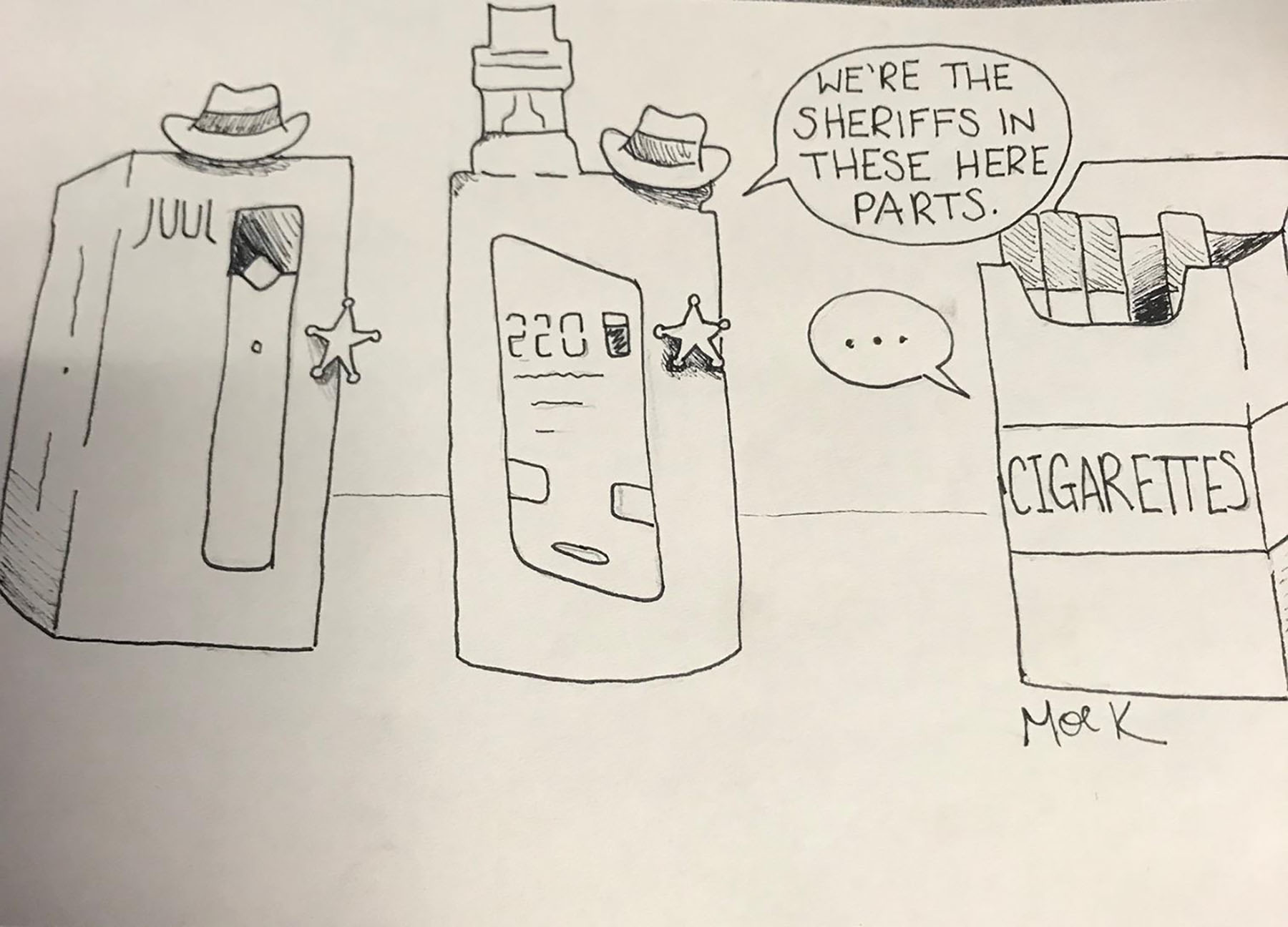
Illustrated by Molly K.
“I don’t think there’s enough research; it’s probably just as bad [as smoking a cigarette],” Mrs. Gladkowski said. “I think even some of the research is saying there’s even more chemicals, [it’s] possibly worse.”
While nicotine is a concern in vaping, it’s not the only chemical to be worried about. Cancer causing ingredients found in antifreezes are found in vapes along with diacetyl, a flavoring agent that causes popcorn lung when inhaled.
“Just getting the education out there, posters, texts, emails and getting the public aware, like a wellness program [is the best way to address the issue],” Gladkowski said.
Vaping and e-cigarettes can not only affect overall health quality, but school performance as well.
“Nicotine can affect concentration, it can cause irritability if you get addicted to it, mood swings and that type of thing which would ultimately affect a student’s work ethic,” she said.
The problem with vaping is widely a teen issue due to the discreet design and fun flavors. Teachers around the country have seen it taking place in school and districts are using new technology to stop it. Plainedge High School in Long Island, NY has installed vape detectors in bathrooms.
“I think there’s definitely a wider use of vaping, and not so much vaping in school because the smoke is so evident, but I think more so with Juuls it’s easier to keep that hidden,” Principal Mr. David Zilli said.
A 2016 report from the US Surgeon General stated a 900 percent increase in usage of e-cigarettes in teens from 2011 to 2015.
“We’re hoping to continue to gather knowledge and information to share with students about the real facts of it,” Mr. Zilli said.
This aim to inform students of the dangers of vaping could be due to campaigns like Truth, an anti-smoking program. According to the U.S. Department of Health and Human Services, only 6 percent of high school seniors smoked cigarettes daily in 2016 as opposed to 1995 where that number was 25 percent. Though these campaigns have seen a significant decline in teenage smoking rates, it seems like a classic “be-careful-what-you-wish-for” situation as teens turn to vapes.
“If there’s harms and dangers out there that are evidenced based, it’s our responsibility to inform students,” Zilli said. “Yes we want to educate students academically, but we also want to educate them socially, emotionally and physically as well.”
Though peer pressure or rebellion are possible reasons as to why a student would start smoking or vaping, their environment outside of school could be a factor as well. According to the Center for Disease Control, 2011 to 2013 data showed that food service and accomodation employees are the most prevalent smokers. This could be a part time job for many students.
“I worked at a restaurant for five years and everybody that I worked with all smoked,” Health teacher Ms. Alyssa Palenchar said. “They were all taking smoking breaks so I would say that has some sort of influence on the person.”
Ms. Palenchar believes that by making these things so convenient to use, they aren’t helping smokers quit.
“I think that it’s just an excuse for people to keep going,” Palenchar said. “It’s not really helping them stop, it’s just helping them get around the ways of doing [it] that cigarettes can’t [offer].”
With people continuing to think vaping is healthier than smoking, she sees the trend continuing as ways to get the nicotine advance. However, the information will grow as well and due to the success of anti-smoking campaigns, one is bound to see vapes being addressed.
“Doing these certain campaigns and having teachers and students go out there and promote non-smoking and activities you can do without smoking is a way to help,” Palenchar said.
Students are influenced by classmates and friends which is why peer pressure is a huge factor. This means that if vaping continues at school, the cycle won’t stop.
“More and more kids are going to get to the high school and they’re going to see that kids are vaping and they think that they need to vape to fit it so they’re going to do it,” senior Noah Roach said.
While he doesn’t feel pressure from companies via ads or commercials, he still sees it around him.
“I don’t know how they really can [address it] because kids aren’t going to listen,” Roach said.
Senior Mackenzie Soriano has noticed its prevalence among users and doesn’t see it stopping.
“They came out with the vape pen and then they came out with the juuls, like it’s not going to stop,” Soriano said. “They’re just going to start making new things so the industries can continue.”
With the appearance of vape shops around the area and even in the mall around teens and kids, it’s not a secret that it’s an increasing production.
“I feel like that’s unnecessary to have that in the mall,” she said. “They don’t even have doors, you just see people vaping in there. They want kids to see you vaping.”
She feels that it’s an issue worth addressing in school.
“I think they need to hold an assembly and tell kids why it’s not a good idea,” Soriano said. “Why do you want a nicotine addiction? You’re 17.”
The Great Dress Code Debate has roots dating back to 1969 when students showed up to school wearing black armbands to protest the controversial Vietnam War. However in today’s day and age, the conversation has shifted. Every year, schools around the country face backlash for their dress codes as students cite unfair or discriminatory treatment.
“I don’t know that we’ve had anyone [feel] unfairly targeted,” Principal Mr. David Zilli said. “We try to inform them we’re trying to maintain a sense of safety here and if that means addressing something, it’s not about who they are, it’s about what they have on.”
Mr. Zilli believes that GS is lenient with what students are allowed to wear and realizes it’s also a matter of accessibility with what students are able and want to buy.
“We’ve always been understanding of what the current trends are in clothing but also need to understand there are some parameters in terms of making sure students are covered,” Zilli said. “There were days in the past when shorts had to be fingertip length and we just know those types of clothing can’t really be purchased that much anymore. We’re not looking for parents to go out and buy a completely separate line of clothing for their students to come to school.”
While the goal of a dress code can be argued – whether it’s to promote professionalism and safety or restrict expression – schools can agree on wanting the focus to be on learning.
“I think what we’re looking at is to be respectful of self and others,” he said. “We could enforce dress code all day, every day and our goal here is for students to learn and walk away from here future ready, prepared for the world beyond GS.”
The Alameda Unified School District (AUSD) in Alameda, California has instituted an “anti-dress code” that begins with, “students can wear.” It goes on to allow students to wear articles of clothing that may be an issue at other schools including midriff baring shirts, yoga pants and hats.
“We believe these changes will reduce inequitable and unnecessary discipline and help us maximize learning time,” AUSD Chief Academic Officer Steven Fong told Teen Vogue.
This “anti-rule” could be in response to the multiple instances of students feeling like the dress code was being used to discriminate against them due to other factors like their race, gender or religious beliefs. The scandals are countless and seemingly out of hand, spanning from a Texas dress code violation video showcasing exclusively female students to an African American student facing the police after not removing a bandana.
“I usually vouch for the students that are getting in trouble for their clothes because honestly, I don’t think it’s that big of a deal,” senior Kenny Shea said.
Shea doesn’t see a controversy about the dress code at GS and has never had a problem with it.
“It’s not like anyone gets in a lot of trouble for not dressing appropriately,” he said. “The only thing that really happens is that they ask you to change.”
Solving dress code violations and the discussion of school uniforms go hand-in-hand, but that doesn’t always seem like a viable solution.
“I’d rather express myself through my clothes,” Shea said.
GS students show their style
While he has few qualms about it, other students are frustrated.
“There were a lot of other people with no straps at all, so bare shoulder, or shorts that were extremely high,” senior Christine Holcombe said when she explained how she felt unfairly treated because of her shirt straps. “It’s kind of like, ‘What am I doing wrong? Why don’t I get accepted?’”
Even though Holcombe can feel defeated by the dress code, she acknowledges that it isn’t all bad.
“I feel like it’s a good rule to have some type of dress code regulation but we need to expand it a little bit,” she said. “When we have extremely hot days, we’re going to want to wear tank tops because it’s so hot.”
While GS aims to keep the focus on education and not the dress code, it doesn’t always seem that way to the students.
“I was already being pulled [from class] for something but then they stopped me before I could even get out the door and said, ‘You need to change and if you don’t change, you cannot go back to class or you have to put something on top,’” Holcombe said. “I ended up having to wear a jacket for the rest of the afternoon.”
She has also noticed differences in dress coding between genders.
“Guys, their shirts, can be more inappropriate with the designs,” Holcombe said. “I see different people walking around with guns on their shirts [but] with girls, I feel like it’s a lot different.”
Though the dress code may never be perfect, the goal is to strengthen the attention on education for all students.
“There’s definitely some good parts about it because some people are very inappropriately dressed,” she said. “I think that’s a good part that we do have a dress code in place but I think it needs to be revised.”







 The Lions' Den