Closed up

By: Kimberly Gray

Greensburg Salem, like many other school districts, shut down in school learning in favor of virtual learning due to COVID-19. But there was more going on behind the scenes that could have a serious effect on students,

             “We monitored how students can effectively social distance within the buildings,” Director of Secondary Education Dr. Ken Bissell said. “Also, the numbers that were coming in from the county, as far as numbers of cases in the buildings. I know we drew a line that if we had five teachers that were out whether it was for a positive test result, or because they were forced to quarantine, we were going to shut down.”

            With a whirlwind of information coming from many different news outlets, it can be hard for people to decipher what is factual and what is not. However, decision makers, like the GS administration, have to take information from the top.

            “We’re using state and county mandates and suggestions,” Dr. Bissell said. “As well as Department of Education and Department of Health guidelines.”

            While some students are doing fine with the transition to virtual learning, others are not.

            “I feel overwhelmed by the amount I have to do, which stresses me out,” freshman Sarah Faulk said. “When I stress out, I get less done and then more piles up and then I get more stressed and it just snowballs from there.”  

            Not being in school affects more than assignments and stress levels. There have been missed opportunities as well.

            “I planned to run cross country for the first time this year after doing track last year and I was really looking forward to it, but my parents would not permit me to run because they didn’t want me having any unnecessary contact,” senior Ella Johnson said. “Also, I do mock trial and we have to do all of our trials completely online which is really challenging to adjust to.”

            Not everyone agrees with the decisions that the GS administration made, and they made their voices heard.

“We received pushback form both sides,” Bissell said. “From closing, many people said ‘We want our kids in the building’ for many different reasons. We also had many people pushing us that we weren’t closing on time. I think that whatever decision we made there was going to be push back.”

The climate is still changing

By: Kimberly Gray

Climate change was a popular conversation that got dropped due to COVID-19 news and then by the 2020 election. But, that does not mean that it is no longer an issue. Climate change is still a problem, even if it is not at the top of everyone’s list.

            Climate change will affect everyone in a negative way if it is not controlled. This is not limited to hotter summers and colder winters. It goes beyond these events.

            “The climate affects our everyday lives,” junior Ecology Club member Alyssa Angiolieri said. “An example would be a farmer needs rain to grow his crops. When the climate starts changing and there is no rain, then there are no crops. This year’s harvest for farmers was terrible because we didn’t have a lot of rain this year. No crops means no food for us and no rain means our ecosystems can become damaged.”  

            People who are concerned about climate change will be glad to hear of a piece of legislation that could help lessen the effects of climate change in coming years. It is called the Green New Deal.

            The Green New Deal was proposed by Representative Alexandria Ocasio-Cortez (AOC) of New York, to help the United States reduce its carbon footprint in coming years.

            “The primary climate change goal is to reach net-zero greenhouse emissions in a decade,” Jessica McDonald, a writer for factcheck.org, a non-profit organization that works to monitor factual accuracy to consumers said. “’Net-zero’ means that after tallying up all the greenhouse gases that are released and subtracting those that are sequestered, or removed, there is no net addition to the atmosphere.”

            While net zero greenhouse gases for the United States is the main goal of the Green New Deal, this is not the only goal in mind. Within 10 years, the Green New Deal hopes to secure healthy food for low-income communities, invest in infrastructure, create jobs within the renewable energy field and reduce air and water pollution.

            “I love almost everything about AOC’s ‘Green New Deal’,” Angiolieri said. “I think if it were enforced it would be very effective. We need to convert to clean energy which is one of her goals. Part of the deal is to also restore ecosystems which is also just as important. Using non-renewable energies damages ecosystem and, as mentioned before, affects climate change.”

            Not everyone agrees that the world is in crisis due to the changing climate. Some scientists do not think that humans are the ones to cause climate change.

            “A report found more than 1,000 scientists who disagreed that humans are primarily responsible for global climate change,” Encyclopedia Britannica reported. “The research on 11,944 studies actually found that only 3,974 even expressed a view on the issue. Of those, just 64 (1.6%) said humans are the main cause.”  

Not all the news is bad. With COVID-19 flooding main-stream media outlets, some new advancements that have been made did not receive much media attention

“There was a satellite that was launched to monitor and collect data on rising sea levels,” science teacher Mr. Angelo Testa said. “This will help us understand the influence climate change has on rising sea levels.  This was a collaboration of US and European effort to help us understand the effects of climate change on a global level.”  

While technological advancements are what are going to effect the most change, individuals can make an effort as well.

“Some ways people can help is by switching little things,” sophomore Rory Damico said. “Like, instead of driving the five minutes to school or work, walk or ride a bike. If it’s raining, ride a bus. If you don’t want to do those, carpool with some friends. If there are less cars on the road, there will be less carbon emitting into the air. Small things like that are how you can help.”

Covid-19 affects volunteering and donating

By: Sierra Hauer

   Because of the Coronavirus pandemic this year, many people have had to turn to alternative methods to volunteer and donate.

giving tree
The guidance counselors wrapped gifts for the Giving Tree. Photo courtesy: Jeremy Lenzi

   Times have been tough for everyone, but some people still want to do their part by donating what they can and volunteering as much as possible. However, regulations set to protect against Covid-19 have made these activities hard to do.

   “For me, personally, I have not seen many volunteer opportunities,” senior Ally Brumley said. “I coach youth cheer every year and that was canceled. At the New Haven Court at Linwood, no volunteers are allowed in.”

   Many volunteer opportunities have been canceled because of Covid-19, but there are many ways that people can still help.

   “I think that people who were already struggling to provide for their families have been affected the most by Covid-19,” senior National Honor Society Vice President Ella Johnson said. “Because many people have lost their jobs and aren’t getting the same wages that they used to, the number of people in need has risen. I feel like homeless shelters aren’t getting enough attention.”

   While there are many new restrictions, food banks are still operating and need volunteers. And there are plenty of other things that people can do to help the community.

   “I know it’s cliché, but I think charity begins in our own homes,” librarian Mrs. Carrie Vottero said. “We can all help out and be kind and empathetic to the people we live with. Something as simple as checking on your neighbor, calling a friend and making sure they don’t need anything or speaking with someone you know who might be lonely and isolated. We all need to be taking care of each other.”

   Along with reaching out to those closest to someone, it is always a good idea to send a little bit of love to those who need it. Seniors in nursing homes are particularly isolated right now.

   “I think that sending letters to nursing homes can help because they are unable to see their families right now or other people in the home,” senior Jenna Stillitano said. “They need some joy in their lives.”

   Elderly people specifically are much more vulnerable to Covid-19, so volunteering has been very strict. However, community members could always make cards and write letters to brighten up the days of those in nursing homes.

   “So many [nursing home] residents are upset or confused as to why they aren’t able to see their families,” Brumley said. “Little things truly are making their days. A simple card would genuinely mean so much to them.”

   Simple gestures as small as sending a card have been cheering people up all year long. Volunteering and donating usually spreads lots of cheer, as well.

   “The holidays are always a big time for donating and volunteering specifically because there are less fortunate people in the world that need help or a little extra holiday spirit,” Brumley said. “And this year it is so important because there is no sense of normalcy.”

stocking stuffers
National Honor Society Vice President Ella Johnson collected stocking stuffers for the Giving Tree. Photo courtesy: Ella Johnson

   Helping those in need always tends to make people feel better, especially nowadays.

   “Being kind feels good,” Mrs. Vottero said. “There is great satisfaction in helping someone else. This pandemic makes me feel helpless and unable to control my world. Helping someone else makes me feel as if I have some control over what happens to me and someone I love. For me, helping someone else makes me feel as if I can do something, at least in my small corner of the world, to make the world a better place.”

Deck the halls with video calls

By: Sierra Hauer

   As Covid-19 cases rise this holiday season, families must think outside the box to safely spend time with each other.

tree
Decorating inside with family is a safe way to introduce the holiday spirit. Photo by: Sierra Hauer

   Thanks to technology, spending time with family is more accessible than ever. In order to avoid any risks of spreading the virus, family members of all ages and in all areas can video call one another.

   “We have been using Zoom in my family,” art teacher Mrs. Kelley Audia said. “We used it to celebrate Thanksgiving. I was with my immediate family and we video-called people.”

   Staying at home with just immediate family can greatly reduce the risk of catching or spreading Covid-19. Even though some people might not prefer video calls, it is one option to keep in contact with others.

   “I don’t like video calls, but it is better than nothing,” junior Evelyn Swanson said. “I’m glad that since we can’t visit, we can at least see each other and talk.”

   Many families have had to adapt the way they celebrate this year and Zoom makes a good alternative for meeting in person. They can stay at home and do similar activities, like watch movies, listen to Christmas music or bake cookies.

   “Because we can’t do our normal traditions for Christmas, Zoom calls and Facetime become the next best thing,” sophomore Glenn Willcox said.

   Video calling and social distancing have also provided a way to somewhat preserve old traditions.

   “We are doing everything that we usually do that we can do at home,” Swanson said. “We have been decorating, painting ornaments and baking.”

cookies
Baking cookies is a safe and easy way to bring joy this holiday season. Photo by: Sierra Hauer

   New traditions have also had the opportunity to arise.

   “We’ve had a lot of campfires and been outside a lot,” Mrs. Audia said. “That’s been a tradition that we’ve started doing this year because we can be socially distanced and not have to bring everyone inside.”

   If families are planning to get together during the holidays this year, there are many things that they can do to minimize the risk of contracting the virus.

   “If people plan to visit their loved ones this year, I think that they should wear masks and try not to stay long,” Audia said.

   Overall, there are many ways that people can interact with loved ones without endangering anyone.

   “I just hope that everyone is careful and does their part to keep the community safe,” Audia said.

Covid-19 forces schools to go fully remote

By: Sierra Hauer

   As local cases of Covid-19 rise, schools in the area have been forced to close down and go fully remote.

remote learning pic
Junior Hannah Schweiger uses Microsoft Teams for remote learning. Photo courtesy: Hannah Schweiger

   GS schools have been as fortunate as possible during the Coronavirus pandemic, but no one knows what the future holds. The elementary schools have gone fully remote twice and the entire district is fully remote until at least January 4th. With the uncertainties surrounding Covid-19, many people have started to worry and speculate how long the hybrid system will last.

   “I think that we should honestly close [all schools] if we want to stop the spread of the virus,” freshman Drezden Gesalman said.

   With cases rising in Westmoreland County, there is a possibility of all schools shutting down. Schools like Yough and Greater Latrobe have already gone fully remote during the spike in cases, and they will remain online until their county statistics show two weeks of “Moderate” transmission rates.

   GS had to make a similar call when they decided to go fully remote until at least the end of Christmas Break.

   “There were several data points to examine when looking at that decision,” administrator Dr. Gary Peiffer said. “These factors include the most recent number of positive Covid-19 cases per 100,000 in our county, the positivity rate of Covid from PCR tests which indicate the rate the virus is spreading, the numbers of positive tests among our students and faculty and the number of faculty who have to quarantine due to being in close contact with a positive case.”

   Many factors dictate whether or not GS schools can stay hybrid or not, but one of the most important ones is attendance. If there are too many students and staff at home, it can be difficult to keep the schools open. It is challenging to find enough ways to cover the classes of a teacher who is home quarantining. However, it’s better to be safe and quarantine if there is a possibility of having been in contact with a positive case than risking spreading the virus even more.

   “I think that we should be remote [because of] the number of cases in tech schools because kids hang out with lots of other people and are capable of spreading Covid-19 unnoticed,” senior Kassidy Sullenburger said. “On top of that, there are probably more cases than we think because not everyone shows symptoms and that puts everyone at risk.”

   Asymptomatic patients are difficult to detect, which is definitely not a good thing when dealing with a highly contagious virus. People may be carrying Covid-19 and not even know it, so ordinary precautions like masks may not be enough.

   Similarly, teaching children to wear a mask and stay six feet apart is a challenge, so it did not surprise some to hear that Metzgar Elementary had to close for a week in October due to cases within the school.

   “Maybe it should remain closed because the little kids aren’t always capable of understanding the complicated things happening right now, so they’ll continue to spread it,” Sullenburger said.

   It can be a challenge to understand the risks of Covid-19 at any age, especially that young. However, there are many advantages and disadvantages to keeping children out of school for safety.

   Especially for high schoolers, online school can be tedious and confusing.

   “I believe that it is difficult to get ahold of teachers because everyone is online at different times,” Gesalman said. “If I were to message a teacher and say they wouldn’t respond for an hour, then I may log off and get an answer in the morning. For some students and I, it’s been hard to explain to myself and receive directions over the computer.”

   Communication has been difficult for some teachers as well because they may have a hard time reaching some students.

   “It is more difficult [to get in touch with students],” chemistry teacher Mrs. Tammy Elliott said. “It is much easier when you see students in class every day to check in with them or remind them of assignments. Now, I can send chat messages and it may take hours for them to respond, and sometimes they never do.”

   Communication isn’t the only issue regarding online school, though.

   “It’s harder to do my tech classes because sometimes I don’t have the materials I need to do the work I need to do,” Sullenburger said. “Tech kids are struggling heavily right now because we have classes that make virtual learning impossible.”

   While GS schools may be fully remote right now, classes offered at the Central Westmoreland Career and Technology Center are still being held in person, as well as online. As long as a student has transportation to and from the high school, they can attend the in-person classes at CWCTC.

   “If we can drive there we are allowed to go, but f we can’t we have google classroom stuff that has all of our assignments, projects and attendance,” Sullenburger said.

cropped google classroom pic
GS students already have to navigate between Teams, Onenote and Moodle, but some CTC students must also use Google Classroom for their classes. Photo courtesy: Kassidy Sullenburger

   Even fully remote students can agree that some classes are more challenging to do online.

   “I think there are definitely classes that are harder to do online,” junior Hannah Schweiger said. “I think pottery is definitely one of them because most people don’t have the materials for it and if they don’t have a license and their parents work and can’t get off, it can be difficult going to the school a lot to get stuff or drop stuff off. I also think classes like chorus, child development and drama could be harder to do online.”

   Despite how challenging a course may be, some students just might need a little extra support with online instruction. There are many distractions outside of a school setting, and most teachers understand that it isn’t always as easy to learn online.

   “I think it depends on the student,” Mrs. Elliott said. “Many students do very well with working and learning independently, setting their own schedule and getting their work done. However, there are students who are social learners who need or prefer the interaction and group work. That is what motivates them to learn, and so far it is harder for them to be remote.”

   Sports and afterschool activities would also be greatly affected by going fully remote. If there are too many cases, there is a chance that the activities will be canceled.

   “Different after school activities have been affected in different ways,” Dr. Peiffer said. “Many activities were postponed or canceled. Coaches and sponsors have been thinking out of the box to provide extra-curricular activities for students while adhering to the guidelines established by the Pennsylvania Department of Health.”

   In general, going fully remote might make some classes a struggle to do. However, health and safety remain a priority for most staff, students and parents, so they are willing to deal with a little bit of discomfort.

   “Overall if classes do get shut down (in person), there will have to be ways to accommodate every class and if the school doesn’t get shut down there will have to be changes made to keep it safe for every student and teacher,” Schweiger said. 

GS football team wins 700

By: Sierra Hauer

   Despite numerous new regulations set in place because of Covid-19, GS’ football team was able to make history.

700 sign pic
The GS football team changes their career victories sign after their historic 700th win. Photo by: Kimberly Gray

   After ending last year’s season at 699 wins, the team was set on making 700. On Sept. 18, the team won 13-12 against the Knoch Knights, making them the fifth WPIAL team to join the 700-wins-club.

   “I was so excited,” junior Billy McChesney said. “It was really amazing because the whole city can get behind it. Milestone victories like that do not happen very often, and when they do, it seems like everyone who ever played for Greensburg has a small part in that accomplishment.”

   McChesney stated that it was one of the most memorable games he’d ever played, and that probably goes the same for most of his teammates. Making the night even more memorable for him, though, was the fact that he was nominated for player of the week because of his performance in the game.

   “My favorite moment of the season was probably the win against Knoch,” senior Alex Briggs said. “The season didn’t go as we planned, and we didn’t have as much success as we wanted… but there are many games that we can be proud of.”

   Briggs was one of the captains for this year’s season, so it was essential for him to motivate and rally his teammates. Even though they lost six out of seven games, the team played fiercely and to the best of their abilities.

   “Some of our best games we played were against our best competition, so that’s something I really liked about the season,” Briggs said.

   The football team gave this bizarre season their all, and sometimes that was tough. Many regulations were set to keep everyone safe from Covid-19, but those regulations influenced the team.

   “There were many regulations set early on that set us back,” McChesney said. “One of the biggest setbacks that had an impact throughout the year was the limited use of the weight room.”

   Not being able to use the weight room to its full capacity made a major impact on the season because all athletes need to train and practice to not only improve their performance and prevent injury, but to build a bond between players as well.

   “The weight room also helps with team bonding,” McChesney said. “In a normal season, you would spend two hours a day, four days a week with your team. This helps get the team and the new players closer as a unit. Football is a team sport, and the better friends the teammates are off the field, the better they will play on the field together.”

   Communication was a key part of making the season go as smoothly as possible as well.

   “We had to do zoom calls at the beginning of quarantine,” senior Joey McGough said. “It actually worked out because we were able to discuss plays and bond with each other.”

   Even though the team was able to discuss what they needed to in order to play, some gaps remained within the energy of the team.

   “I’d say the energy was different, and the focus was the same,” Briggs said. “The energy was different because everyone plays for a different reason. Some people play for fans while others play for a chance to play for colleges. Whatever their reason might be, some people just weren’t as excited to play as they should’ve been.”

   While not having the support of the Salem Psychos for some games impacted the environment of the games, the players didn’t let it influence their performances on the field.

   “It’s nice to have fans and to be able to see people having a good time, but at the end of the day, it didn’t change the outcome of the games,” McGough said.

   While everyone was thankful to be there and did their best to adjust to everchanging rules and guidelines for attending the games, there was some hesitation. The number of Covid-19 cases in the area was thankfully low enough that the sport was never canceled, but the thought certainly crossed the minds of both players and spectators.

   However, the threat of each game being their last never phased the team. Likewise, the new changes and regulations never stopped them. They persevered through it all and managed to land that historic 700th win.

   “I wasn’t worried about the season being canceled because I knew that regardless we had to go out and play like every game was our last because any game could be,” Briggs said.

scoreboard pic
The GS football team celebrates on the field after their 700th win. Photo by: Kimberly Gray

Two Sides of the Same Needle

To vaccinate or not to vaccinate? That is the question. Among students and adults, everyone has their own opinion about what’s right.

   Winter is upon us, and as the snow falls outside, students are falling out of classrooms due to sickness.
  

The Center for Disease Control and Prevention (CDC) recommends that the flu vaccine is administered before the flu season begins. The season for the influenza virus can stretch from November to May, but peaks in the winter months, December through February. While the flu vaccine is one of the most well-known vaccines, there are others that are just as important.
  

“[Some of the most common vaccines are] MCV, MMR, polio, chicken pox, the flu and pneumonia,” School Nurse Miss Amanda Cogley said.

   The meningococcal vaccine (MCV) prevents meningitis, which is an infection of the brain and spinal cord, and may cause blood infections. The measles, mumps and rubella vaccine (MMR) contains weakened forms of the measles, mumps and rubella viruses. Getting vaccinated helps the human body protect against diseases. Mrs. Julie Firmstone, a high school science teacher, explained how a vaccine works.
  

School nurse Miss Amanda Cogley works diligently each day to ensure students are safe and healthy. Photo by: Delaney Bortz

“The basics of it is that it’s a weakened or dead form of whatever that virus is,” Mrs. Firmstone said. “When they put it in your body, your body recognizes it as foreign and forms a response to those foreign entities, so the next time they’re exposed they can react better to them. They can react faster to them.”
  

While receiving a vaccination greatly lessens the chance of contracting a disease, it can’t guarantee that it won’t be contracted. Senior Sydney Tressler doesn’t believe in vaccinations and is worried about the chance of contracting the disease.
   

“They inject the live virus into you with the live vaccines,” Tressler said. “Not all of them are like that, but most of them are live vaccines. They give you the live virus, which makes you sick.”
  

If there is no vaccination received, no symptoms may show up, but the disease may have still been caught.

   “If you’re not vaccinated you have a greater risk of getting that [disease],” Firmstone said. “Not that it’s 100%- you could go your whole life and never get chicken pox without the vaccine. If you do get it, some viruses can lay dormant in a person for a period of time, and then when they begin to express themselves from stress or something, another virus, or whatever else affects it, you may still not know. Therefore, you could be at risk to be contagious for a period of time. If other people aren’t vaccinated, it could affect a lot more people.”
  

Even when you get a vaccination, it may not stop the disease from spreading.
  

“Things like the flu aren’t necessarily [stopped] because there are so many different strains of them,” Firmstone said. “There’s a gamble every year with the flu vaccine to really guess which one. The CDC and the World Health Organization, the WHO, they have to track the flu the whole year prior to figure out what form of the vaccine they should give, which version of the flu vaccine should we predict will be affecting this region. Even different regions of the Earth could have different vaccines for that year.”
  

Senior Alexa Cuccia doesn’t support the use of vaccines due to the fact that she has had some of the diseases that vaccines protect against, and is all right.
  

“I actually had whooping cough, I had chicken pox, I’m alive and I’m fine,” Cuccia said. “I did not get whooping cough from someone unvaccinated. People [who are] vaccinated get whooping cough. There are people who have gotten chicken pox who are vaccinated. Do you know why? Because when you get the vaccination, they’re putting that disease in you. You could get [the disease] from the vaccine. Someone [could] get vaccinated with the flu shot and come near me and just give it to me because they’re literally walking around with the virus.”
 

Non-vaccinated students may make others fearful for how it affects their own health. Photo by: Delaney Bortz

  When vaccinations are occurring, it lessens the chance of somebody contracting a disease. If enough people don’t receive a vaccination, it can hurt the rest of the population.

   “Once 30% of the population is not vaccinated, it decreases what’s called herd immunity,” Cogely said.
   

According to vaccines.gov, herd immunity is when people get vaccinated and prevent the disease from traveling through a population. This prevents an outbreak in a community and makes everyone living there less likely to get the disease. Cuccia believes that people are protected through herd immunity and don’t have to receive vaccines.
   

“The only way to actually be protected forever is natural immunity,” she said. “If you read about it, it says how many times you have to get your vaccines updated through life because it’s not natural. If you get that natural immunity, you have it for life.”
  

There are many reasons that someone would choose to waive a vaccination, though.
  

  “Either it goes against their religious beliefs, or they have a moral objection to them,” Cogely said.
  

 Some of the moral objection to vaccinations comes from the belief that they cause autism. The debate on whether or not vaccinations can cause autism was caused by a study by Andrew Wakefield and twelve colleagues in 1998. They studied 12 children and said that all 12 showed signs of developmental issues after exposure to the MMR vaccine. Nine were eventually diagnosed with autism.

    Further studies into the vaccination later refuted the claims that vaccines cause autism, and 10 of the 12 others who worked on the paper retracted their statements. The retraction was because the data was insufficient and that no link was found. The paper was completely retracted in 2010 and was admitted to be incorrect and contradict with former investigations. Despite the paper being disproven, the research still discouraged people from getting vaccinated.
  

“I know a lot of people feel that it has an increased risk of autism,” Cogely said. “They [also] feel that herd immunity will prevent them from [getting it]. And fear of possible long-term effects.”

Flu vaccines at local chain pharmacies make it easier for more people to get vaccinated. Photo by: Delaney Bortz

   Despite so many people receiving a vaccination, there may not be as much research on the topic as there should be.
    

“With literally every other drug or medicine they do a placebo trial,” Cuccia said. “Someone’s given a drug that’s not a real drug, and then they give one that is real. With vaccines, there is not that safety testing done. There is literally nothing done on that at all. But why not? Why do they refuse to do that trial? Get the non-vaccinated kids, get the vaccinated kids, do a study of them through their life and see which is healthier.”

    The possible lack of research into vaccines can also cause the material to not be taught well to students hoping to be in the medical field.

    “I’m doing my senior project on vaccines so I’ve been interviewing holistic doctors, who come with more of a natural approach, and I’ve interviewed a medical doctor, too,” Cuccia said. “I asked him how much he got taught about vaccines in [his] schooling, and he said ‘nothing at all really. We just get told that vaccines are good and this is what you give to your kid,’ and that’s all they’re told in school.”

   Tressler has researched vaccines and is very well informed on the concepts. One of the things that she wrote about was the number of chemicals in a vaccination.

    “I did my senior research paper on [vaccines], and nobody knows about anything that’s in a vaccine,” Tressler said. “There [are] so many different extreme chemicals that can harm your body like formaldehyde and mercury. People always say vaccines don’t cause autism [and] they don’t, but they contribute to it because if there’s extreme amounts of mercury, [and] you keep getting different shots over and over again the amount of mercury in them affects your brain. There are so many cases where right after someone’s child was vaccinated, literally 24 hours later they were showing signs of autism.”

    While there may be a link to autism through certain vaccinations, there are ways to still be protected and avoid the possible risks of being vaccinated.

   “I’m a mom, so I understand the risks and I know that there is some research that shows a link between certain types of autism and things with vaccines,” Firmstone said. “As a scientist, though, I did research on it and found that you can opt to separate out the vaccines so you don’t get them all at once which is one of the risks supposedly associated with the increased chance of having autism.”

    When parents don’t vaccinate their children who are attending school because of these fears, it can lead to consequences for not just their children, but others in the classroom.

    “I think it has an extreme effect on a student’s progress and their success,” Firmstone said. “I think that it may not be that some students can actually rebound from it, while other students can take a lot longer to rebound. It’s dependant on the student, too. Their work ethic, and things like that. I think it affects every student, in one capacity or another.”

    Even if vaccinations have risks, there are advancements to vaccines to help make them safer and to prevent the spread of diseases.

    “There’s the HPV one that’s to help prevent cervical cancer and certain types of cancers in males,” Firmstone said. “That’s an advancement. I think with the flu vaccine, they are really trying to work hard at getting a better strain, or combination of strains, I think medically they’re doing that. Also, the vaccines possibly coming up for those with AIDS and HIV. There are some studies that there might be some of those in the near future.”

   Even with these advancements in vaccinations, that doesn’t stop people from being wary of anyone who’s not vaccinated.

   “Everyone is scared by the non-vaccine people,” Cuccia said. “I’m not vaccinated, and everyone’s always like oh my god, you’re going to get sicknesses. But my question is if you believe that vaccines work, and you believe that they’re effective, then why are you worried that you’re going to catch something from me? You’re vaccinated, you should be protected.”

   Vaccinations can help prevent diseases, but not everyone thinks they’re the best option for them.

   “People should at least be informed about what’s in them and do research on them before they have an opinion about them,” Tressler said.

Graphic created by: Delaney Bortz

Green (Card) Means Go

As a national discussion, the topic of immigration has spread through our country’s politics as well as the halls of GS.

   A current battle on the United States border is raging, and there doesn’t appear to be a happy ending in site.

   Immigration is a long and hard process that, according to the United Nations’ migration report, affected 258 million people in 2017. There have always been people emigrating to other countries, but most of the public eye in America has been turned to the Mexican/American border where a large group of immigrants is attempting to cross into America without the proper papers. They’re a part of the migrant caravan. Many people have emigrated to America before the migrant caravan, two of which are senior Asher Joy’s parents.

   “My mom came first in 1989, and my dad in 2000,” Joy said.

   They were granted citizenship in 2011 and went through a long process to get the privilege of being an American citizen. They had to learn about American history and culture and pass a test to be accepted into the country.

   “They already knew how to read and write, so that stuff was easy,” Joy said. “They just had to learn about the Constitution, the Bill of Rights, that kind of stuff. [There were other things like] who’s the Senator. There was a test they had to take, I helped them study a little.”

   Despite a cultural climate that isn’t always welcoming to people from other countries, Joy said that her family hasn’t really experienced much discrimination.

   “I know some person where my dad was working didn’t want my dad to serve him because he was not from America,” she said. “Other than that, not really.”

Ellis Island in New York is now used as a museum showing what the immigration process used to be like. Photo by: Delaney Bortz

   While there are legal immigrants to the country, people are attempting to cross the borders into America illegally. While it might be hard to gain citizenship into the United States, not everyone agrees that the regulations to be able to enter the country should be lessened

   “Personally, I feel like my parents had to go through a lot to become citizens and whatnot, and I feel like it shouldn’t be easy to just walk across the border and become a citizen,” Joy said. “I think it has to be fair. At the same time, I don’t think it should be that strict. I know [the people on the Mexican/American border] were living in poverty, and they wanted better lives, so it should be easier for them to gain citizenship.”

   The immigrants on the border who are attempting to enter America have gone through their fair share of tribulations.

   “I don’t really know [much about immigration], but I have heard of the migrant caravan,” junior Lien Ferry said. “There are a bunch of immigrants, and I heard some stories about how they’re treated really harshly, which I don’t agree with.”
   The migrant caravan currently at the border is a large group of people who have traveled more than 2,000 miles from Honduras to reach the Mexican/American border. The migrant caravan may have traveled a long way to reach the border, but there is a lot of controversy on whether they should be let into the United States or not. One opinion is that they should have to return to Honduras and reenter the country the legal way, which can take years.

   “I do believe that [immigration is] a good thing, but it should be done correctly,” sophomore Adam Nichols said. “My ancestors were Italians [and] they came through Ellis Island. They did it the right way. I would like all the current immigrants that come over to do it the right way as well. I don’t want any people coming in illegally.”

   While Ellis Island hasn’t been used for immigration in 60 years, there are ways that people can enter the country with a green card. A green card is a permit allowing people from foreign countries to live and work in the U.S. permanently. The four fastest ways to apply for a green card are to have family already living in the U.S., have a job willing to sponsor you for a work visa and green card, be a refugee or someone seeking asylum in the U.S., or enter the visa lottery for a green card. While these ways can eventually lead to a green card, it can still be hard to obtain one due to America’s immigration policies.

   “I think the U.S. should have policies that help immigration, but at the same time aren’t too lenient,” Joy said. “I think that’s important as well.”
   The fact that it can be hard to obtain a green card is part of the reason so many people enter the country illegally. According to the Pew Research Center, there were 10.7 million unauthorized immigrants in the U.S. in 2016. While that is a big number, it’s only about 3.3% of the U.S.’s total population for that year. The migrant caravan has approximately 8,500 people attempting to enter the U.S. illegally. The conflict isn’t just with the United States. As they’ve moved from Honduras to the Mexican/American border, they crossed through Guatemala, which is the country between Honduras and Mexico. The Mexican authorities claimed that as they passed from Guatemala to Mexico, they attacked their agents with rocks, glass and fireworks. U.S. President Donald Trump addressed the issue in Mexico at a press conference at the beginning of November 2018.

   “They want to throw rocks at our military, our military fights back,” Trump said. “I told them to consider it a rifle. When they throw rocks like what they did to the Mexican military and police, I say consider it a rifle.”

Senior Asher Joy’s mother (in green) when she moved to New York after immigrating. Photo courtesy: Asher Joy

   There were also stones thrown at three border patrol agents on the Mexican/American border, which led to the use of tear gas on the caravan.

   “They were being provoked by [an] aggressive force from the other side, there’s not much they can do, really,” Nichols said. “If you’re getting rocks thrown at you, people can get pretty injured from that. I don’t want to use aggressive force as in guns, because that could kill people and I don’t wish that upon anyone, [but] I don’t know if [using tear gas] was the [nicest] thing to do.”

   When the people attempting to enter America try to cross the border illegally, they are actually committing a crime, even if they’re seeking asylum, and can be subjected to criminal prosecution. If a family is being prosecuted, the children cannot be held in jail, and are given to the Office of Refugee Resettlement (ORR) and wait for the opportunity to live with a relative or sponsor inside the country. This has resulted in the separation of approximately 2,000 children from their families according to the Department of Homeland Security. Many children were traveling with their families and only wanted to be safe and live in nicer conditions, but are still being punished for leaving their home country.

   “You really just shouldn’t come in illegally,” Nichols said. “That’s the wrong thing to do. If they could be sent back as a unit, that’d probably be better. You don’t want to be cruel to people, wish bad things on other people, but they keep coming towards our border because we do have it well here in America. I wish we could help their own country so they could make their own country prosper. Then they wouldn’t have to come over illegally and face all these difficulties.”

   As the border crisis continues, tensions on immigration become more of a problem. The issue with immigration has continually been a dividing factor in the U.S., whether it’s between settlers and natives in the 1500s or conflicts that are affecting people in the modern world. With the United States population being 19% immigrants, the people affected by these issues don’t just live near the border.

   “Just talk about [immigration] more,” Ferry said. “It’s not something you talk about at dinner with your family, but it should be talked about more often, especially since it affects so many people.”

Teaching and Learning

Teachers across the country work second jobs and it’s a combination of salaries and financial situations.

A career in teaching is a passion for many people and having one great teacher can be life-changing; this makes it especially shocking to hear that one in five teachers work second jobs according to Education Week.

   “I work many jobs – some are with the school district and some are not with the school district,” math teacher Mrs. Christine Burkhart explained. “I’m a single mom so I come from a single income household and I have two children in college right now.”

   Thankfully, Burkhart’s teaching career has not caused any conflict with part-time jobs which include retail, SAT proctoring and working detention.

   “Most people for part time jobs are looking for people who are willing to work, they show up on time and they have some availability,” she said.

   However, she does admit to there being occasional strange moments if she happens to work with students.

   “I’ve had former students that are technically ahead of me so I’m going to former students and asking, ‘Hey, how do I return this item?’ or ‘Hey, how do I find this item?’” she said. “I wouldn’t say it’s a problem, it’s just odd.”

   Though she’s able to manage working multiple jobs, it can take a toll on anyone.

   “I think it makes it hard on the teachers because during Christmas time when I’m working a lot at my other part-time job, it becomes, you know you’re tired, we get worn down and sick,” she said. “I understand why teachers have to do it, but it’s hard.”

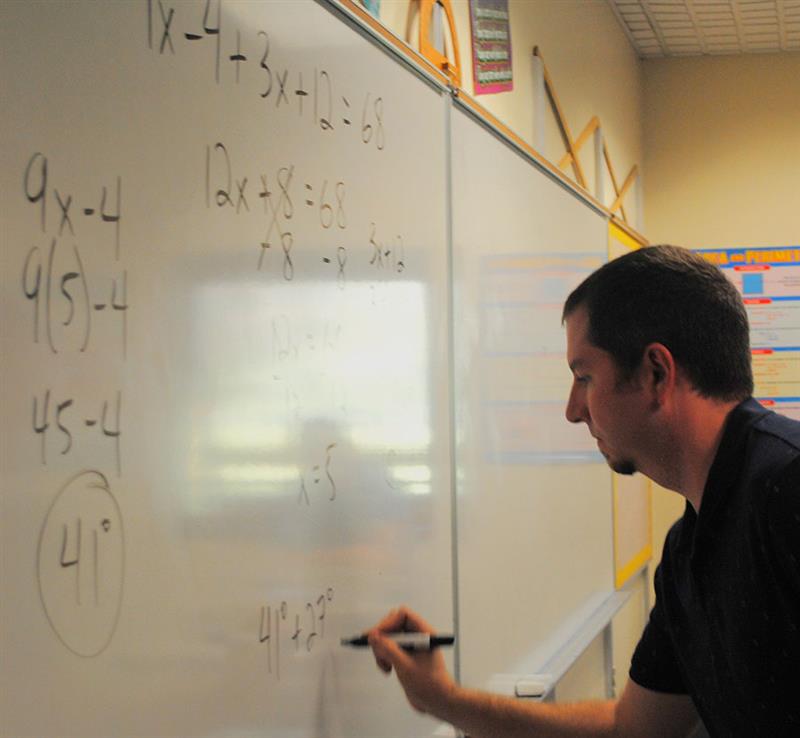
Math teacher Ms. Christine Burkhart writes on the board as she teaches class. Photo by: Emma Skidmore

   However, there are many factors that go in to education finances apart from teacher salaries, including millage rates. A millage rate is the amount of tax on $1,000 of property value. Schools use millage rates to calculate a budget and the current rate in Greensburg is 88.22 for schools. This means for every $1,000, there are about $88 in taxes.

   “I see all sides,” she said. “I actually think our tax system should almost be changed. I think it [the finances] should be discussed because I don’t know that a lot of people understand that the tax base in Greensburg is becoming smaller and smaller. Seton Hill is buying up a lot of property and they don’t pay taxes. Excela Health, the churches – they don’t pay property taxes. Our tax base is being taken down and I don’t think a lot of people know that. I also don’t think people really understand what a mil is. When it gets written in the paper that a school district is raising their millage by two mils, people get upset, but when you actually try to figure out what a mil is, it’s not an awful amount of money.”

  Burkhart also recounted the hiring process and three interviews she went through to eventually be hired at GS.

   “Back in 2001 things were a little bit different,” she said. “There was a little bit more money in the schools and [it was difficult to get a long-term teaching job because] there weren’t a lot of openings in the school districts. Now when teachers are leaving they’re not hiring for that position so that makes it more difficult now for them.”

   Though there are discrepancies in how much a teacher should be paid, it can also be situation-dependent.

   “I don’t know that I will continue working two jobs,” she said. “I’m doing it because for two years, I have two kids in college continuously which is just a big burden. I don’t want to go in to a lot of debt so I’m trying to do these jobs so I don’t go in to debt. Will I continue working all these extra jobs after two more years when my son graduates? Probably not.”

   Nevertheless, being a teacher is still extremely valuable to her.

   “Being inside the classroom actually doing the teaching, I absolutely love it,” she said. “I absolutely love teaching, I love that part of the job. There’s nothing better than that.”

   New hire Mr. Angelo Testa also recounted his interview process and while he doesn’t work a second job during the school year, he does things over the summer to make a little extra money.

   “I guess you could say that compared to other careers, teachers might make less on the average compared to other professions,” Testa said. “[It] might be because of the teacher’s schedule. They do have summers where they could pick up another job or free evenings.”

   Statistically, teachers are the ones who are more likely to work second jobs than other career paths as reported by Dick Startz, an Economics professor at the University of California.

   “The simple solution would be to increase pay,” Testa said. “If teachers were paid more money then I guess there would not be a need to work second jobs. It’s tough because then you’re affecting the entire Greensburg community because you’re increasing wages for teachers and you have to increase taxes. The school only gets so much money, so it’s tough.”

    However, for the teachers at GS, passion will always be more important.

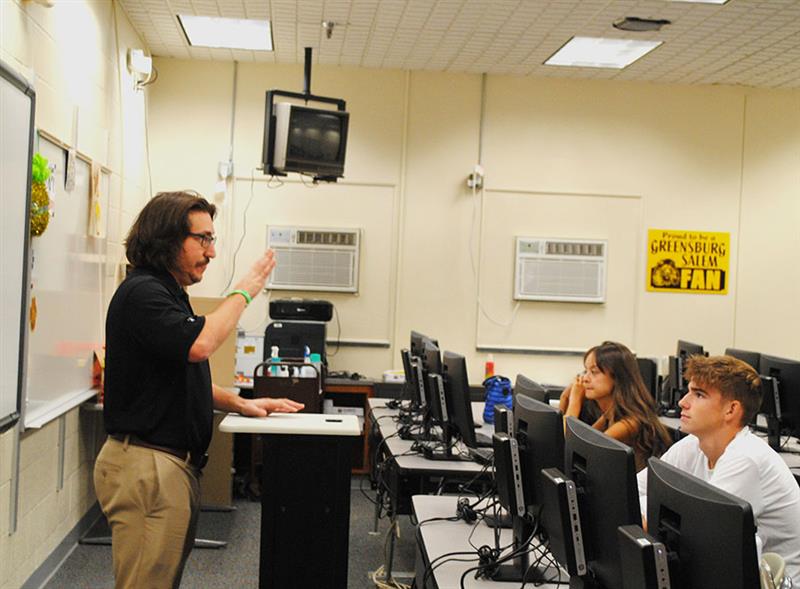
Mr. Angelo Testa teaches his freshman Environment and Ecology class. Photo by: Emma Skidmore

   “Not just teaching but teaching science was my main goal,” Testa said. “Because I like science and because I’m so passionate about science, teaching other people about it and getting them to like it as well is why I wanted to do it.”

   That passion extends outside of the seven hours inside the walls of GS.

   “The scope of a teacher’s job goes beyond the recognized school day,” school board member Mrs. Lynna Thomas said. “Most of the teachers I know devote many hours outside of the classroom – grading papers, putting lessons and assignments together, organizing materials as well as working on professional development and learning so they can continue to stay current on the knowledge in the field.”

   Having worked more than one job herself, Thomas understands how difficult it can sometimes be.

   “I know that it can be mentally and physically tiring to do so,” Thomas said. “While I don’t believe it would necessarily affect their passion for teaching, I think it could affect the time, energy and focus a teacher needs to perform at their very best.”

   From her perspective, the solution is more than just increasing pay.

   “To me, it is not a question of agreeing that salaries should be greater, it is a question of how to find ways to better fund public education so that we do not create such a burden on local taxpayers,” she said.

   She believes that in addition to reforming salaries, teachers could be supported more by encouraging professional growth, listening to their input and placing more value on education overall.

   “It is important to have state and federal support to improve teacher salaries for all teachers in all districts so that we can get closer to paying them what they deserve,” she said. “Right now teachers working in poorer districts are doing the hard work of dealing with students who have many struggles and needs, while having fewer resources available and getting paid less for the work that they are doing. This is not right. There should not be such great discrepancies between poor districts and rich districts.”

  As an integral part of the community, teachers do much more than just teach the curriculum.

   “I think that our society on the whole does not fully understand or value the work that teachers do,” she said. “We entrust teachers to care for our children, to keep them safe, to educate them so that they can become productive members of our communities and care for us in the future. We hold them accountable for students’ social, emotional, moral and intellectual growth.”