Saving Lives on the Sidelines

Friday night lights, salty snacks, soda and students filled with school pride – these are the hallmarks of a high school football game. On the sidelines, however, paramedics stand with their equipment. While fans may only think about an injury in the moment it happens, the lasting effects can be worrisome.

“I think that there obviously needs to be changes throughout the rules from time to time with injuries occuring every so often,” football captain and junior Trent Patrick said. “I do think that schools should look at more proactive ways to finding better ways for students to be protected.”

Just six years ago, 163,670 middle school or high school players were in the emergency room for concussions according to the At Your Own Risk program.

“I think that some of the rules have been changing already and in order for students to maintain that level of safety, I think some of the rules do need to change,” Patrick said. “For instance as we had this week with the early dismissal, I think that needs to be addressed whether to let players on the fields whenever it’s so hot and humid.”

In 2017, the National Federation of State High School Association’s new rule to ban blindside blocks made national news and the guidelines are updated every year.

“I think that our coaches prepare us enough to teach us the right way to do things on and off the field and I feel safe in the equipment we’ve been issued throughout the season,” he said.

With the presence of Athletic Trainers, students are staying even safer.

“The safety protocols for all the sports are pretty standardized now,” Athletic Trainer Miss Barbara Marschik said. “We’re luckily in a day and age where we’re not making it up as we go. The school district is really good at providing those safety policies and we kind of fill in the blanks on the medical side.”

headshot autumn

Senior Tyler Williams stands at football game photo by Autumn B.

While it’s exciting to get new equipment, Miss Marschik feels GS is prepared to handle any issue with what it has now.

“I think the way that the coaches and the administration and us all work together is what makes us such a great team and what makes emergencies go as smoothly as possible when things do happen,” Marschik said.

According to the Huffington Post, schools with Athletic Trainers have lower recurrent injury rates and report more concussions, giving students the care they need and not letting issues go undiagnosed. Marschik treats everything from cuts and bruises to broken bones and rehabilitation.

“You just never know what’s going to come your way so you have to be ready,” she said. “Sometimes we even get to go observe their surgeries so we see them in the moment, but typically once they come back to school or they’re able to ambulate and move again, that’s when we start working with them again. They come see us instead of going to practice and we do rehab and just try to make small improvements every day.”

Not only do the trainers work reactively with students, but they also help them to prepare in order to avoid getting the injury in the first place.

“We really work with the teams a lot in the off season for strength training and hopefully, protect them and their bodies and their awareness of their bodies moving in space before they even hit the field so that they’re stronger and more aware,” Marschik said. “Hopefully we eliminate some of that injury beforehand.”

The responsibility falls on everyone to keep the players safe and Assistant Football coach Mr. Matthew Boe feels the same way.

“Safety, from my perspective, has always been a priority,” Mr. Boe said. “We would have had to be doing something really, really wrong to see a significant change [in rules].”

However, research shows that 90 percent of student athletes sustain some degree of injury while playing their respective sport according to At Your Own Risk.

“It’s a sport that’s physical,” Boe said. “It’s demanding and there is a likelihood of some form of injury. Despite all measures, the likelihood of getting hurt is high.”

Sometimes, coaches and players can do everything possible, but Mother Nature has a different plan.

“For football for example, we have to do a week of heat acclimation,” Boe explained. “That’s essentially in response to several student athletes across the country over the years who [experienced] a shock to the system. And due to that shock, have experienced cardiac arrest or heat stroke or things of that nature.”

At Your Own Risk reported that over 300 young players suffered athletic-related deaths between 2008 and 2015. GS coaches recounted serious injuries they’ve heard of or seen happen.

“There’s a kid from Laurel, I believe, that is kind of a headline in the news due to a spinal injury, a significant spinal injury,” he said. “I think it’s those types of stories that often draw the attention. They don’t see how Tyler Williams [for example] has been predominantly healthy the entire time. You hear about the kid that gets hurt.”

GS Boys’ Assistant Varsity Basketball coach Mr. Andrew LoNigro remembered a particularly stressful time on the court when a student had a seizure during the game.

“It was one of the most real experiences I think, and everyone was concerned,” Mr. LoNigro said. “That prompted some changes on our end as far as the coaching staff went. We constantly questioned if players are okay, how they’re feeling, what medications they were taking and things like that. And the parents gave us some signs we need to look for too,”

He has seen the requirements to coach change throughout the years to ensure player safety as well.

“[There are] certain clearances that every coach must have every year and safety tests that coaches now need to take every year as far as player safety and things like that go,” LoNigro explained.

Like football, basketball presents its own set of safety precautions.

“Players don’t wear any head protection in basketball, so I’ve seen multiple players hit the court head first,” he said. “You have rolled ankles [too], nowadays kids are wearing more low top shoes where in the past with the high tops it would really protect your ankle.”

Safety is also the students’ responsibility. 54 percent of students athletes kept playing despite an injury in order to support their team according to At Your Own Risk.

“If the referee blows the whistle for a player being injured, we take them off the court,” he said. “They have to be evaluated by one of our trainers. Now, where it becomes kind of a judgement call for the coach is if you see a player hit the ground head-first or head to head contact; as a coach we’ve been trained, and now we have to look for signs of concussions.”

Nevertheless, high school sports not only promote team spirit, but learning outside of a classroom.

“I think there’s tremendous value in sports, things such as learning to get through adversity and revealing character when the chips are down and when things aren’t going your way,” LoNigro said. “I played them the whole way through [high school] and that’s why I coach now, to teach those lessons.”


More information can be found at:

www.atyourownrisk.org/studentathletes

Student Security

Change has started for schools all across America to protect the student body from threats that haven’t been seen before.

There have been over 100 mass shootings in the United States since 2018 began, according to Business Insider in an online article on June 28, 2018. Companies around the world are starting to provide students with protective gear to accompany the ongoing threats to schools. While you can decide to purchase protection, schools have started implementing new drills and policies to try to protect their students. These are to help students to be more comfortable and safe in the buildings.

“The best way to protect us all the time, and that’s whether you’re at school, or at a restaurant, or a football game, or a concert, is to be proactive and think ‘alright, what is my easiest exit out of here,’ and how can I keep myself safe if something did happen,” Assistant Principal Dr. Joe Maluchnik said. “It’s not about changing your whole lifestyle, but it’s about being proactive and thinking ahead of what could happen where you’re at.”

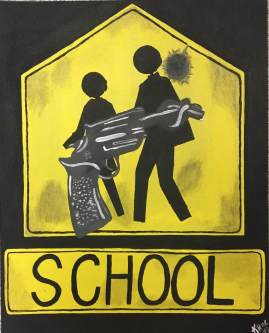
img_36252

Illustrated by Kenzi C.

The Pennsylvania Department of Education requires fire drills to be conducted once a month while school is in session, but only in public schools. Public schools are also required to conduct at least two bus evacuations a year. In addition to the required fire drills, GS has been trying to implement active shooter drills into our regularly scheduled fire drills.

“You have no choice but to continue to plan and prepare,” Dr. Maluchnik said. “All schools are thinking differently than we did 10 or 20 years ago, just like when there used to be a lot of fires in schools. What did schools and other buildings do? They started putting in sprinkler systems, they started putting more fire extinguishers in, doing more fire drills. And since that happened, I believe there hasn’t been a death in a school [from] a fire since the late 1950s or 60s because they’ve put things into place. Hopefully, the safety things that we’ve put into place will decrease those things from happening.”

New drills are definitely a way to help the school stay safer, but there are other ways to keep a school safe.

“We have had executive sessions that discuss safety measures that we are planning to implement,” GS school board member Mrs. Charlotte Kemerer said. “Some of them we cannot discuss because, obviously, we would not want them out in the open for some potential person to understand what we’re doing. Some things have been discussed at budget meetings, like jam locks or the possibility of having a resource officer. While we do know that one is not going to resolve any potential problems at five schools, one is better than none.”

Mrs. Kemerer, as a board member and not a faculty member, isn’t in the school building all the time. Because of this, she doesn’t get to see students every day to see how, and if, they’re taking any steps toward change. She wishes to see more action from the student body outside of the school that’ll make an impact.

In the schools, it’s much easier to see the effect that gun violence can have on students. Mrs. Jackie Yuhas, one of GS’s Chemistry teachers, has seen change among the student body.

“You hear students talking about taking action,” Mrs. Yuhas said. “That never used to be a thought at all. Unfortunately, it’s become part of everyone’s everyday thinking.”

While these events affected the employees of the school and caused a jumpstart in action, students decided to take a stand too. Last year after the devastating shooting in Parkland, Florida, many students rallied with the March for our Lives movement. It drew major attention and the movement continues today, even if people aren’t actively marching. One student who seems to care a lot about student safety is sophomore Lexi Marx. Marx participated in the school-wide walkout with a fair amount of the student body.

“[Students] can be more aware,” Marx said. “They can be into it more. Just care about it.”

Students have opinions on the kind of things that can be added to protect their lives, too. They are not just worried about their grades anymore. When a student starts to see an effort to help keep the school safe being taken, they’re sure to notice.

“We’ve closed a lot of the entrances in the morning, and just in general,” Marx said. “That’s a good step, whether it’s inconvenient or not sometimes. They definitely seem to be more aware of it. We can’t have headphones in the hallways anymore, which I think is smart.”

Teachers are making changes inside the school buildings as well. Many members of the students and staff are changing the way they function on a daily basis, all in an effort to stay safe.

“Everything we do is different,” Yuhas said. “We used to not lock our doors, all the doors are locked now. There’s just a different feeling in the buildings. It’s a different mindset, not only in schools, I think, but in society.”

Students also see ways to help improve the protection of the school, due to knowing the school like the back of their hand, and the student body just as closely.

“I would say [add] metal detectors, or at least some sort of bag search every month at some point,” Marx said. “While we are closing off some of the entrances, that doesn’t mean students can’t still bring things into school.”

Kemerer said that they are looking for students to be more active with their safety, and talked about what was said at a board meeting.

“[They] would like to see students participate,” Kemerer said. “How they feel about something like a metal detector, and I’m not saying we’re getting that, but [Joe Gongaware] discussed that at the school board, but we haven’t had any reaction to that.”

From the standpoint of someone who’s always in the building, Dr. Maluchnik had some different views on what the student body is doing.

“I see students are more concerned,” Maluchnik said. “They care more, they want to give their input more on safety, which is good, and they look out for each other, even. They always did, but students are more apt to come to us if someone looks like they shouldn’t be in the building, [and] they don’t have a pass.”

The bottom line is, Schools are changing. New policies and safety procedures are going into place for the benefit of everyone. Hopefully, this leads to a brighter future for bright individuals.

“I think school is a place where we should go to learn,” Marx said. “Not to think about waking up, going to school, and not coming back.”

To Future Editors…

When you see closing letters on other blogs, final pieces by renowned columnists, or sign-off broadcasts by retiring radio hosts, they usually address their vast audience, talking about their fondest memories and greatest achievements before one last farewell.

But that really wouldn’t make much sense for me. My readership is nonexistent now, and if this site continues to exist in its current form, most readers will likely be future students looking back on the history of the school or the history of the site. Addressing this letter to the present with respect to the past wouldn’t make much sense, now would it?

So, I decided that instead of a farewell letter, I would write to you future editors of  The Lions Den. Mr. Lenzi tells me that, regardless of whether the editors of the paper will make physical copies or not, from this point forward, this site will serve as home to every article written.

As of now: June 1, 2018, gshslionsden.org is in its fetal stage, but it has potential, and there are two things that can actualize it. Those things are love and money. With dedication and love from a team of people, maybe an assigned photographer and thorough team of student editors (I’m sorry, Mr. Lenzi) along with a little bit of cash to buy things like video features could really make this site shine.

Some of the ideas I had with the current site that I never followed through on include:

  • Updating the site’s homepage with seasonal photos
  • Recording the scores of sports games in a separate widget
  • Pairing articles with photo galleries
  • Animated charts
  • Making a custom icon for the site tab

Though these things in themselves would certainly take some work, and I would be thrilled to see a loving team do these things and also incorporate their own creative preferences. I’m sure one of you future editors will realize an idea that I wasn’t able to because (A) I am but one man, (B) I’m lazy and (C) I am limited by the current version of the WordPress engine.

All in all, though I didn’t publish nearly as many articles as I was told to, and not nearly as many as I wanted myself to, and though I sometimes dreaded coming to first block in the morning and handing in my articles just to see I made the same mistakes made over and over again, I’m really fond of this, and I sure do hope that you, dear future editor, will be too.

IMG_5709.JPG


Sincerely,


Julius N. McBride

First Digital Editor

Getting to Know the GS Class of 2018

   Less than two weeks of school remain for the graduating class of 2018, a fact that evokes many feelings for the seniors, who are anxiously preparing for their future.

  As one might expect, the 2018 seniors have no small amount of things to share, nor dreams to realize. Here are six of them and their stories.


charity11.jpg

Describe yourself. What are your hobbies, interests? Who do you hang out with? Etc.

  Well, I’m not that interesting of a person. I do mock trial, I like running, and I try to go to the gym at least four times a week.

Where did you go to elementary and middle school?

  My living room! I was homeschooled [laughs]. But I did go to Saltsburg starting 8th grade.

Freshmen, sophomores, and even juniors don’t really understand what it’s like to be a senior. Could you sum up the experience?

  A lack of motivation – that’s all I have to say! I was literally the nerdiest freshman you’ve ever met. I did every project like a month beforehand. I would get the work before it was even assigned… and it would be done before it was assigned. This year, I barely do my math homework!

Describe the feelings of being nearly two weeks from freedom.

  Indecisive – that’s the one word I’d describe it with. Maybe that’s just me, though. Everyone’s like “What do you want to do with your life?” and I say “That’s a great question [laughs]. You could answer it better than I can.”

Is there anything you can’t wait to do once you’re out and free?

  I mean, I’m excited for college. You get to study what you’re interested in more so. So it’s actually finding out what you like, rather than just a little bit of everything. So that’s cool. I guess I’m also excited to do internships and research and actually accomplish something besides “Congrats, you’re on honor roll! You know what I mean?”

Tell us a little bit about your near future plans. Are you going to college? If not, will you be working?

  I plan on going to Penn State, tentatively for chemical engineering, I have no idea if that’s going to stay the same – actually, I do know that.  

Why Penn State?

  It’s in our state – which is a big thing because I didn’t want to go super far away. It’s a good distance. It’s also very accredited in the field that I am pursuing, and so, obviously, accreditation is important. And it seems like a fun place to be. I’m not joining a sorority, though [laughs].

  Penn state also has a nuclear reactor. So that’s pretty nifty.

Will you continue postgraduate work? Why or why not?

  Oh yeah, of course. Not everyone but most people go to college, and you’re not going to be distinguished just by having a bachelor’s. And besides, I want to get my MBA because I want to be the boss [laughs]. I don’t do well with taking orders, so I want to be educated. I think going to a UC school would be cool. My mom went to UC Berkeley, but I’m not looking at Berkeley, because that’s like – [indicates “high level” with hand].

You’ve learned a lot of things here, some of which will never serve you again. Are there valuable things you have learned at GS?

  I learned a lot through mock trial about leadership and working as a team, especially through controversy. There was a lot of butting heads, but you still have to work as a team. So, working with other people would be a good thing to say.

What will you miss most about GS? Will you miss it at all?

  I think it’s cute. Everybody’s so nice here. This is me comparing two different schools, by the way. There is not one good thing I have to say about my last school other than my social studies teacher: the only decent thing about that school.

  But at this school, everyone is so nice. I came in my first day and, other than one person in my Spanish class, everyone said “hi” to me, and they were all really chill. I feel like I’ve been here for a long time even though I’ve been here less than two years.

  It’s a lot different from other schools. The other schools, I think, are really cliquey. Like really cliquey. But here I feel like I have a friend from every different group.

  I like how we set up our honors classes, too. It’s just the right amount of rigor without being overwhelming because of the block schedule, which definitely helps us learn faster. When I was working at Wendy’s with a kid from another school, they were still doing things in calculus that we had been done with in three days. We move so much faster than everyone else, just in a good way.

***
 

DYLAN1

Describe yourself. What are your hobbies, interests? Who do you hang out with? etc.

  Well, I love the outdoors; anything outdoors is basically where I’ll be.

Freshmen, Sophomores, and even Juniors don’t really understand what it’s like to be a senior. Could you sum up the experience?

  Yeah, it’s rough. You start looking ahead, but not in the present, where you are now. You don’t worry about high school. It starts becoming “Oh, what college do I want? What do I have to do for college?” Your senior year, Senioritis is real. It does kick in.

Describe the feelings of being nearly two weeks from freedom.

  [Jokingly] Me, I’m like “How many more days can I miss before I get sanctioned?” I’m down to four, by the way [laughs].

Is there anything you can’t wait to do once you’re out and free?

  I’m excited to go to college, get out of the house, and get away from the family for a little while. And yeah, I want to do all the internships and stuff, but actually accomplish something with what I feel passionate in.

Tell us a little bit about your near future plans. Are you going to college? If so, where? If not, will you be working?

  I’m planning on going to Penn State Behrend for plastics engineering, but I don’t know if that’ll stay because I’m debating environmental systems engineering, so there’s that.

Why did you pick Behrend?

  Penn State Behrend has one of the few plastics programs around. I think they’re like one in five in the country that has a plastics program. Originally, when I toured Penn State Behrend, I realized how big it was and how many people graduate with a major in plastics. I had taken a tour at MSA – that’s Material Safety Appliances, and I wanted to look into it more, so I did what I guess you could call a job shadow at MSA. I ended up loving the everyday routine.

Will you continue postgraduate work? Why or why not?

  It depends on what the job requires. I’ll do my internships throughout my degree, and if whoever wants me to go back for school, I’ll go back for school. If that helps me move up, I’ll do a little extra school. It’s all what they want and what I want. I don’t know, though, at the moment, because I haven’t, you know, started yet.

What will you miss most about GS? Will you miss it at all?

  Well, I guess you could miss it because it’s a small school. Not like Hempfield, you know?  I’ll miss the small atmosphere at Greensburg Salem. You can get one-on-one teacher time, not like at college.

  And I like the block schedule more than anything. It seems the day goes faster and you learn more. You don’t have as many classes to do homework in.

  But yeah, I’m not gonna miss it at all [laughs]. I’m glad to get out and move on.

***

 

IMG_5491

MORGAN1

Describe yourself. What are your hobbies, interests? Who do you hang out with? Etc.

  Music. That’s my biggest passion right now. Pretty much all I do is go home, play guitar and read, sometimes.

Any clubs or activities in the school?

  Oh, yeah. I did French club and foreign exchange this year. I’ve also done numerous choir activities, like county chorus, select ensemble and stuff like that.

Where did you go to elementary and middle school?

  I went to Hutch, but only for 5th grade. I moved from South Carolina.

Freshmen, Sophomores, and even Juniors don’t really understand what it’s like to be a senior. Could you sum up the experience?

  Being a senior is getting to the point where you’re ready to just leave, and sometimes it is hard to find that motivation because you know you’re so close. You’ve been through school so much, and the last year really wears you down with a bunch of deadlines coming up, like, college applications, signing up for scholarships, doing your senior project, and preparing yourself for your next step.

Describe the feelings of being nearly two weeks from freedom.

  It’s so exciting. I’m kind of nervous, but I think the excitement overrides that, because I’m ready to move on to the next phase of my life and get into my actual interests. I’m getting into foreign language.

Is there anything you can’t wait to do once you’re out and free?

  This summer I plan on trying to go to as many concerts as I can. I’m going to Warped Tour, and I’m also going to see this band called The Wrecks.

Tell us a little bit about your near future plans. Are you going to college?

  Yes, I am going to college. I am going to IUP in the fall, and my major is Spanish Education and hopefully I’m going to minor in French. And then after college, my plan is to teach abroad.

A major in Spanish but a minor in French? What could you do with that combination?

  Well, my plan is to get certified in Spanish and then certified in French. There’s no French major at IUP, but there are still ways I can get certified in teaching French with a minor.

Does teaching abroad also mean teaching English?

  [Skeptically] Yes? I might be able to teach Spanish to very young kids, but mostly it would be teaching English as a second language. Then, once I’m done, I just want to teach Spanish or French once I decide to settle down.

Why did you pick IUP?

  Because their education program is really good, and they’ve got a nice foreign language program. And, my cousin went there. She actually started out as an education major, but then she switched to biochemistry [chuckles]. Really big change, I know.

Will you continue postgraduate work? Why or why not?

  Yes, but I don’t know where. I’m just kind of seeing where life takes me. I might even still be going to IUP, but once I get closer, I’ll figure that out. I just gotta get through right now.

What will you miss most about GS? Will you miss it at all?

  I think I’ll really miss the relationships between the teachers and the students. Whenever I was struggling in school, I really did get the help I needed. We have a lot of one-on-one, and our school’s really special because we have that close connection with the teachers.

You’ve learned a lot of things here, some of which will never serve you again. Are there valuable things you have learned at GS?

  I don’t know. Because we live in a small town, we’re nice to everyone. We’re nice to everyone we encounter because we don’t know who they are or what they’re going through. I think I’ve learned to be nice to everyone, just to say “hi” to them even if that’s the best part of their day.

***


TROY2

Describe yourself. What are your hobbies, interests? Who do you hang out with? Etc.

  Well, I work two jobs at New Haven Court and Famous Footwear. New Haven is a Senior living home. I’m in National Honors Society, Red Cross, and Interact Club. I love playing soccer, playing sports – I like to watch football on TV, hockey occasionally. My friends are all seniors and so is my girlfriend, Makayla.

Where did you go to elementary and middle school?

  I went to Metzgar Elementary and Greensburg Salem Middle School.

Freshmen, sophomores, and even juniors don’t really understand what it’s like to be a senior. Could you sum up the experience?

  Well, being a senior entails a lot of responsibility. For me, I had two jobs and had to constantly keep up with those. I had to make sure I was there on time – I left school early for work release. Then you also have the senior project, which takes up a lot of your time if you want to do it well, which I did. You’re always doing journal entries, you’re always thinking about your senior project. And then you’re also thinking about college and getting all the requirements done – Kent State requires ALEKS, this online math test, and all these applications. Then you have all the requirements of all the clubs you’re in. I did National Honors Society and Dodge for Dementia this year – a huge part of my senior year. And then you have your sports, your practices that run two and a half hours after school. I’d go straight to work from those, come home, work on my senior project, do any homework, then go to bed – [laughs] – for about four or five hours a night.

Describe the feelings of being nearly two weeks from freedom.

  [Sighs] I’m very excited and I cannot wait. Yes.

Is there anything you can’t wait to do once you’re out and free?

  Well, I can’t wait for summer, obviously, my last summer with all my close friends because we’re all going to different colleges. I cannot wait for three months without a lot of stress. Even as like a junior, you had a little bit with thinking about your senior project, but with these three months, I’ve got all my college requirements done by now, I’m just so excited and cannot wait to relax.  And then I cannot wait to just experience college and do what I actually love to do.

Tell us a little bit about your near future plans. Are you going to college?

  I’m going to Kent State University in Kent, Ohio. They have over 45,000 students across eight campuses, and I’m going to the main campus. I’m majoring in architecture and I am doing a 5-year program. It’s a masters program; after five years you receive your master’s. That’s one of the reasons I’m going to Kent State. I got about $55,000 in scholarships, too, and that’s another reason why I chose them [laughs]. My other schools were Penn State, University of Maryland, and Ohio State. And all are great schools, especially in architecture, but Kent State rises above all of them because of the 5-year masters program.

  I also like the distance, and the number of students it had was exactly what I wanted it to be. Penn State and Ohio State had a ton, and, well, Maryland had a similar number but it was just a little farther away. So Kent State just mixed it all together and made it perfect.

So why architecture?

  Well, I’ve always had an interest in designing things. Just, literally anything. I’m really good at layouts and planning, and that’s what you have to be when you’re doing architecture. And I love any shows on HGTV, any of those interior design or architecture shows. Also, my grandparents always built their own houses when I was young. You know, they designed their own houses, did all this outdoor outside stuff. And I always was involved so it gave me a big interest in it.

Will you continue postgraduate work? Why or why not?

  Yes I will. After graduation from college, I already have an internship set up with Des Moines architects in Pittsburgh. They have a close relationship to Kent State University.

What will you miss most about GS? Will you miss it at all?

  I will miss a lot of the great things we do here, one of them being that we were able to do Dodge for Dementia this year. I will also miss Mrs. Harper a lot. I will miss a lot of the teachers here, I didn’t say all, I meant some. Mrs. Harper being one of them. I have grown to know a lot of people from different grades, and you know, we do a lot of things here at Greensburg.

You’ve learned a lot of things here, some of which will never serve you again. Are there valuable things you have learned at GS?

  Yes, for sure. I’ve learned a lot of valuable things, well, academic things obviously, but just a lot about other valuable life things. A lot of our teachers are really good about just talking to you about not just teaching you about academics, but also life skills as well. Mr. Zahorchak and Mrs. Harper would be two teachers that do that.

***
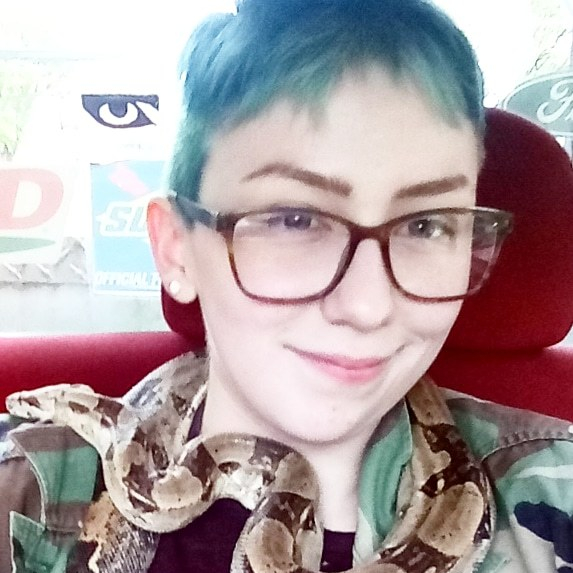
 

IMG_5525

parker

Describe yourself. What are your hobbies, interests? Who do you hang out with? Etc.

  Well, I would say I’m really into art and writing. My hobbies are really anything to do with art. My favorite thing is just hanging out with people, talking to them, seeing what they’re into. I definitely surround myself with my closest friends and try to make the strongest relationships I can with them.

Where did you go to elementary and middle school?

 Hutchinson and Greensburg Salem Middle School, But I transferred to Maxwell Elementary (Hempfield) for a year.

Do you remember anything from that year at Hempfield?

  Well, I was in a wheelchair when I was there because I broke my leg really severely, and I remember that people would put me at the top of the ramp and push me down. At first it was fun, but then people just started doing it real fast, and I would fall. I re-broke my leg twice because of it.

Freshmen, sophomores, and even juniors don’t really understand what it’s like to be a senior. Could you sum up the experience?

  Stress. All the time. Like, everything feels like it’s so insurmountable. And the senior project, even if you have everything prepared, feels super stressful. And it’s a very hand-holdy project; it tells you everything you need to do, but there’s just so much. It’s definitely a lot more intellectually demanding to be a senior, and I don’t know if that’s because I take all the honors classes, but regardless, I think that everyone could agree.

Describe the feelings of being nearly two weeks from freedom.

  Well, I’m no longer living with my mom, so once I graduate, I will be 100% completely free, and I can do whatever I want. I feel throughout my entire life I’ve been pushed to not live my life to the fullest, and once I graduate, school will be over and I won’t have any obligations except for work. It’s really surreal. I think about it, and I can’t believe that I’m already here. I remember like it was yesterday being 12 years old and saying ‘I can’t wait to be 18 and graduate and be free.’ And now here I am.

Is there anything you can’t wait to do once you’re out and free?

  Travel. I want to pack a bag, and if I don’t have any money to fly or drive, I’ll walk somewhere. Just go. I want to see new things, new people.

Tell us a little bit about your near future plans. Are you going to college?

  I’m looking for jobs right now. I’ve called at a bunch of places: Panera, Journey’s and a couple pet stores, but I’ve heard literally nothing back from anyone.

  For college, I’m going to triple Cs for a year for architectural design, because I want to do something with art that will make me money. After WCCC I want to transfer up north to Mt. Aloysius.

So why WCCC?

  ‘Cause it’s cheap. I wanted to get my cores out of the way. I want to spend as little money as possible on college because I have… $15 to my name?

What about beyond college? Let’s say you’re out and you have your architectural design degree. What now? Will you continue postgraduate work?

  I’m not sure. It really depends on how much money I have or if I’m even still enjoying the major I’m in. I might decide to change it. But besides that, I still want to travel. Even if I just have $10 in my pocket, I’m still going to try. As long as I can go somewhere and not go somewhere in my life and I’m not stagnant, I’ll be happy. Conformity and consistency really irritate me.

You’ve learned a lot of things here, some of which will never serve you again. Are there valuable things you have learned at GS?

  To be honest: academically, no. I’ve learned a lot of things academically but I’m never going to remember them, Ten years from now I’m not going to remember what a logarithm is. I barely know what a log is and I learned it last year. There’s a lot of things I’m ever going to need and much less remember.

  But socially, some of the lessons I’ve learned have absolutely formed me into who I am today. I’ve been on all parts of the social spectrum: I’ve been one of the popular kids, I’ve been bullied, I’ve been the bully. I’ve been the quiet kid in the back, and I’ve been the troublemaker. I’ve been everywhere. And I think I’ve learned a lot about everyone in general. I’ve learned that everyone’s really different in their own way, and I really enjoy looking at that. I’ve learned so many social lessons and how to deal with people, how to treat problems differently based on the personalities involved.

  I think the most important thing I’ve learned throughout high school is what it says on my arm. “I am mine before I am anyone else’s.” Originally, I got the tattoo because it was something that meant something to me. I wanted to cover up my scars. My mom didn’t want me to get a tattoo at all, so before I got it, my mom said to me: ‘You need to get a quote on your arm if you’re going to get that ugly snake.’ So, I got upset and said ‘Fine, I’ll put a quote on it,’ and I got this one, and she was furious because she knew that was a shot at her.

Will you miss GS at all? What will you remember it for?

  My friends, and the absolutely hilarious memories that I’ve made. I get so sad when I think about leaving my friends here. Odds are, I’m not going to talk to most of them again, and you know, I’m going to try and they’re going to try, but distance will separate us, and that’s just how it is.

  I’ll never see what they grow up to be as a person, at least fully. And even then, they won’t be the same as I know them now. So I think I’ll miss people the most.

  I’ll miss the structure. I’m terrified of having a life without structure. I feel like I’ll just lose all motivation for everything. Realistically, I know I won’t. I’ll push myself because that’s who I am.

You hate conformity and consistency but you’re terrified of living without structure?

  I make my own structure. I have my own little ledger I carry around to keep a schedule. You know how in the summer when you’re like ‘Oh, I’m so depressed because I have nothing to do, and I don’t have the motivation to seek something to do?’ That’s what I’m scared of.

***


POLL: Gun Control and School Shootings

  [Photo Credit: Getty Images]

   Do the names Emma Gonzalez and David Hogg sound familiar?

   In March, immediately following the shooting at the Stoneman Douglas High School in Parkland, FL, a national campaign in favor of banning firearms rose out of Florida, spearheaded by these two survivors-turned-activists. Across the nation, waves of Americans raised their voices in reply. Some voiced their support. Others, their disapproval.

  After the event, there was an abundance of columnists, news anchors, show hosts, politicians and thousands of personalities on social media whose were happy to speak out. Although its focus was on school safety and not gun laws, GSHS also spoke out in March. Clearly, school security is more pertinent to GS, but gun laws are, understandably, part of the conversation. To capture this conversationThe Lions Den took a voluntary poll of the GS student body on their opinions on gun laws and armed violence.

  While examining the data, The Lions Den asks that the readers remember that a poll is only a representation of public opinion, not an accurate picture of any one person’s opinion. Individual opinions themselves are more complicated than a simple yes or no.

Do you believe stricter gun laws or gun control measures will decrease the risk of school shootings?

IMG_5515


Students were polled during 2nd and 3rd lunch on April 25. Students were also asked their sex and grade, but were told they could refuse to answer any or all parts of the question. Some did not mark either their sex or grade, but the vast majority were totally compliant. Most, but not all, of the lunch tables were polled per lunch period.


Total Polled: 180 students

Male / Female:  92 / 87

Senior / Junior / Sophomore / Freshman:  56 / 32 / 60 / 32 *
For those not graph-savvy, here’s a point-by-point rundown:

  • Overall, a little over half of GS students believe that stricter gun laws will not decrease the risk of school shootings.
  • About one in three GS students believe that stricter gun laws will decrease the risk of school shootings.
  • About one in ten GS students are unsure of the effects of stricter gun laws.
  • The majority of male students believe that the risk of school shootings will not be decreased by stricter gun laws, whereas females appear much more divided on the issue.
  • When it comes to the effects of gun laws on school shootings, female students appear more unsure than male students.
  • On average, freshman are least sure about this issue, whereas juniors are most sure.*

   *By happenstance, about half as many Juniors and Freshmen were polled as the other two classes. Thus, accuracy within these categories should be regarded as questionable.

According to a survey taken by Hamilton College in 2013, the overall results at Greensburg Salem are not extreme by any means. The raw data from the survey can be accessed here. Hamilton’s 941-student nationwide survey reported that about 47 percent of high school seniors believed that stricter gun laws would decrease gun violence to some degree. Three years later, the respective number at GS was 46 percent. For the opposing opinion, Hamilton’s number was higher. This is likely because Hamilton’s survey had a different method which did not include a ‘Not Sure” option.

However, Hamilton College reported that the opinions showed no difference in opinion between the sexes. Interestingly, this is not the case for GS. Male GS students appear twice as likely as females to say that gun laws would not be effective at stopping school shootings.


There may not be anyone at GS who has been empowered as much as Hogg, Gonzalez and the survivor activists in Parkland, but that does not mean that GS students don’t have the ability to get involved, make a statement, and be informed.


Students Take the Wheel, Drive GS Forward

  GS students never stop giving their time to their school and community, and this April, two organizers gave their time to help two community events stand out above the rest.


   Dodge for Dementia

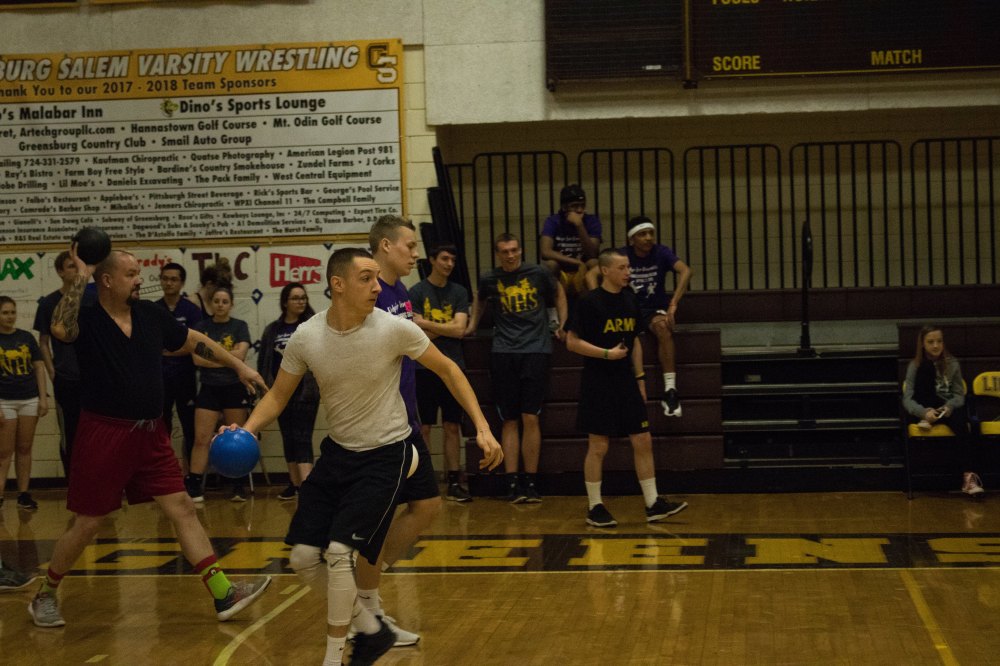
   On Saturday, April 8, 256 students from 11 school districts in the region came to GS’ gymnasium for one reason and one reason only: Dodgeball.

DementiaDodge-15

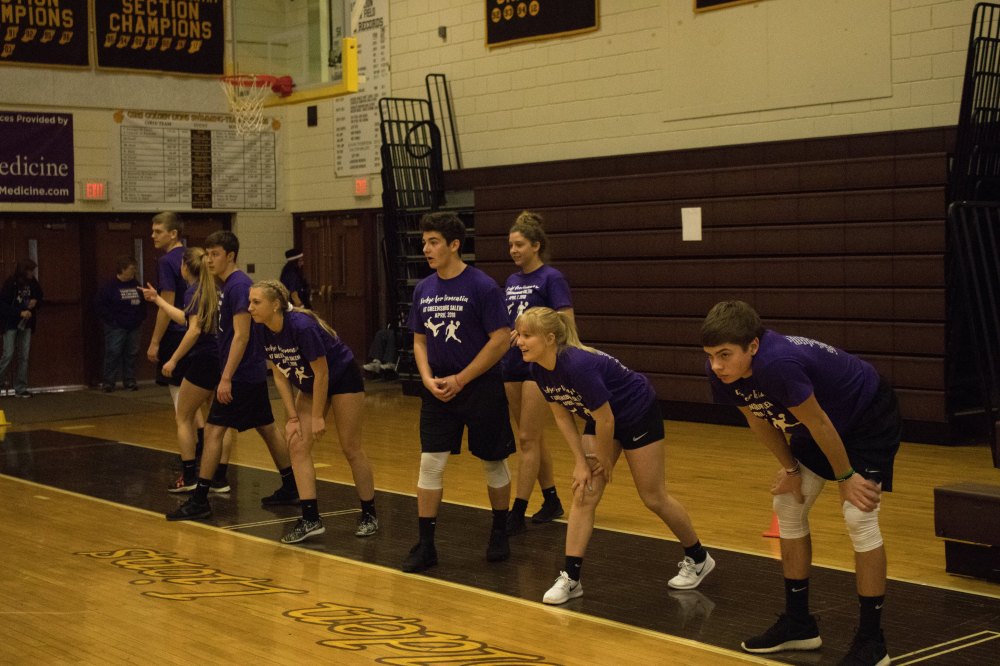
A GS dodgeball team crouches at the line, ready for the Dodge for Dementia tournament to begin. Photo credit: Gabe Vogel

  At some point or another, every high school student feels the intensity of a dodgeball match, but in terms of scale and purpose, GS’ Dodge for Dementia wasn’t the typical dodgeball tournament.

   “We came up with the idea at the National Honors Society [NHS] conference in Pittsburgh back on November 29,” senior NHS President Melissa Paravate said.

   Paravate remembers the date because, whether she knew it then or not, the commitment she made was monumental. At the conference, their task was to create an event for their school that could raise funds “for a good cause.” From the start, Paravate and the NHS organizers were drawn to the Alzheimer’s Association as well as World Vision, an organization targeting international poverty with a focus on children.

   “We wanted to do something to make a difference,” Paravate said.

   And of course they did, but how would NHS raise the funds? What would the event actually be? For Paravate, the answer had to be a sporting event. Paravate and the team of NHS organizers were initially torn between volleyball and dodgeball, but they decided that volleyball was too exclusive.

   “We didn’t want it just to be aimed at athletes,” she said. “We wanted more people to get involved. So we picked dodgeball.”


DementiaDodge-30

DementiaDodge-10

Seniors Tony Altieri (below) and Kevan Downs (above) competing in their respective matches. Photo credit: Gabe Vogel

  “At our school, we promoted it all over the halls, posters everywhere, announcements all over the place, social media, you know,” she said.

  But that was only effective at GS. To get other schools to participate, Paravate recruited three other NHS members: seniors Erica Faulk, Peter Laskoski and Troy O’Black. Then, like foreign ambassadors, the four drove around the entire county, from Southmoreland to Burrell, meeting with school administrations to get them involved in their event.

  “The amount of people we had to contact and the ways we had to contact them….” Paravate remembered. “Emails, phone calls, messages… any way that you can think of to contact people we definitely did.”

DementiaDodge-13

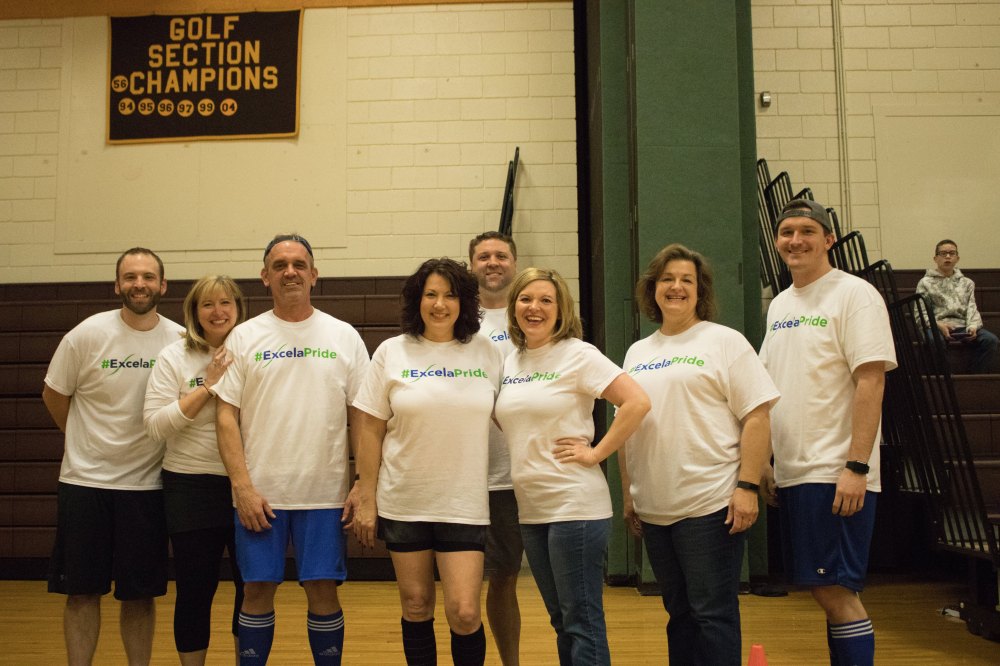
The participators weren’t just students! Excela Health sent a team to help the cause and compete as well. Photo credit: Gabe Vogel

  After this and months of planning, Paravate’s team finally hosted the event two weeks ago. It was a triumph both for them and for the GS team that won the tournament. Juniors Reid Amundson, Kobe Dinsmore, Dajauhn Hertzog, Lucius Nicolai, Jack Oberdorf, Sage Parsley, Noah Sweeney and one senior, Darren Beirne, made up the winning team.

  “I was really pleased with the whole tournament,” Paravate said. “Everybody showed up, and all our referees came.”

  Paravate wanted to give “a huge shout-out,” to the National Guard, which sent six reserve officers to referee the tournament among teachers and other volunteers.

DementiaDodge-32

On behalf of NHS and the organizers, Troy O’Black thanks their supporters, listed on Paravate’s shirt. Photo credit: Gabe Vogel.

  The NHS President said the event had its share of flaws. For example, Paravate thought she missed the mark on organizing the time slots, meaning they had much more free time than they anticipated. Additionally, it was hard to get teams to sign up at the beginning. The organizers had to do a lot of “chasing.”

  “People were really understanding that this is only our first year doing this; we’re only seniors in high school,” she said. “We did our best.”

  All in all, the event was a success. The event was highly praised by many participants and by GS administration. According to Paravate, the Dodge for Dementia team raised $2,383 just on the day of the event, in addition to all of the sponsorship and participation money raised beforehand. Paravate said she estimated the event’s total revenue at about $4,300, all of which will be donated to their beneficiaries, along with the NHS and the National Junior Honors Society [NJHS].

  “Thank you, thank you, thank you to everyone who helped us out with this,” Paravate said. “We couldn’t have done this without everyone’s support.”


Walk a Mile in Her Shoes

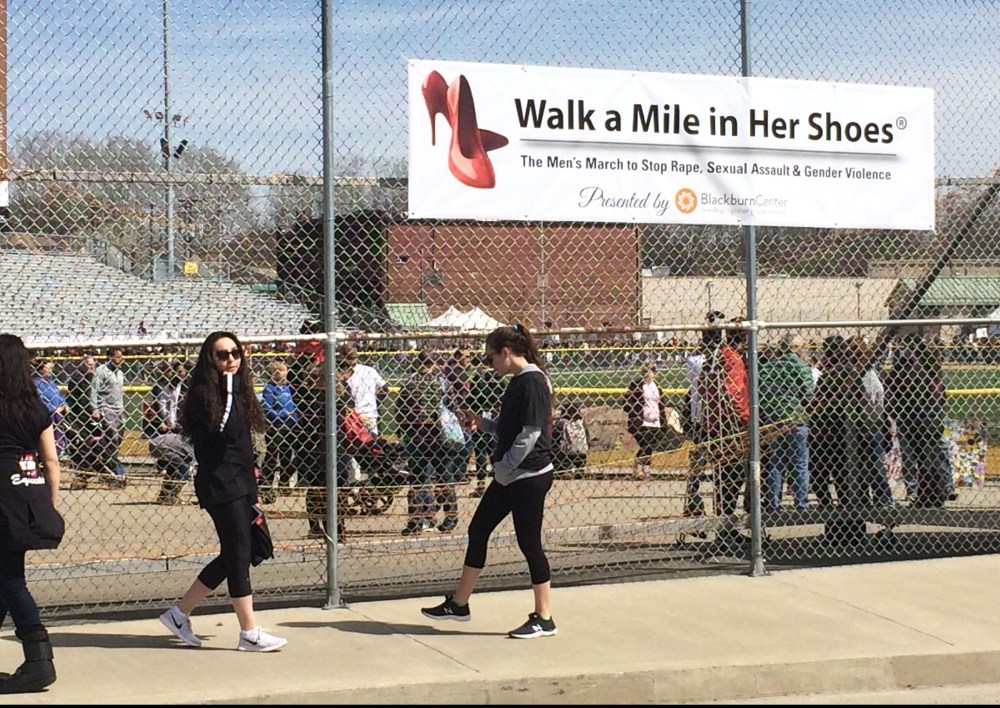
   Dodge for Dementia was a boisterous event, but the art students in room 238 gave to their community in a quieter way, donating symbolic pieces to the Blackburn Center’s Walk a Mile in Her Shoes®️, which was held at Offutt Field last Saturday, the 21st.

IMG_5429 (1)

A group of walkers leaving Offutt near the end of Walk a Mile in Her Shoes. Photo by: Jules McBride.

   Every year since 2011, the Blackburn Center, a local anti-violence organization, has held a march against gender-related and domestic violence somewhere in Greensburg. The event is largely a fundraiser, and it’s growing in popularity: in recent years, the number of walkers has more than tripled since the first WMHS®️. Mrs. Kelley Audia, art teacher of room 238, spoke of the event.

  “Men come – I know they get the Seton Hill football team to attend – and they wear red high-heel shoes, and they symbolically walk a mile in those shoes to symbolize their support,” Mrs. Audia said.

  In past years, the Blackburn Center has held the event at Lynch Field and St. Clair Park, but no matter where they’ve marched, they always bring one thing: art.

  “Offutt Field is a big space, so I’m kind of hoping we can make enough of a visual impact and provide as much as possible,” Audia said.

  Though she couldn’t attend this year, the art teacher donated a collection of pieces to the March, which were displayed around Offutt’s fence for all the participants to take in. Over the last two years, WMHS®️ has seen in the neighborhood of 1,100 participants, which means the donated work got a lot of exposure.

IMG_5431 (1)

IMG_5447

A few of Painting II’s many symbolic pieces zip-tied to Offut’s fence. Photo by: Jules McBride.

   Throughout the years, Audia has encouraged her advisory class to get involved and make art for this event. This year, her art students also chipped in.

  “My Painting II kids did the piece out in the hall, and the Printmaking kids were very willing to help,” she said.

  Painting II, which Mrs. Audia has first block, created a set of colorfully painted ink prints of shoes. Some depict the symbolic high-heel shoe used by the Blackburn Center, while others are more inventive. A few are decorated with quotes or positive messages, while others stand alone. This year, the Painting II students took notes from Andy Warhol.

  “We try to do something different every year, but we typically kind of focus on shoes as our subject matter,” Audia said. “So this year we took Warhol as our inspiration, specifically his early work.”

  These pieces were small, but Audia and her class made a lot. Audia said that it might be possible to arrange them like a quilt to strengthen their visual impact, but in the end, they decided to spread them out around Offutt’s fence.

[Junior Molly Krunszyinsky, Sophomore Haylie Roth, Mrs. Kelley Audia, and Senior Matis Stephens hold their respective pieces.]


   In addition, the printmakers made a piece of their own.

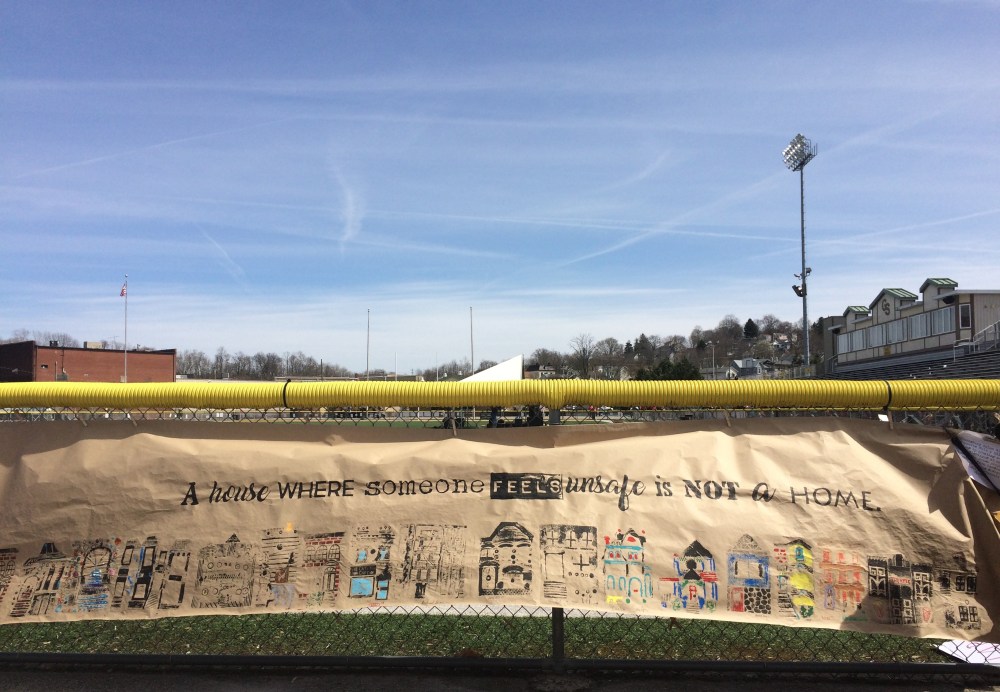
  “My printmaking class did what’s called a collograph of houses,” Audia said. “They each had to choose and design their own houses, and we did a whole sort of city block.”

  The piece was placed on the front end of the football field so that the participants could see it as soon as they walked in. It boasts a full row of unique houses, accompanied by a quote above the rooftops: “A house where someone feels unsafe is not a home.”


   The piece was placed on the front end of the football field so that the participants could see it as soon as they walked in. It boasts a full row of unique houses, accompanied by a quote above the rooftops: “A house where someone feels unsafe is not a home.”

IMG_5452 (1)

The printmaking class’s piece, lifted from the fence by the breeze. Photo by: Jules McBride

   Audia and the art classes also donated a mixed media piece entitled “Cultivate kindness,” a collaborative piece by seniors Katelyn DiCriscio, Kendra Kennedy, Claire Simpson and two juniors, Hannah Ahearn and Natalie Susa.

“I think it’s important for people to get inspired to let themselves be heard,” Audia said. “And giving these pieces is something that can accomplish that.”


So what?

  GS students will never stop finding ways to give to their school and their community. At GS, there are perpetually student-run or student-oriented events to raise funds, such as Open Mic Night, the talent show, and of course, Mini-THON. But when one is surrounded by student leaders, organizers, dodgeballers and Mini-THONers, it might become natural to ask: Why? What’s the incentive for giving hours of one’s life to a larger cause or a one-night event?

  “You don’t always need to get something out of it,” Paravate said. “There was nothing in it for me.”

  Paravate didn’t know if she considered herself an altruist, but it could be justified. The NHS President claims she has over 800 volunteer hours under her belt.

  “I think it’s really important to give back and make an impact on the people who are coming up,” she said. “Make it something people in the future would look forward to, if they would want to do it again.”

  The NHS President and the art teacher had unique stances, but both thought it was important to inspire others.

  “I always tell [my students], you’re doing something for the community,” Audia said. “And that might not seem like a big undertaking, but when it all comes together that’s going to make a big impact. Art is powerful.”

IMG_5441 (1)

As the walk simmered down, participants, some still carrying signs, hang out in pockets by the Offutt locker rooms. Photo by: Jules McBride

  Mrs. Audia hopes to expand NAHS into more than just face painting and donating. She has thought about taking her students to events promoting art and art activism. Paravate is optimistic for the future, too.

  “I do hope [Dodge for Dementia] continues,” she said. “But it really depends on who your [NHS] officers are next year.”

   Paravate in particular wanted to express her gratitude to the multitude of GS staff, students and community leaders who gave their time and money to make Dodge for Dementia work. Greatly pleased with the support and compliments she got, she regards her event as a success.

  “Mrs. Harper told me she didn’t think I was crazy enough to pull this off,” Paravate laughed. “Well, we all learn things about ourselves through a process like this!”


GS Students Become a Part of National Walkout

   At 10 am on March 14, 2018, over 100 GS students left their classes, joining the ranks of hundreds of thousands of other students across the country in honor of the 17 students who died in the Stoneman Douglas High School shooting in Parkland, FL.

  “We wanted to get everyone to stand together to try and change things,” senior student organizer Jordan Mitchell said.

  Major media companies have made it clear that student, school and activist groups around the nation were protesting the current gun possession laws. However, Mitchell and her partner, senior Dante Howard, did not advertise GS’ walkout this way, abstaining from any mention of guns or gun laws. They instead focused on uniting the student body to rally for school safety and honoring the lives lost in Parkland.

  The core idea was present in the students who showed up on the 14th, but many had different takes on the assembly.

  “I just feel bad for the parents of the kids who passed away from this,” freshman Aiyana Morris said.


IMG_5298

Stylized postcards on which students were given the opportunity to write to Parkland families. Photo by: Jules McBride.

   Some students, like Morris, openly said their purpose dealt with guns. Morris did not specify that she wanted guns restricted or not, but did make clear that she cared about weapon safety.

  “Gun safety is something that should be expressed more often,” she said.

  Other students, such as senior Hannah Douglas, said that the assembly was not a protest against gun laws.

  “Maybe [students] are thinking that this is a protest against gun rights,” Douglas said. “Which is why a lot of people would not want to be here. A lot of people in Pennsylvania support having guns in their possession.”

  Douglas is correct with that statement. The statewide laws in PA are non-licensed open-carry, except in Philadelphia.

  “We’re not here to say no one can have guns,” she said. “We’re here to honor the lives of those who were lost.”

  Guns didn’t seem to be on the mind of many of the participants. Most, like Douglas, seemed focused on their student body.

  “I’m here to say that this isn’t okay,” junior Cole Turnbull said, referring to the bomb and shooting threats that have happened infrequently at GS in recent years. “It’s nothing to joke around about.”

  Turnbull’s classmate, junior Sean McFeeley, who stood on the opposite side of the gym, had a stance focused on the suffering of those in Parkland.

  ”I’m here to honor the families for what happened down in Florida,” McFeeley said.

  When asked why some students might not have come to the event, McFeeley was quick to point out what he thought they may suspect.

  “Well, they might think this is about gun control,” he said. “If it is or isn’t, I’m just here for the families.”

  Several other students felt similar to McFeeley in the sense that they simply wanted to honor the families of those who died, and didn’t pay mind to why others might have been there.

  “I want people who come to this protest to have a voice,” junior Adam Goldstein said. “I want people to be able to say: ‘Hey, it shouldn’t be like this. Kids shouldn’t have to come to school in fear of dying.’”

  Goldstein, like McFeeley, was asked why he thought some students didn’t attend.

   “Some people may not have come out today simply because they want to stay in class,” he said. “Or, it’s possible they disagree with the idea of leaving class for a protest. Others might not come out because they disagree with the idea of a protest itself.”

  Neither Goldstein, McFeeley nor Turnbull condemned those who didn’t participate.

  “Everyone has their own opinion,” Turnbull said. “Some people are with it, some people aren’t.”

IMG_5291

The gym floor on March 14th, flooded with walkout participants. Photo by: Jules McBride.

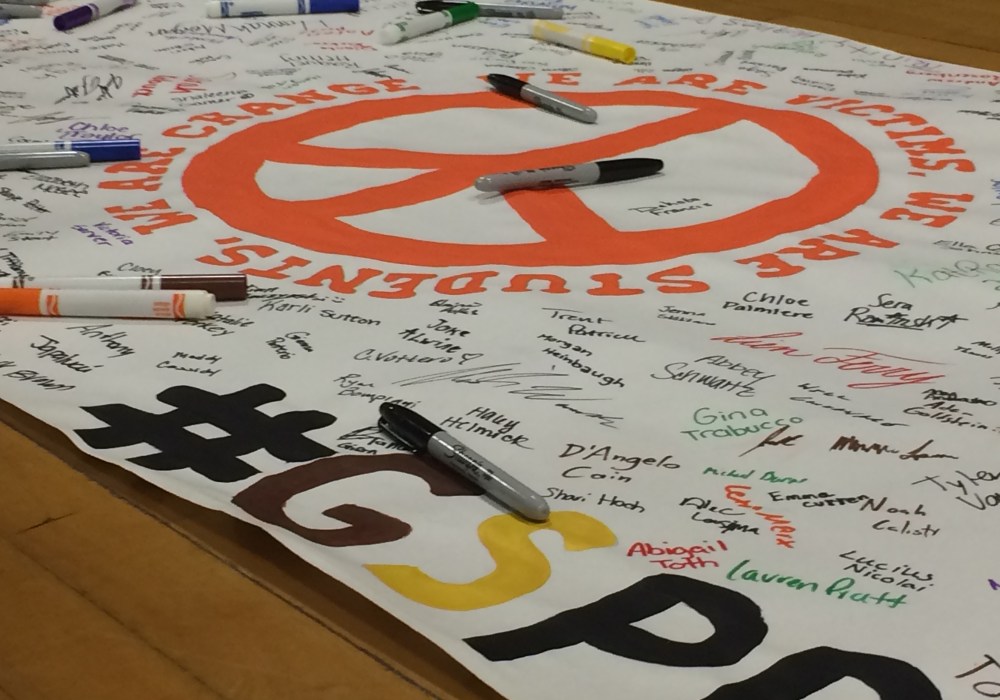
   What students said at the event matters less than what they did there. A large number attended and many attendees actively participated. Students had the option to write postcards or letters to the families that lost members in the Parkland shooting and sign a poster [featured image] that now hangs in the lobby. All the while, Mitchell gave a short speech and read the names of the victims aloud.

  “We wanted to make people aware that this can happen anywhere, and we wanted people to take that more seriously,” she said.

  Signatures accrued on several petitions set out on a table in the middle of the gym. According to Mitchell, those petitions will be sent to state officials as well as Senator Conor Lamb and district representative Eric Nelson and state senator Kim Ward. The organizers hoped that the petitions would get legislation talking about improving schools “security-wise.”

  “We read all the names of the people who passed in Florida,” she said. “We had a moment of silence too.”

  During those 15 seconds, the familiar kind of chatter usually heard in every corner of the school stopped, giving way to the airflow in the gym and the silent reflection of hundreds of students.

  “This made people aware that they actually died,” Mitchell said. “We honored them that way.”

  Most would say that 17 minutes is not a long event, but more than enough to make a statement. At the end of the 17 minutes, principal Mr. David Zilli concluded with a short speech, sending the students back to their usual schedules. For the sake of all of GS, he hoped this would not be a “one-and-done.”

  “You think about this moment and how you can take the next step and make this something that lives forever,” Mr. Zilli said. “This is the first step in making real change for all of us. For you and for me, for your kids and for your kids’ kids. This is our chance to keep this something that’s important to us, that’s near and dear to us because we respect and love each other.”

  At this, Zilli announced that Mitchell and Howard were going to release balloons outside to conclude the assembly. As students returned to class, their appearance out the window reminded them of the reasons they came.

 “I appreciate your respect and your willingness to be a part of this,” Zilli concluded. “Have a wonderful day as a Golden Lion.”

Spaghetti Engineers Bring Two Trophies Home

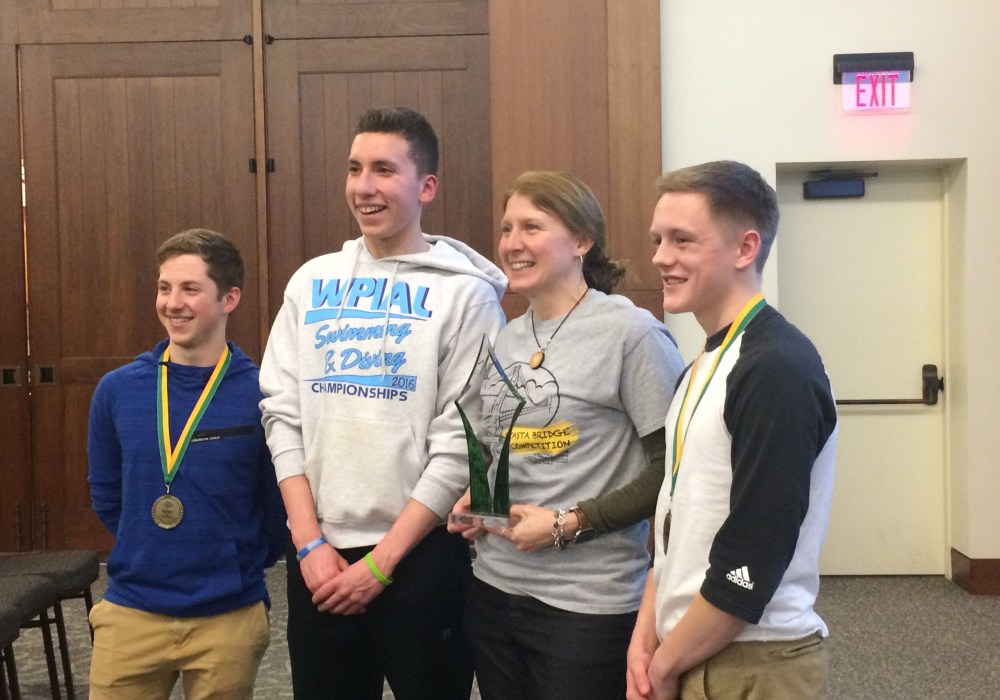
[Featured Image: The winners of Carbone’s Spaghetti Bridge Engineering competition pose with their awards. Pictured Left to Right: Ian Merendino, William Crites, Mrs. Cheryl Harper, Christopher Writt]


   51 pounds, 6 ounces – that was how much it took to break a pasta bridge constructed by three GS juniors at Carbone’s annual Pasta Engineering competition.

  “You have to build a bridge that’s a meter long at least, under a kilogram, and the goal is to get the bridge to hold as much weight as possible before it ultimately breaks,” junior William Crites, one of the three winners, said.

  On March 12th, Crites and his two teammates, Ian Merendino and Christopher Writt, were just one of 23 teams from all over western PA that crowded into St. Vincent University’s Fred Rogers Hall. Each team carried with them a bridge they constructed out of spaghetti and lasagna. Each bridge was tested to its limits, and the weight it held was listed as the team’s score.

  The trio of juniors were the last to put their bridge to test, and took the win by almost 10 whole pounds. Juniors Scott Armentrout and Peter Mica, whose bridge looked set to take second with 41 lbs 6 oz, still took a third place trophy home.

IMG_5281

Armentrout and Mica pose alongside physics teacher Mrs. Cheryl Harper with their medals and third place trophy. Photo by: Julius McBride

  Carbone’s only gives awards to the three strongest bridges (plus one for aesthetics), but all of the GS teams did well. Second place may have eluded them, but every GS bridge held at least 20 lbs. It pays to be knowledgeable in modern bridge design and material science.

  “Obviously, there’s a lot of physics behind it,” senior Peter Laskoski said. “We spent weeks studying structural design of bridges in real life and what makes a good solid bridge.”

  Laskoski’s team didn’t place in the top three, but its bridge held a respectable 27 lbs 8 oz, enough to top well over half of their competition.

  At the beginning, there were plenty of choices to make and designs to pick. Trusses, cables, suspension wires, as well as basic aspects such as shape and size were all considerations for the competitors. However, Crites, Merendino and Writt knew what they wanted.


IMG_5276

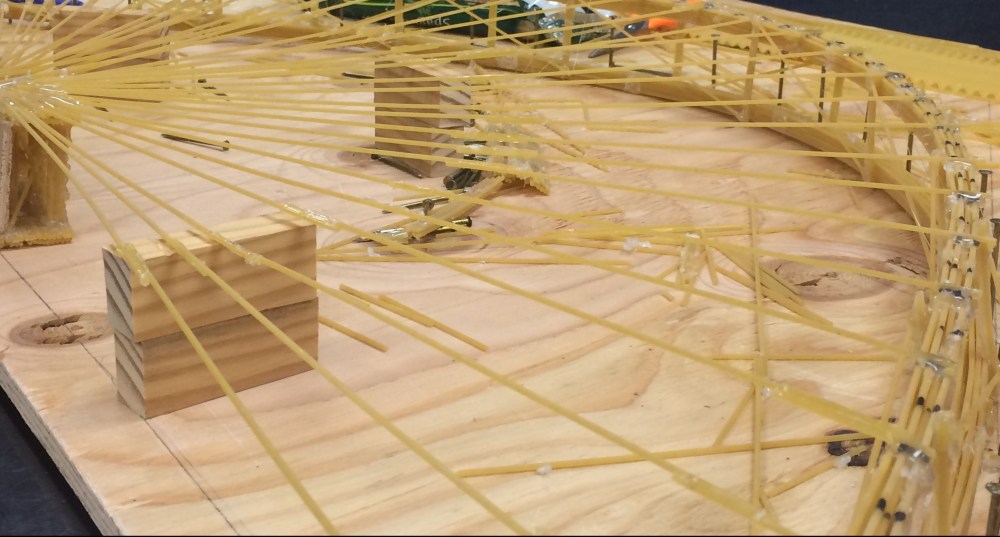
Wooden blocks hold the spokes in place as the glue sets. Photo by: Jules McBride


   “We chose the arch bridge,” Crites recounted. “Since all the weight was load-bearing in only the center of the bridge, and there was no need to have the weight distributed evenly, the arch-bridge was structurally the most sound.”

  Crites was referring to the fact that the testing weights aren’t put on the bridge itself, but are added to a bucket that is hung on a hook at the center of the bridge’s base. This means that the team didn’t need to design a bridge optimized to hold weight along its entire length, just at its center.

  “Our entire class modeled their bridges after practically the same design,” Laskoski said. “We modeled our bridge after previous designs that our school has done that have won in the past.”

  In recent years, the arch design has proven its effectiveness by dominating the competition. The record holding bridge to date clocked in at an astounding 109 pounds. That legendary bridge used a large number of “cables,” just one noodle thick, to help to distribute the weight over a sturdy arch. This year, the top three teams attempted the simple design, hoping to reap the benefits. But of course, just because the design was simple does not mean it was easy to build.

  “One of the issues was making sure the arches were as symmetrical as possible,” Crites said.

  To build the most symmetrical bridge they could, Crites’ team used a variety of tools, including placing a frame of nails in a board to curve the arches just right. The entire way through, the trio used careful measurements, precise gluing and teamwork.

  “We had to come up with the best possible idea,” Crites noted. “Usually Ian would come up with the first idea, then Chris and I would revise that. Then we’d all three come to an understanding on how to address the issue.”

  Even when the various hurdles of building the bridges were jumped, getting the structures to St. Vincent was still a challenge. And remember, they’re made out of spaghetti.

  “We were nervous the bridge was going to break just walking through the door,” Laskoski said. “That was probably the most nervous I was.”

  Before their various other design choices were put to the test, each competing bridge was given a display spot in the Fred Rogers Hall. Each of the 23 unique bridges, traditional and hybrid, painted and unpainted, all sat on tables throughout the hall. Spectators could indulge in refreshments and admire the design of every bridge, while competitors could scope out their competition. Meanwhile, every bridge was weighed, measured and inspected by the moderators to ensure it followed the specifications laid down months earlier. GS teams made sure to keep an eye on the other arch bridges.

  “It was kind of nerve-wracking walking around, seeing the other bridges,” Laskoski said. “There were definitely some well-designed bridges from other schools that gave us a run for our money.”

   It shouldn’t come as a surprise that building a bridge out of dry spaghetti is not easy. If a bridge isn’t properly fortified, small asymmetries can make a bridge twist, lean or buckle unexpectedly under enough weight. Thus, during the competition, minor mistakes could quickly become major concerns. Competitors are sure to watch for even small issues every step of the way.

  “In the end, it just comes down to good joints and good symmetry,” Crites said.

  According to Laskoski, their bridge would have done much better if not for one small oversight.

  “The bridge worked as planned,” he said confidently. “From a structural point of view, the arch was pretty well done. The downfall was that we overlooked a very, very tiny detail in our bridge.”

  Laskoski’s team noticed early on that their base wasn’t completely level. In his own words, the issue ended up being “makeshift” taken care of, but not properly fixed.

  “When we looked at the footage, that was exactly where our bridge broke,” he said.

  Crites, Merendino and Writt had better luck. They were the last team to bring their bridge up, and had a brief mishap with the scale before clocking in at 51 lbs 6 oz, surpassing the standing winner by almost 10 pounds.

  The number scored by the team of junior boys is certainly impressive, but less than half of the standing record. So then what was it that stopped them from getting any higher?

  “It worked as planned,” Crites said. “Everything was going well with our bridge. Until…”

  Crites’ team had the same adversary as Laskoski’s team: the base.

  “We didn’t make our base long enough, so the bridge didn’t break the way it was supposed to,” Crites explained. “The amount of weight caused it to flex, and it just slid off the side.”

IMG_5277

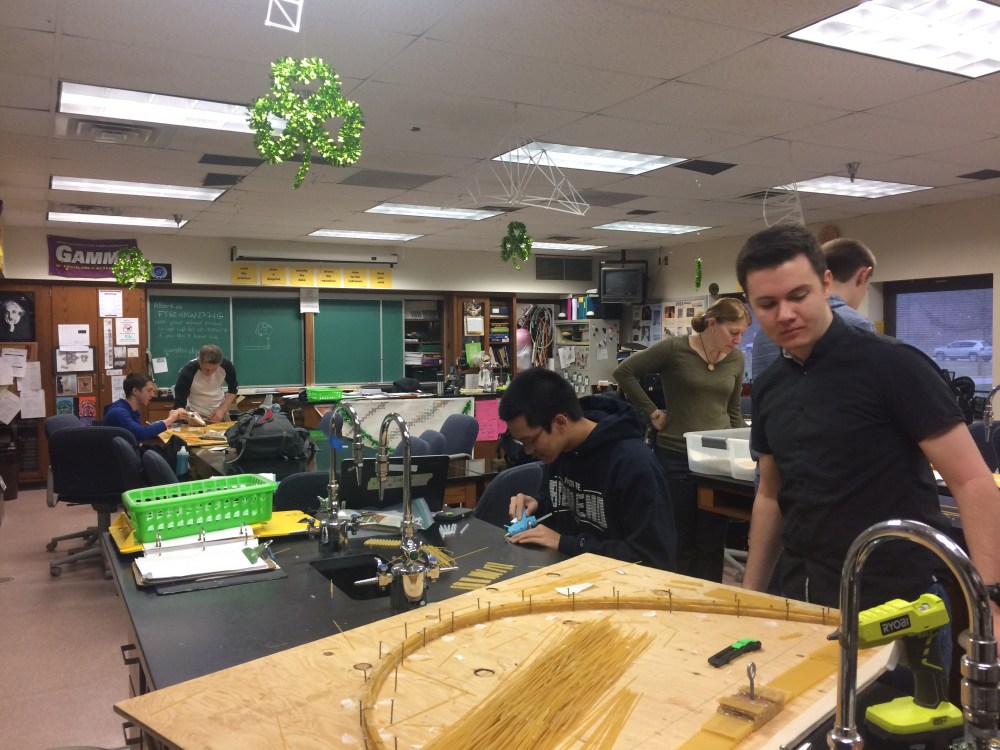
Laskoski (center) and his teammate Colin Bashline (left) prepare to glue down the load-bearing spokes onto their arches. Merendino and Writt (right) work in the background. Photo by: Jules McBride

But a victory is a victory, and despite their shortcomings, Crites and Laskoski were both glad they were able to participate and grateful for the conceptual science in Honors Modern Physics.

“I think in that part of HMP, we learned a lot,” Crites said. “I mean, I didn’t know anything about tension or compression beforehand.”

Laskoski didn’t think they would have made it without HMP either.

“Not just anybody can pick up a pile of spaghetti and some hot glue and make a bridge that can hold even five pounds,” Laskoski chuckled. “Or one pound.”

  And that’s true. A handful of teams from other schools walked away with a score around two or three pounds. Sadly, a few teams even got a score of zero.

  “You have to have some conceptual knowledge of what you’re doing to even attempt to make a bridge out of pasta,” Laskoski added. “We learned a lot about bridges and forces and tension prior to building the bridges. This is just kind of an added on project that Mrs. Harper does for us so we get some experience with forces and tension.”

 Crites and Laskoski both agree that Carbone’s Pasta Bridge competition fits within the Honors Modern Physics curriculum. Though bridges may not be as exclusively modern as particle physics – a subject covered in the same class – bridge physics is obviously still relevant.

  “Obviously, we’re still going to be building bridges in the future,” Crites said. “So it’s good to learn and I would consider [the competition] a part of Honors Modern Physics because it encompasses many of the aspects of modern physics that we still use today.”

GS WIRC Team Out-reads their Competition

   [Featured image: Seniors…? Poses with their ribbons, trophies, and WIRC plaque. (Left to right, top down:  Jessica Prentice, Janelle Hayward, Grant Hoffer, Jesse Quatse, Melissa Paravate, Maria Mlinarchak, Claire Simpson, Shannon Brady, Elizabeth O’Neal, Gillian Perez), Photo Courtesy: Claire Simpson]

   Last week, six months of reading and preparation paid off at the Westmoreland Interscholastic Reading Competition (WIRC), where Seniors…?, a GS team, took first place.

  WIRC is a quiz-bowl style competition hosted at Seton Hill University where teams compete to get the most questions right. Teams, usually more than one per school, compete in rounds where each team is paired against another team. When the dust settles and the day is over, whoever has the highest total score wins the competition. The structure is simple. The subject matter is not.

  “I haven’t been to a competition yet, so I can’t say too much about it, but the thought that we read a lot of books is definitely true,” senior Kane Claflin said the week beforehand.

  Competitors face the challenge of remembering details of the content, plot and characters of 30 books preselected by the high school librarian, Mrs. Carrie Vottero.  

  From his year of reading, Claflin maintained that WIRC is all that it seems: reading, reading and reading. This is Claflin’s first year, but he has friends who have participated in WIRC for four years, including a chunk of his team, The Good Guys, who snagged the sixth place spot this year.

  “The reason that we started our team is because of Claire Simpson’s team, and so I think they’re our biggest competitor,” he chuckled.

  Simpson was a member of this year’s winning team: Seniors…?. Simpson herself was unable to schedule an interview, but her teammates, seniors Janelle Hayward and Jessica Prentice, were able to speak about their involvement.

  “I think a lot of people think it’s boring, but I like it,” Prentice said. “It’s fun to go to Seton Hill for a day,”

DSCN0505

WIRC’s exclusive shelf and its rapidly cycled books. Photo by: Jules McBride

 “Seniors…?” was the chosen name for Hayward, Prentice and Simpson’s team because of their mostly senior team members. Regardless of grade, they were all eager to compete.

  “It’s always fun to geek out,” Hayward added. “We have a blast when we’re there.”

  Both Hayward and Prentice enthusiastically agreed that competition day was a holiday for them, but ceded that some of this year’s books dragged. Not all of them are fiction, and some, like The Kingdom of Little Wounds, are a hefty 500 pages.

  “Usually a lot of them are enjoyable, but this year they’re few and far between,” Hayward said.

  Hayward praised The Serpent King, and Prentice said that The Sun is Also a Star was the only book she enjoyed. But there were not a lot of books up their alley this time around.

  “There’s a lot of nonfiction this year,” Prentice groaned.

  As aforementioned, the book selection, as well as a myriad of other tasks, is done by Mrs. Vottero and Mrs. Debbie Kozuch, the GSMS librarian.

  “[Mrs. Kozuch and I] receive the registrations from the different teams from all over Western Pennsylvania,” Vottero began, listing their duties. “We have to create a schedule for them to compete against each other, we have to reserve the facility, Seton Hill University, be in constant contact with the people there, set up the cafeteria….”

  Many students do not realize the hours the librarians put into WIRC. Across the middle and high school divisions, almost 1,000 students compete every year. Of course, all of these students need buses and slots on the schedule, not to mention lunch at Seton Hill. The logistics of all of these things and more fall squarely on the librarians’ shoulders.

DSCN0506

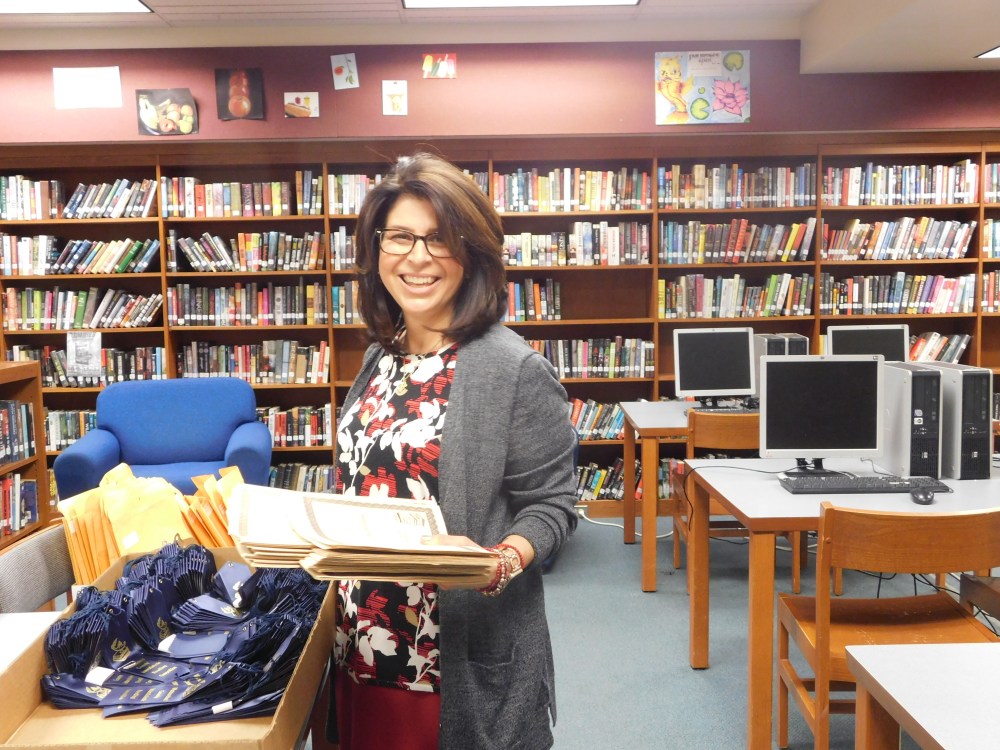
Mrs. Vottero sorting the certificates, ribbons, and trophies to be awarded at the competition. Photo by: Jules McBride

 “You have to have the space organized,” she continued. “You have to do the scoring of the event, you have to write the questions….”

  Vottero is always enthusiastic about the event, but when it comes down to it, she’d rather spend time helping her students manage their team and organize practices to increase GS’s fighting chance rather than hosting the competition.

  “Greensburg Salem has six teams this year that really deserve their own coach,” she said. “I don’t get to spend nearly enough time being that coach to them because I’m running the actual event.”

  Vottero believes GS students are disadvantaged because librarians at neighboring districts have the opportunity that she doesn’t: getting to read and practice alongside their teams.

  “I feel bad about it all the time,” she said. “I wish I had more time to prep and question [the teams], and have pretend contests and see how prepared [they] are.”

  However, Hayward and Prentice don’t feel necessarily disadvantaged.

  “We’re doing our own thing, you know?” Hayward said. “We just have to do what’s best for us, and [Mrs. Vottero’s] coaching may or may not mold with our strategies.”

  The pair both competed in WIRC at the middle school, where Mrs. Kozuch regularly quizzed teams on certain books. They agreed that Mrs. Kozuch’s questioning definitely helped, but were skeptical of any impact beyond that.

  “I don’t know if we’d need it,” Prentice said.

  Because Vottero doesn’t coach, student teams become largely independent. According to the librarian, most of the teams prepare themselves for the competition to the best of their ability, and Vottero places “great faith” in the idea they will.

  And they do. Throughout the years, new approaches have been created or old ones tweaked by inventive student teams.

  “We try to get two or three people on each book, because if you only have one person on each book, the odds of them remembering for every single question are slim,” Hayward said. “We also like to do notecards on the day of the competition to prompt each other and get our minds running.”

   Seniors…? used a hand-drawn chart, while The Good Guys preferred an Excel spreadsheet, but both use the same concept: charting the books vs. who’s read them.

  “I’m in charge of most of the administrative things, like keeping track of the books that people have read, and making sure people get the money for our shirts and everything,” Claflin said.

  Of course, this isn’t a GS-only event. Dozens of schools participate every year, and a few quickly became “threats” in competitions past.

  “I want to say that Hempfield won the top three spots last year,” Vottero said. “First, second, and third place. Which – wow – that’s a really big deal.”

  According to Vottero, 39 teams competed this year – a typical number. Hempfield’s sweep of the leaderboard last year means that their wins haven’t been flukes, and GS students were ready to be diligent to keep up. For Seniors…?, that diligence clearly paid off, as Hempfield’s best team placed second.

  “Hempfield is usually the team to beat,” Hayward remarked before.

  GS readers were also watching out for DuBois Area, a more secluded central Pennsylvania school district. In the very first year DuBois participated in WIRC, they were hardly acknowledged, that is, until they trounced every team they played and won the competition. This year, they also placed high in the top ten.

 “I would love to see us take those top three spots this year,” Vottero said, almost predicting the future.

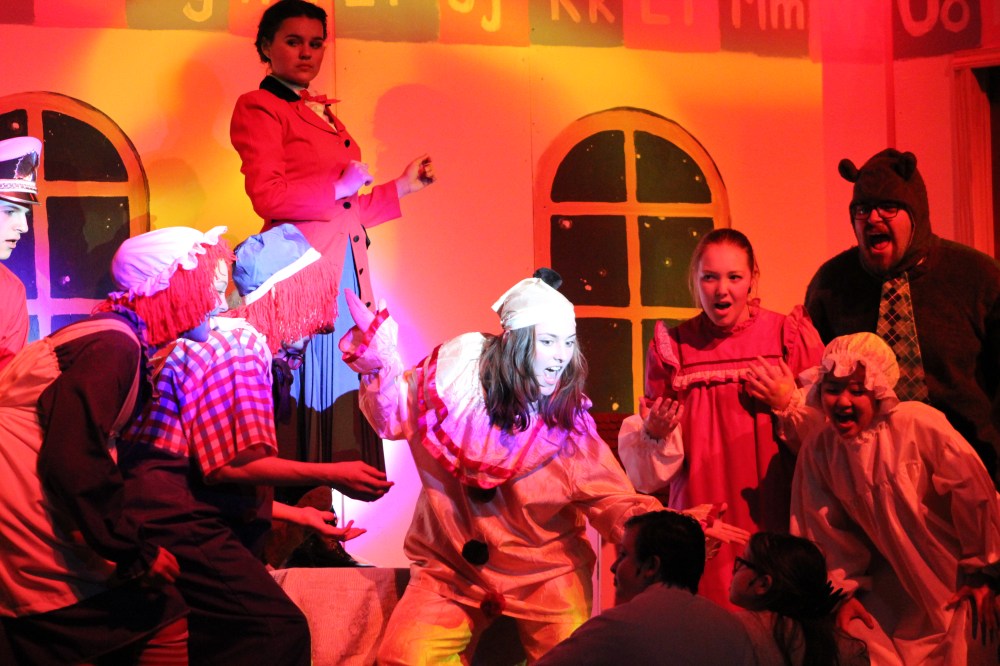
Mary Poppins Cast Flies into Opening Weekend

[Featured Image: Left to right, front: Audrey Johnson (Mary Poppins), Sarah Koebuck (Mrs. Corry), and Alex Podolinksi (Bert) finish off a dress rehearsal run of Supercalifragilisticexpialidocious! Photo credit: Charity McBride]  

As February wanes into March, the auditorium comes to life, and the 2018 cast of Mary Poppins will put on a show of many firsts to thrill the audience opening night.

The cast will take to the stage Thursday, Friday, and Saturday evening and a Sunday matinee.

Aside from production details which are not allowed to be disclosed until the curtain opens, this year will be the first year where two non-high school students have a role in the show. Logan Lewis, who attends Metzgar Elementary, will play Michael Banks along with Ellie Swanson, who will play his sister Jane. It will be Lewis’ very first musical.

“I think I’m like Michael at the beginning,” Lewis said of his role. “I can be a cool kid, but sometimes a very nice kid.”

Lewis spoke positively of the musical, but noted that even his schedule was “crazy,” with musical rehearsal and trombone practice back-to-back on Tuesdays.

Even at the high school, many GS students have a similar attitude about their musical schedule.

“There’s no schedule other than musical,” laughed senior Audrey Johnson, who will play Mary Poppins. “Essentially, when I’m not at rehearsal, I’m sleeping or eating.”

The name Audrey Johnson may ring a bell, as she was crowned Homecoming Queen this year. Freshman Owen Johnson (unrelated), a chimney sweep, made similar comments to Audrey.

“I usually go home, do homework, eat dinner, then come here [to rehearsal],” Owen said.

IMG_1130

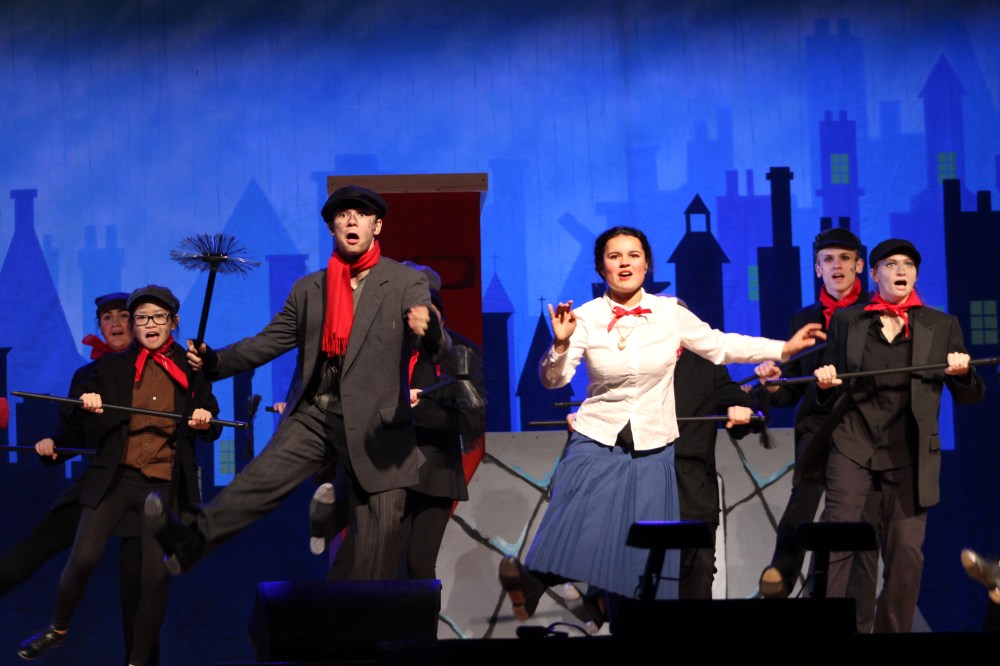
Audrey Johnson pictured with Alex Podolinksi (Bert) during the iconic number Step in Time. Photo credit: Charity McBride

Owen and Audrey share more than a last name. They both have been in every musical they could since they were in 6th grade.

A lot of students in musical have this sort of streak. But this year, a few students found rehearsal schedule to be too challenging, and caused a stir when they quit. Three of them had roles with lines and/or singing parts. Sophomore Autumn Fink, formerly the Bird Lady, was one of them.

“Sometimes I just wanted to go home and rest,” Fink said.

According to Fink and pretty much everyone involved, preparations for this year’s show have been rigorous. The later practices are usually long and hard, but this year, the various special effects, multiple costumes per person, the presence of two fifth graders in the cast, the stage crew playing car-sized tetris with an abnormally large number of set pieces, and the show’s various dance styles all had the cast busy and the directors busier. For this reason, Production Director Mrs. Sue Glowa was unable to schedule an interview to contribute to this article.

“In middle school they would have this specific group of people go, and [they’ll] work on you the entire time,” Fink said. “I felt it was better that way.”

Audrey, who also worked on the middle school’s stage crew, felt that the middle school musical schedule was more regimented, whereas the high school’s directors have a difference in style, and prefer to “finesse it.” She considered it a minor detail.

“The costuming is really the biggest difference,” she said. “All the [middle school] costumes are hand-made, and they’re really particular about how you look. Here, they’re more concerned about sounding good rather than looking good.”

IMG_0928

Audrey striking an authoritative pose during the more sinister Playing the Game. Owen Johnson, pictured directly below (obscured by wig), plays one of the toys. Photo Credit: Charity McBride

At the middle school, all the music is taken from pre-recorded tracks, so as a freshman, Owen was excited for the live music at the show. After his first night working with them, he relishes what the pit adds to the show.

“I really like that we can change the tempo and be more lenient with timings and stuff,” he said.

Owen, whose first high school musical will be this year, noted that the atmosphere is different from the middle school.

“The people here [in musical] seem more interested in the musical,” he said.

The freshman dancer’s thoughts are reflected by the number of cast members who agree it’s worth the tough schedule. The first perk that Audrey mentioned was being able to “connect with the audience,” but she also knows a lot about the value of music education, as she wrote her senior research paper on the subject.

“There’s a term called ‘transfer,’ which means when you succeed in one thing, it can help you succeed in another thing,” she said.

Actors not only need to learn how to focus onstage, but their spatial awareness needs to be refined. An actor must keep in mind the location of the audience, other actors, props, set pieces, etc. In addition to this, one run may differ from another, and adjusting usually demands critical thinking and creativity. These skills are not only vital to performing onstage, but to performing in school.

“So if you’re able to learn music or dance, it could help you in your math class, per se,” she said.

According to Audrey, musical specifically could help in a more direct way.

“It can help your English; there are words in that show that I’ve never heard before,” Audrey said.

Most musicals portray historically accurate settings, or at least some historical elements. Because they are built poetically, lyrics sometimes contain uncommon words or phrases. This is especially true in the case of Mary Poppins, which rhymes excessively with the word that made it famous (precocious, halitosis, etc.) and has plenty of British words (promenade, miffed, gasworks, lummy, etc.).

Audrey emphasized that one does not have to be musically gifted; just being “musically participant” is enough to benefit from skill transfer.

Owen also said it was good to get involved. Musical, like all student activities, is another hobby students can use in their future.

DSCN0510

Two crew members inspect for possible set changes a week prior to opening night. Photo By: Jules McBride


Even Fink encouraged students to participate.

“I’d just say give it a try,” she said. “If it’s something you would think you’d be interested in or you think you could become better from, then I would say to definitely give it a try. And if you don’t like it, it’s okay not to like it.”

Fink called Mary Poppins a “growing-up show,” as in it shows how the children, Jane and Michael, mature. It’s not just a show targeted at children. Mr. and Mrs. Banks go on their own emotional journey alongside the kids.

“In the beginning, Mr. Banks wants to love his family, but he’s unsure how to show it,” senior Dante Howard said of his role. “By the end, he understands how to truly love his wife and kids.”

Sophomore DeLaney Swank also commented on her character’s development, the mild Mrs. Banks.

“Winifred is caring and always tries to her best to take care of her husband and children,” Swank said. “As the show progresses, Mary Poppins and the children help Winifred realize that she has her own voice, and that she shouldn’t be afraid to use it.”

Eventually, all the characters – old and young – learn the values of life.

“Winifred is a wonderful and dynamic character that teaches an important lesson,” Swank said.

In other words, Mary Poppins is not exclusively a kids’ show.

“You can watch it as a kid and understand it,” Audrey said. “But an adult can watch it and understand it on a deeper level.”

Many of the musical kids are involved in other activities. Owen, along with a handful of other ensemble members, actively reads for WIRC, a competition that happens the Monday after opening weekend. Audrey holds the lead role but finds time for a myriad of things throughout the year. She is president of the SADD club, an SCA member, and teaches kids at her church on weekends.

Exhausted as they are, the cast overall cherishes being in Mary Poppins, and are optimistic about tackling opening night.

“Musical has been a wonderful experience, and I think there’s only one word to describe it, which is supercalifragilisticexpialidocious!” Audrey said, harkening her role.